
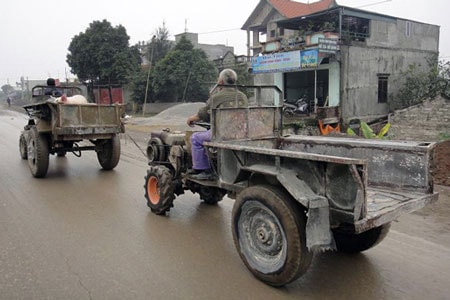
Across the country, there are still over 9,000 homemade agricultural vehicles and makeshift vehicles that have not been phased out.
On December 6th, the Vietnam Road Administration (VRA) held a conference to summarize the implementation of management and support for replacing agricultural vehicles, three-wheeled motorized vehicles, and rudimentary 3-4 wheeled vehicles that have been suspended from participating in traffic.
 |
| Source: atgt.vn |
According to the Vietnam Road Administration, the ban on agricultural vehicles, three-wheeled vehicles, rickshaws, and handcarts has been in effect since 2008. Over the past five years, to assist the people, the State has provided more than 860 billion VND in support to owners of agricultural vehicles, motorized rickshaws, three-wheeled motorized vehicles, and 3-4 wheeled rudimentary vehicles to cease operation of 154,220 vehicles subject to the traffic suspension. This has significantly contributed to ensuring traffic safety and reducing traffic accidents.
In addition, through inspections, the Transport Inspectorate and Traffic Police forces in localities have inspected nearly 17,000 cases, handling more than 12,500 cases with fines totaling nearly 3.8 billion VND. From 2009 to the present, self-made 3-4 wheeled vehicles are not allowed to register for license plates to participate in traffic. Three-wheeled vehicles for people with disabilities that are newly manufactured and assembled must comply with quality control regulations during production, assembly, and import. However, according to statistics, as of now, more than 9,000 such vehicles remain unregistered nationwide.
According to HNMO


