
Japanese voters cast their ballots in the Upper House election.
On the morning of July 21, Japanese voters began arriving at polling stations to cast their first ballots to elect 121 seats in the Japanese Upper House from among 433 official candidates who have filed applications.
Traditionally, half of the 242 seats in this legislature are re-elected every three years. Of the 121 seats up for re-election this time, 73 will go to candidates from constituencies in 47 provinces, while the remaining 48 will be chosen from a nationwide proportional representation system. Thus, voters will simultaneously cast ballots for two electoral systems.
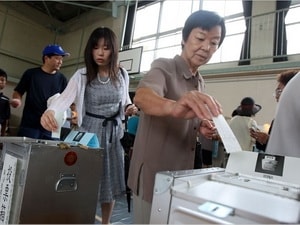
Japanese voters cast their ballots in an election. (Source: ttnewsflash)
A recent public opinion poll conducted by Kyodo News indicates that the ruling coalition led by the LDP is expected to secure a safe majority in the Upper House, guaranteeing at least 129 seats, including 59 seats that will not be up for re-election.
Such an outcome would also allow the ruling coalition to control all standing committees as well as the Senate, facilitating the passage of bills that it already holds in the powerful House of Representatives.
The Senate election on July 21st was the first nationwide election since Abe took office in December 2012. It also served as a crucial test for Prime Minister Shinzo Abe after seven months in power.
Up to this point, it seems that this "test" is somewhat progressing toward a result that is favorable to the LDP and Abe personally.
On the final day of campaigning, July 20th, Prime Minister Abe chose Akihabara district, where young Japanese people flock to buy electronics and anime merchandise, as his final stop after two weeks of official campaigning.
Here, once again, Prime Minister Abe mentioned the economic policies known as Abenomics, which contributed to the LDP's victory in the Tokyo City Council election at the end of June 2013, and which also boosted the LDP's confidence ahead of the Upper House election.
With considerable support for Abe and the LDP, the prime minister advocated for a decisive resolution of a "divided parliament" in order to gain control of the Upper House with his coalition partner, the New Komeito Party.
The prominent issues raised before and after the election included the recovery of the Japanese economy after decades of deflation, revising the pacifist constitution amidst changing security conditions, restarting reactors shut down after the nuclear accident, and participating in negotiations for the Trans-Pacific Partnership (TPP) free trade agreement. These were also issues that Prime Minister Abe was particularly concerned about and strived to achieve after the election.
Meanwhile, opposition parties criticized Abe's economic policies and expressed concerns about the LDP's dominance. Speaking to a crowd in Hiroshima, Banri Kaieda, chairman of the Democratic Party of Japan (DPJ), said that the lives of the people depended on this election. He argued that "politics cannot be put in Abe's hands."
Meanwhile, Toru Hashimoto, co-leader of Japan's Japan Restoration Party, warned against the LDP's dominance and emphasized the importance of a new opposition party to act as a restraining force against the ruling party.
Polling stations are expected to officially close at 8 PM on the same day, and preliminary results will be announced after the majority of votes are counted on the night of July 21st.
According to (Vietnam+) - DT


