
Delegates pointed out many shortcomings in the economy.
This morning (May 23), the National Assembly held group discussions on the socio-economic situation as well as solutions and directions for implementing the socio-economic plan for 2014.
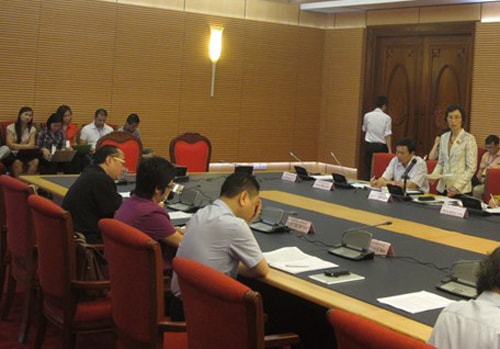 |
| Delegates discuss in groups. |
The National Assembly acknowledged that the Government has done very well in many areas recently, with 11 out of 15 socio-economic targets being met – as stated in the supplementary report on the implementation of the 2013 socio-economic development plan and the situation of the 2014 socio-economic development plan presented by the Government to the National Assembly. However, National Assembly representative Tran Ngoc Vinh (Hai Phong City) also pointed out that two major targets have not been met: the budget deficit and the poverty reduction target. Despite numerous solutions implemented by the Government, the poverty reduction target has not been achieved. The Government needs to conduct a thorough analysis of why the target was not met and must implement solutions to overcome these difficulties and obstacles.
Paying special attention to poverty reduction and the efficient use of investment capital from the state budget and public investment projects is also a view shared by many National Assembly deputies. According to National Assembly deputy Vu Cong Tien from Lam Dong province, in addition to leveraging the province's internal resources, the State also needs to pay attention to implementing projects through effective and practical measures, accelerating progress to facilitate the exploitation, use, transportation, and trade of local people's daily lives along the province's main transportation routes. Irrigation infrastructure is also extremely important. The central government has recently invested in the province, but only to a certain extent. Thirdly, there is a need to focus on investing in rapid and sustainable poverty reduction in all localities, creating the necessary conditions for people to rise out of poverty.
More specifically, National Assembly representative Truong Van Vo from Dong Nai province affirmed that the economy has recovered but is not yet stable. One of the three bottlenecks that need to be addressed for socio-economic development is the more vigorous reform of institutions, including public administration and public spending. Regarding public investment, according to representative Truong Van Vo, it is crucial to recalculate, adjust, amend, or even enact a new system of laws to ensure consistency related to public investment.
Besides focusing on more practical and innovative poverty reduction policies tailored to the current situation, National Assembly representative Le Thi Tam from Nghe An province believes that special attention and support should be given to businesses operating in and serving agriculture. Policies are needed to help businesses stand firm and develop even better, especially those investing in agriculture, farmers, and rural areas.
We highly appreciate the Government's report which addresses China's activities violating our sovereignty in the East Sea. If left unaddressed, these actions will negatively impact the economic recovery, investment, production, and business activities in many sectors, especially attracting foreign investment, import and export, state budget revenue and expenditure, affecting employment, people's lives, and social order and security.
Many delegates also particularly emphasized that solutions for restructuring businesses and the economy must be linked to the current situation of the country. Accordingly, it is necessary to proactively implement solutions to support businesses by securing raw materials for investment in product manufacturing; supporting the market with programs such as "Vietnamese people prioritize using Vietnamese goods," and reducing and minimizing dependence on external sources.
Representative Pham Quang Nghi (Hanoi City) assessed that this is a very important topic for discussion.
Overall, the delegates generally agreed with the government's report assessing the socio-economic results of 2013 and the first months of 2014. However, despite the improvements in the economy, the delegates felt that progress was still slow and many issues remained that needed to be addressed in the remaining months of the year.
Representative Trinh The Khiet (Hanoi City) stated that the 2013 results were a tremendous effort by the whole country, with 10 targets exceeding the plan and 3 targets nearly met, including a GDP growth rate of 5.3% compared to the target of 5.5%.
“Although the economy is showing signs of recovery, difficulties remain, such as policies being slow to be implemented (for example, the 30 trillion VND package, which has been absorbed very slowly), and administrative reforms still have many problems,” said delegate Trinh The Khiet, assessing that the current tax policy mechanism is inappropriate, with high taxes on production, while taxes should ideally be levied on the operational aspect. For example, with automobiles, high taxes are levied on the production stage, but taxes on the vehicle's operation, such as fees, charges, and fuel, should be collected in this area. The methods of adjusting tax management are still limited.
Delegates proposed several solutions for macroeconomic stability through strict management of budget funds. If budget allocations are primarily for construction investment and are tightly controlled, it will limit losses and reduce risks. Focus should be placed on collecting outstanding debts and large amounts of tax arrears. Unnecessary administrative procedures in the process of implementing domestic and foreign investment should be streamlined.
Regarding businesses, Representative Khiet emphasized the need for early equitization, noting that there are still many state-owned enterprises. Counterfeit and substandard goods are still prevalent, such as fake fertilizers and pesticides. For the rice industry, long-term strategic support is needed, rather than the current seasonal support. The National Assembly requires farmers to achieve a 30% profit margin, but this has not yet been met.
Representative Bui Thi An remarked that our country has never experienced such a difficult period as the present. She highly appreciated the government's efforts to maintain economic and social stability. State management in many sectors has undergone rapid changes. A particularly noticeable change is in transportation, a sector with many long-standing problems, but which has become more transparent, responsive, and efficient. For example, projects that are behind schedule have been suspended, officials who violate regulations have been disciplined, and the identities of those previously only disclosed internally have been publicly revealed. Situations are being handled more quickly and effectively.
Ms. An argued that the government should revise the figures, determining the actual amount of bad debt, public debt, cross-ownership, etc. These are factors that make the economy unsustainable. A clearer analysis of the causes is needed, especially in evaluating the management of state agencies.
Restructuring some sectors is very strong, but how can we restructure many state-owned enterprises (SOEs) that are on the verge of bankruptcy without harming taxpayers' money, especially since many of these enterprises are heavily indebted? Transparency is needed in this restructuring process to allow for public consultation.
Also during the morning session, delegates discussed the 2012 budget settlement.
This afternoon, delegates met in the Assembly Hall to hear the Government's report on the draft Law on the management and use of state capital invested in production and business, as well as to hear the report on the review by the Chairman of the Economic Committee, Nguyen Van Giau.
According to tinnhanhchungkhoan.vn/daibieunhandan.vn


