
Revolution gives birth to countless destinies.
(Baonghean) - My grandmother recounted that in 1945, when she took a train from Saigon to the North, she witnessed the most horrific scene of her life upon disembarking at the station.
Gaunt figures wandered aimlessly through the desolate landscape, mournful cries filled the air, deaths came in an instant, and villages were silent. I don't understand why my grandmother chose to stay and live with her homeland, sharing those most sorrowful days. Perhaps it was because she, a child far from home, longed for her homeland so deeply that she considered death, if it were on her native soil, better than living somewhere alone!
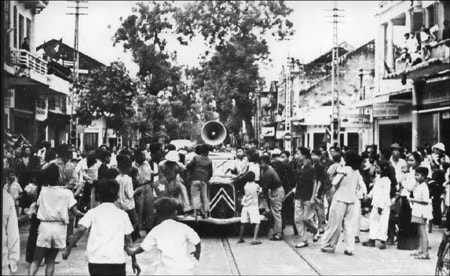 |
| A loudspeaker vehicle broadcasts the order for the August 1945 General Uprising in Hanoi. (Archival photo) |
My grandmother only told the story of the famine of 1945 once. But for some reason, perhaps it was the tearful tone in her voice that haunted me. At that time, she must have wept at the scene shrouded in death and sorrow, but above all, because of the pain of everything that had made people so fragile and vulnerable. And I remember, in her lullaby to my younger sibling, she hummed that line: "Oh, going to the rubber plantation is easy, but returning is difficult / When you go, you're strong and healthy, but when you return, you're emaciated." She didn't want to recall that memory, but it's not easy to forget. Later, there were times when I stood silently before the abandoned railway tracks in Phu Quy, in western Nghe An province, my heart still filled with the melancholy of my childhood. On this land of crimson basalt, how much sweat, tears, and even blood were shed for the enslaved lives of the plantation workers, and how much of this fertile land was transported back to what people call the "motherland" on those wagons?
From then until later, when the saddest chapter of the tragedy had closed, when the greatest revolution had put an end to a century of colonial rule, my grandmother also witnessed great historical transformations. She said that she cried many more times, but these were tears of joy.
And then came the story of the peasants' struggle, rising from the mud, the losses and sacrifices, the joys of victory, the pride of August... My grandmother, a city woman who only had enough education to read and write, had to struggle to make a living from her youth, unable to reason about freedom and its value. She was merely a storyteller. But it was her stories, her deep, anxious gaze at memories, and her sparkling smile that spoke volumes: that revolution gave birth to human destinies, destinies that allowed people to live and enjoy Freedom – the simplest and most sacred thing for every nation and every individual.
I've had, though not many, journeys between North and South Vietnam by train. On some trips, I spent all my time admiring the scenery through the train window. Here's the river that has been immortalized in history, songs, and poems; there's the majestic mountain range silhouetted against a brilliant sunrise. Lush green grass, vibrant flowers, towering buildings stretching endlessly across the city streets. And above, the sky a deep blue, a symbol of peace and boundless wind... I remember my grandmother, whom, if she were still alive, I would take on this Reunification Express train south, so she could tell me about her arduous youth in Saigon-Chợ Lớn, reminiscing about the lands we passed through that were once filled with corpses and bomb craters, now teeming with life. She would surely be happy and smile!
NACT


