
How to distinguish between stroke and sudden death
The causes of sudden death are often coronary artery blockage or cardiac arrhythmia.
Doctor, can stroke cause sudden death? In many cases, stroke patients are still saved after a few hours of being transferred to the hospital. So, are stroke and sudden death the same or different? (Le Vinh Thanh, District 10, Ho Chi Minh City)
Associate Professor, Doctor Nguyen Huy Thang - President of the Ho Chi Minh City Stroke Association, advises:
Sudden cardiac death can be referred to as "sudden cardiac death" or "sudden cardiac arrest." A common symptom is a seemingly normal patient suddenly collapsing due to cardiac arrest.heartThe heart stops suddenly. The patient can die within minutes if not given immediate emergency care.
The causes of sudden death are usually blockages in the blood vessels supplying the heart (coronary arteries) or heart rhythm disorders.
Stroke originates from the term "Stroke," or what was previously used to refer to cerebrovascular accident. In reality, stroke encompasses both ischemic and hemorrhagic strokes. However, foreign literature uses the word "stroke" to mean ischemic stroke.
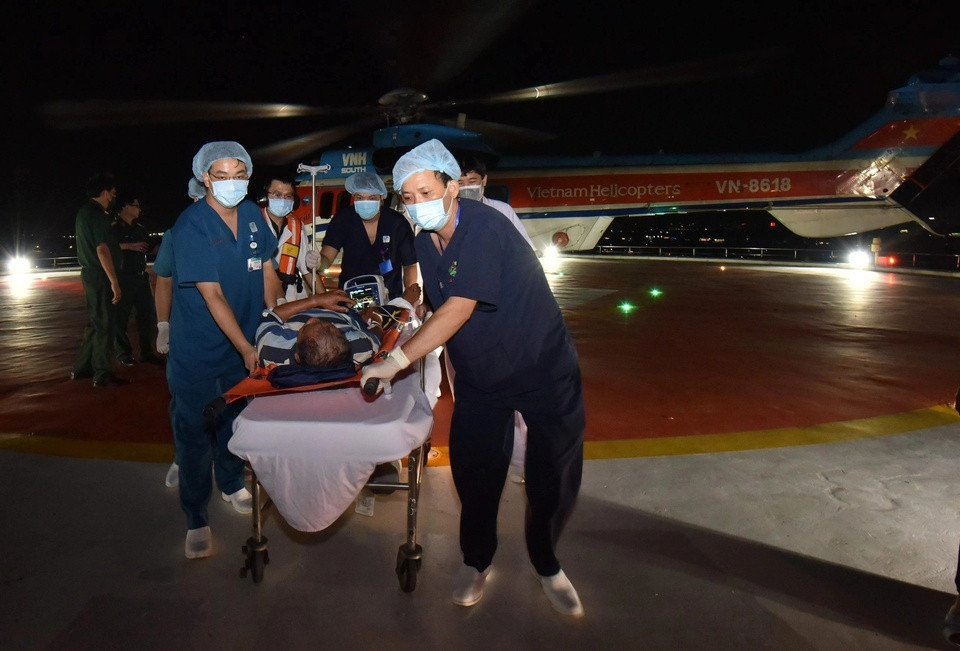 |
A stroke patient is airlifted to the mainland for emergency treatment. Photo: Military Hospital 175.
Stroke is caused by a sudden blockage of blood vessels in the brain. As a result, brain cells nourished by the blocked blood vessels gradually die, leading to loss of neurological function. Patients will then exhibit symptoms such as paralysis of one arm and leg, slurred speech, and facial asymmetry.
When large blood vessels become blocked, over time, a large number of brain cells die, which can lead to edema, affecting consciousness and causing coma.
More serious and time-consuming is the compression and herniation of the brain, affecting the brainstem, which is considered the "command center" of the circulatory and respiratory systems. Only then can a stroke lead to death.
Thus, there are two key differences between stroke and sudden death.
Firstly, over 90% of strokes begin with "FAST" symptoms: weakness or paralysis on one side of the body, facial drooping, and slurred speech.
Secondly, sudden death can be fatal within minutes, while stroke is not fatal in the first few hours, but usually occurs after several days.
Early stroke detection through the FAST rule.
According to Dr. Nguyen Ba Thang, Head of the Stroke Unit at the University Medical Center of Ho Chi Minh City, early detection of stroke requires relying on initial signs according to the FAST rule.
F - Face paralysis: Patients may experience paralysis on one side of the face, manifesting as a crooked mouth and deviated philtrum, most noticeable when opening the mouth or smiling.
A - Arm paralysis: The patient has difficulty or is unable to move one arm or one side of the body. When asked to raise both arms, one arm will not be able to be raised or held in place.
S - Speech: The patient has difficulty speaking, pronounces words unclearly, slurs their speech, has unusual stuttering, or does not understand spoken words.
T - Time: Make the most of the time to call an ambulance immediately and take the patient to the hospital for timely emergency treatment.
Additionally, remember this: "A distorted smile, slurred speech, drooping arms - Call emergency services immediately, go right away, don't wait."


