
How to detect 6 common types of cancer early
Observe your mouth every time you brush your teeth. If you notice any abnormalities such as bleeding in the mouth, white or red streaks, difficulty opening your mouth, or unusual lumps, beware of oral cancer.
Cancer is a curable disease if detected early and treated promptly. With cancer, feeling pain already indicates a late stage of the disease. Professor Nguyen Ba Duc, former Director of K Hospital, shared some methods to help detect cancer early:
Breast cancer
This is the most common type of breast cancer in women. It is 100% curable if detected in the preclinical stage. Women aged 20 and older should perform monthly breast self-examinations five days after their menstrual period ends.
Breast self-examination:
Observe:
- Lower your arm and observe for any changes in your breast such as lumps, thickening, dimpling of the skin, or changes in skin color.
- Place your hand behind your neck, then observe.
- Place your hands on your hips and move your chest up and down by raising or lowering your shoulders. This movement will make any changes in your breasts more apparent.
Palpation:
- Gently squeeze the nipple to see if any fluid comes out.
- Place your right hand behind your neck, and use your left hand to palpate your right breast. Place your four fingers close together to form a flat surface, and apply even pressure to different areas of the breast tissue against the chest wall in a spiral motion, starting from the nipple and moving outwards.
- Examine each area of the breast and also towards the armpit.
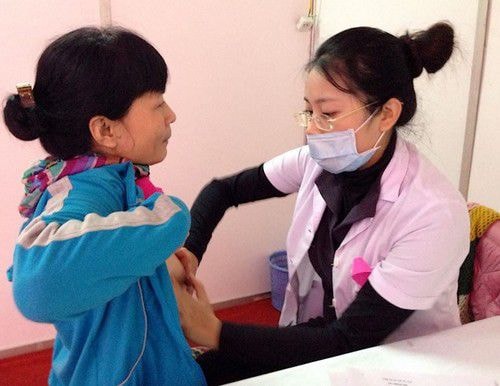 |
| Women aged 20 and older should perform monthly breast self-examinations five days after their menstrual period ends. Photo: N. Phuong. |
Warning signs of breast cancer:
- The lump in the chest is painless.
- Frequent itching and burning around the nipples.
- The nipple may bleed, have unusual discharge, or be retracted or shrunken.
- The skin on the breasts may be rough, thickened, or indented with folds.
- There are lymph nodes in the armpit.
Having these symptoms doesn't necessarily mean you have breast cancer; however, you should see a specialist for an accurate diagnosis. Women aged 30 and older should have regular checkups at a specialist clinic every 1-3 years. Women aged 40 and older should have regular mammograms.
Cervical cancer
This is a common type of cancer, second only to breast cancer. Women should have an annual cervical cancer screening three years after they begin having sexual intercourse.
Gynecological examination
The doctor will examine the cervix and other organs in the pelvic region; vaginal cells may be taken for testing.
Vaginal cytology test
Doctors take cells from the surface of the cervix and vagina for testing. This method is quite accurate, allowing for the detection of very early cellular changes.
Acetic acid test
This method involves applying a 3-5% acetic acid solution to the cervix and observing it visually to detect abnormalities, including precancerous lesions. It is a simple, inexpensive, relatively accurate, and highly effective method for early detection of cervical cancer.
Lugol's test
This method involves spotting cervical cells with a 5% log solution and observing them with the naked eye. Normally, cervical cells stain brown when this solution is applied; if there are abnormalities, they will appear light brown or yellow. This is also a simple, inexpensive, and effective method.
Cervical examination
Using a colposcope magnifies the image of the cervix to make it easier to observe lesions. Acetic acid or Lugol's solution can be applied in combination as described above. Doctors usually perform colposcopy when the above tests show abnormalities or when there is suspicion of abnormalities during visual examination. If a suspected lesion is found, doctors will perform a biopsy for diagnosis.
Colorectal cancer
This is the third most common type of disease, and it has been showing a sharp increase in prevalence in our country in recent years.
Test for occult blood in stool
Polyps or malignant tumors of the colon and rectum are prone to bleeding when stool passes through. When the bleeding is in small amounts, it may not be visible to the naked eye. A fecal occult blood test can detect these small amounts of blood.
Those who test positive are at higher risk for colorectal cancer and should have a full colonoscopy. People aged 50 and older should have this test once a year.
Complete colonoscopy
This is currently the best method for screening for colorectal cancer. During the colonoscopy, if any suspected cancerous or precancerous lesions are detected, doctors will perform a biopsy. People aged 50 and older should have this test.
Oral cancer
This is a common type of head and neck cancer, often associated with smoking, chewing betel nut, and alcohol consumption. For early detection, you should observe your oral cavity in the mirror every time you brush your teeth. If you notice slightly red or white patches on the oral mucosa, slow-healing wounds in the oral cavity, bleeding in the oral cavity, limited mouth opening, or feel an abnormal lump, consult a specialist.
It is recommended to have an oral cancer screening every three years for people over 20 and annually for people over 40, especially those who smoke cigarettes or pipe tobacco.
Skin cancer
This type of cancer is easily diagnosed with the naked eye and can be cured if detected early. To detect it early, people can observe their entire body's skin, especially exposed areas, ideally after each shower.
Symptoms of the disease include persistent ulcers, occasional bleeding, nodules possibly in areas of skin keratinization due to sun exposure, a persistent pale red spot with slight abrasions...
One type of skin cancer, melanoma, is often associated with moles. It's important to pay attention to signs such as changes in the color, size, shape, borders, and surface of moles.
To detect skin cancer early, you should have a check-up every three years starting at age 30 and annually after age 40.
Thyroid cancer
If you notice a lump or swollen lymph node in your neck, you should see a doctor. Some cases show no symptoms until the disease is in an advanced stage.
If you experience any of the following unusual symptoms, you should see a doctor: a lump in the neck or a noticeable enlargement of the neck, pain in the front of the neck, persistent hoarseness or changes in voice, shortness of breath, or a persistent cough. You should perform a neck self-examination twice a year to check for any lumps.
According to Vnexpress.


