
How to use your car's air conditioner in hot weather.
(Baonghean.vn) - In hot weather, the air conditioning system has to work at almost full capacity when the vehicle is in operation. Therefore, using the air conditioner properly will help the vehicle operate more efficiently and save fuel.
Do not turn on the air conditioner before starting the car.
If you turn on the air conditioner before the engine starts, the battery will have to work to power the fan. If this happens frequently, the battery's lifespan will decrease significantly. Turning on the air conditioner after the engine is off also affects the battery due to the sudden load. Turning on the air conditioner immediately after starting the engine will cause the car to consume more energy and take longer to cool down due to the hot air inside, thus affecting the lifespan of the cooling system.
Therefore, you should start the engine before turning on the air conditioner and turn off the air conditioner before turning off the engine. Start the engine, open the doors to let the hot air escape, and after about 5 minutes of starting the engine, turn on the air conditioner and adjust the fan speed to a suitable level.
 |
Lower the car windows before turning on the air conditioner.
Lowering the car windows before turning on the air conditioner helps the heat inside the car escape. Parts of the car, such as the dashboard, leather seats, door panels, and many other details, are made of plastic. These parts can emit unpleasant odors in hot weather; lowering the windows allows the heat and odors to escape.
Therefore, before turning on the air conditioner, you should open the car windows, start the engine, and turn on the fan to blow out the hot air for 5 minutes, helping to ventilate the air inside the car. Note that you must close all the windows after the temperature inside the car is comfortable to avoid letting the cool air escape, which wastes fuel.
 |
Avoid letting the temperature get too cold.
Low temperatures will lead to higher energy consumption. More importantly, this can easily cause heat shock when the body steps out of the car. In addition, when using air conditioning, pay attention to the fan speed. If the fan is set too high, energy is consumed more, and being hit by a blast of cold air can easily lead to negative health effects.
Adjust the temperature appropriately.
After following the steps above, when turning on the air conditioner, adjust the cooling temperature gradually. Do not set it to the highest cooling level, as this will overwork the cooling unit. Furthermore, the large temperature difference between the inside and outside causes the air conditioner to overwork, leading to increased fuel consumption and premature failure. Additionally, the temperature difference can negatively impact your health when getting in or out of the car, potentially causing sore throats or colds.
Adjust the fan speed to a suitable level after turning on the air conditioner.
Adjust the fan speed appropriately when using the air conditioner, because a fan speed that's too high will consume more energy or cause discomfort from the strong airflow. A fan speed that's too low will not provide enough cooling. Therefore, adjust the cooling temperature gradually; avoid setting it to the highest cooling level, as this will overwork the cooling unit.
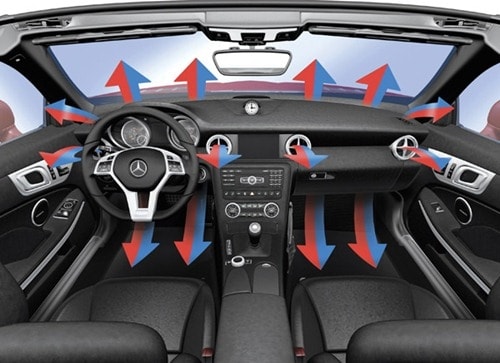
The air vents should be adjusted appropriately to avoid blowing cool air directly into your face, which can affect your health. They should also not be blown directly onto the windshield, as this can cause condensation.
 |
Use air conditioning flexibly.
Adjust the air conditioning power to suit the number of passengers. Another tip is to let the air conditioner cool down gradually, avoiding sudden changes in temperature to very low or very high levels.
According to research from the Australian Department of Environment, on average, air conditioning consumes 10% of a car's fuel. When driving at speeds above 80 km/h, it's advisable to turn on the air conditioning and close the windows to reduce wind resistance, which leads to increased fuel consumption.
Turn off the air conditioning system when entering a flooded area.
When driving in the rain or in areas with high water levels, you should turn off the entire air conditioning system to prevent debris from being carried by the water and potentially clogging the fan, thus damaging the air conditioning system.
Do not turn off the engine and air conditioner at the same time.
About 10 minutes before stopping the car, you should turn off the air conditioning and open the windows to allow the air to escape before turning off the engine.
Regular air conditioner maintenance
Just like home air conditioners, car air conditioning systems can also accumulate dust and dirt on the filters and fan blades, causing blockages that prevent cold air from reaching the car cabin.
 |
Therefore, after a few months of use (this timeframe depends on the level and conditions of vehicle use), the air filter needs to be cleaned and replaced if necessary. According to the periodic maintenance standards of some car manufacturers, the air conditioning filter should be replaced after 20,000 km. In harsh weather conditions with a lot of dust, heat, and humidity, the air conditioning filter should be replaced sooner.
Besides cleaning the filter, you should check the high-voltage and low-voltage lines, maintain the indoor and outdoor units of the air conditioning system, and add refrigerant if there is a shortage.
Ngoc Anh
(Synthetic)
| RELATED NEWS |
|---|


