
Mr. Sy's way of escaping poverty.
(Baonghean) - Mr. Dau Tien Sy and Ms. Nguyen Thi Huong, from Quynh Luu hamlet, Tan An commune (Tan Ky district), started their family and moved out on their own, facing very difficult circumstances. Thanks to applying technological advancements in livestock farming and cultivation, veteran Dau Tien Sy has created a rare fruit orchard on this land, helping his family overcome poverty and gradually rise to prosperity…
When asked about his gardening, Mr. Sy modestly replied, "People run farms and earn hundreds of millions of dong a year, but I only have a few fruit trees that aren't worth much." However, when he led us to his orchard, he couldn't hide his joy, calmly telling me about his gardening journey, a story filled with pride alongside the hard work...
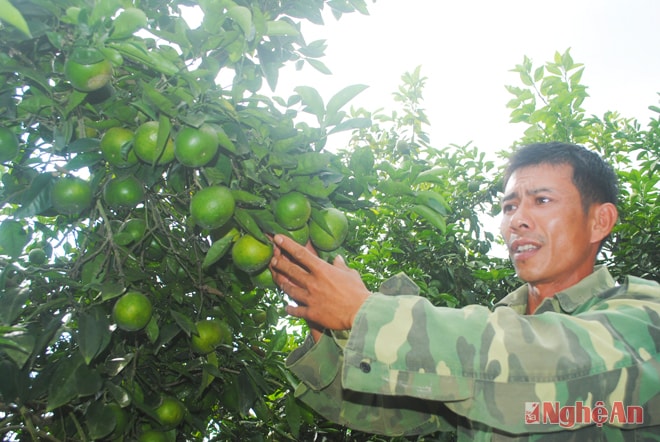 |
| The tangerine orchard of Mr. Dau Tien Sy. |
Born in 1977, he enlisted in the army in 2000. After completing his two years of service, he returned to his hometown and started a family with Ms. Nguyen Thi Huong, from the same village. In 2004, the couple moved out to live separately. Because his parents were not well-off, they lived in a small house with nearly 1 hectare of arable land. The early years were incredibly difficult, and the couple was classified as a poor household in the village. To make ends meet, he worked daily as a laborer, tapping rubber trees, harvesting sugarcane, or working as a construction helper. The work was arduous and exhausting, but the income was meager. Despite working year-round, he couldn't save a single penny. Many nights he tossed and turned, wondering what he could do to earn a living, to have something to eat and save, and to escape poverty. He pondered this, but deciding what crops to grow or what livestock to raise that would be profitable in the long term remained a constant source of worry. Previously, oranges were the main crop in this area, but the An Ngai State Farm had eliminated them, replacing them with small-scale rubber plantations. After watching a television program about growing tangerines and earning a high income, he immediately thought of commercial tangerine cultivation. If successful, this would be the first tangerine farming model in the area and could yield high economic returns, as tangerines are in high demand during Tet (Lunar New Year). Acting on this idea, one day in early 2006, he went to the Phu Quy Seedling Center (Nghia Dan) to buy 50 seedlings to plant in his garden. With his diligent and hardworking nature, and by learning from tangerine growers in other localities, caring for his tangerine garden was initially easy, and the trees thrived. Following the principle of "using short-term gains to support long-term growth," he planted short-term crops on the remaining land, providing him with annual income. Unfortunately, during the 2007 rainy season, floods submerged the orchard for days, causing all 50 mandarin trees to become waterlogged, their branches dry, and their leaves wither. With no other option, he had to grit his teeth and cut them down to the roots, then continued to care for them, hoping for new shoots to sprout, while simultaneously planting another 30 mandarin trees. "The land rewards hard work," and after three years of care, the orchard bore its first fruits. For four consecutive years now, thanks to proper fertilization, irrigation, weeding, and pest control, the fruit has been large and of good quality. Word spread, and during the Lunar New Year, traders from many places come to buy in bulk for resale. Since then, every year, as the year ends and the mandarins ripen to a golden yellow, customers come to harvest them in baskets, transporting them downstream. Last year, this orchard brought him 150 million VND, after deducting approximately 20 million VND in fertilizer costs. According to Mr. Sy, this year there are fewer tangerines, but they are larger. If the selling price is the same as last year, the income will be lower.
Walking around the garden, we saw that every tree was lush with leaves and laden with fruit, and the area under each mandarin tree had been cleared of weeds. At this time, Mr. Sy was focusing on digging a shallow circle around each mandarin tree, level with the canopy, to apply bio-fertilizer mixed with NPK. Mr. Sy explained: "For mandarin trees, once they bear fruit, you should fertilize as the canopy grows, but you shouldn't dig too deep to avoid damaging the roots. After fertilizing, you should water diligently for 7-10 days so that the roots can absorb the fertilizer. The bio-fertilizer, in addition to providing nutrients to the plants, also retains moisture and creates loose soil. At this time, the fruit is turning yellow, so it's necessary to invest in fertilizer to ensure the trees have enough nutrients to nourish the fruit, so that they can be harvested closer to Tet (Lunar New Year), when the mandarins will be very juicy and beautiful."
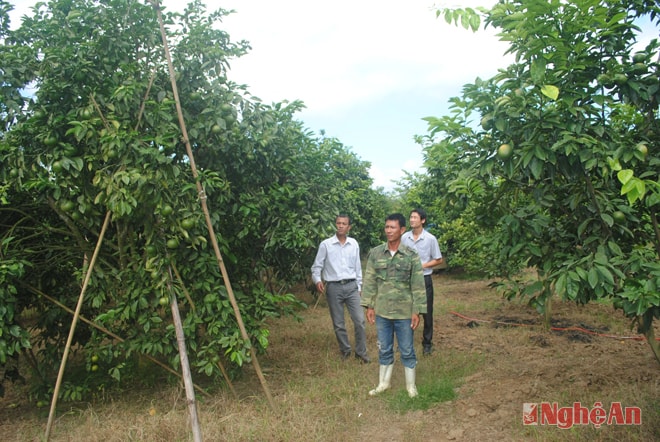 |
| Dr. Dau Tien Sy visits his tangerine orchard. |
After many years of growing tangerines, Mr. Sy shared his experience: tangerine trees aren't "fussy," but you need to know how to care for them to get a good harvest. Before planting, you need to dig a hole, gather manure and phosphorus fertilizer, mix them together, and pour them at the bottom of the hole. After buying the seedling, cover it with a thin layer of soil before placing it in the hole. As the tree grows, fertilize it twice a year with a mixture of manure, phosphorus, and potassium fertilizers. When the tangerine tree bears fruit, you need to fertilize it four times a year, and you need to know how to fertilize so the tree can absorb the nutrients. Tangerine trees need plenty of water, so they must be watered daily during the dry season. In this area, the biggest difficulty is the inability to drill wells; he had hired workers to drill three times, all unsuccessfully, because there was no groundwater. Taking advantage of the abundant water source in Khe Sanh, he invested nearly 20 million VND to install a system to pump water from the stream to irrigate his orchard, solving the irrigation problem for his garden. During the growth of mandarin trees, it is necessary to monitor common pests and diseases such as red spider mites, green leaf-eating caterpillars, leaf miners, etc., in order to take timely preventive measures.
Besides the main crop, mandarin oranges, Mr. Sy's nearly 3-hectare hillside garden also grows many other fruit trees: 100 Quang Tien pink pomelo trees, a specialty variety widely grown in Quang Tien ward, Thai Hoa town; 70 pear guava and Taiwanese guava trees; and 50 large-fruited apple trees. The guava trees, in particular, have been yielding fruit for the past two years and are always in high demand because of their distinctive delicious taste. Mr. Sy then picked a few guavas to offer to his guests. This guava variety is crunchy, with a readily discernible sweetness and a light aroma. Mr. Sy proudly shared that 1 kg of these guavas currently sells for 25,000 VND, and his wife sells everything she harvests at the village market. Last year, he earned tens of millions of VND from selling guavas. With so many fruit trees, providing year-round harvests, his family has a steady income, enough to live on and even save some money. What Mr. Sy shared is that, in order for crops to have a long-term income and high yield, annual investment in care is necessary. With these fruit trees, once they reach harvest age, they don't need much investment; each year, about 10-20% of the product sales revenue is allocated to fertilizers and other expenses.
In addition, Mr. Sy and his wife also received some hilly land to plant 500 rubber trees (already 2 years old), combined with raising breeding buffaloes and cows. His farming method is not to raise large herds, but only 2 female buffaloes and 1 breeding cow, raised in pens and grazed. Each year, these female buffaloes and cows produce 3 calves (hybrid calves), which are sold after 1-2 years. With this method, his family earns over 50 million VND annually from selling buffaloes and cows. Raising buffaloes and cows is not difficult; all that's needed is to plant a small area of elephant grass, diligently cut the grass, use straw as a reserve feed, and build shelters that are warm in winter and cool in summer for them to thrive.
With good health and a resilient spirit, veteran Dau Tien Sy has developed a scientific approach to farming, applying technological advancements to his crops and livestock, resulting in high economic efficiency. Through this method, his family escaped poverty in 2007 and is now one of the exemplary members of the Veterans Association in developing family businesses in the locality. Recently, he was a distinguished member who attended the 5th Congress of the Nghe An Provincial Veterans Association!
Xuan Hoang


