
How to react and escape when attacked by a dog.
(Baonghean.vn) - Dogs can attack for many reasons, and if you don't know how to handle them, you can further agitate them, leading to serious injuries and even life-threatening consequences...
Here are some tips on how to respond and protect yourself when attacked by an aggressive dog:
1. Prevent the attack.
Don't panic.
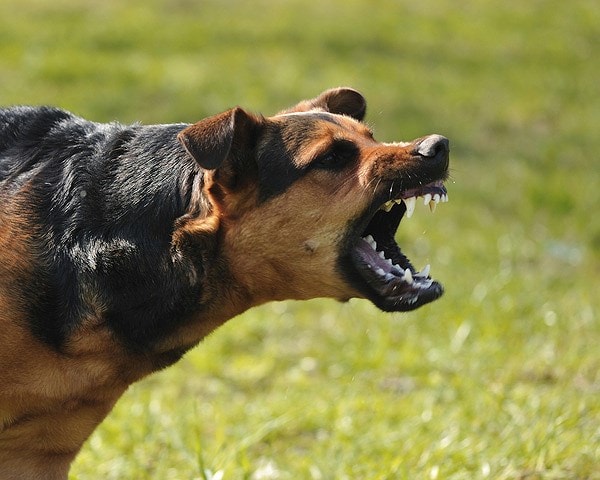
Dogs are among the animals that can "sense fear" in humans. If you become agitated and run away or scream, it can make the dog more likely to attack, or worse, make you a threat to them. Both of those situations are bad.
 |
- Maintain a rigid and motionless posture.
When the dog approaches, stand still, arms at your sides, body fixed like a tree, and look away. In many cases, the dog will "lose interest" and leave if you ignore it.
- Absolutely do not flail your arms or kick your legs.
The dog will perceive such actions as a threat. Avoid making eye contact with the dog, as this could provoke it to attack.
Stand to one side and use your gaze to observe instead of standing directly in front of the dog. This signals to the dog that you are not a threat.
Keep your hands open and your arms raised high. Clench your fists to avoid being bitten by the dog. The dog may approach you, even sniff you, without biting. At this point, slowly back away until it is no longer a threat.
- Don't try to run away.
Running away can awaken a dog's hunting instincts. It may aggressively chase you even if it initially intended to play. Furthermore, you can't outrun a dog while jogging. Many dogs can even catch up to you while you're cycling.
 |
- Distract the dog with another object.
If the dog continues to threaten you, give it something to chew on, such as your backpack or water bottle. Or you could pull out a sleeve and let it bite on it. As soon as the dog bites the "prey," immediately take off your sleeve and slowly back away. This might distract the dog for long enough for you to escape.
It's a good idea to carry toys or treats to lure your dog when passing through areas where you know aggressive dogs are likely to be present. If an aggressive dog approaches, throw the food or toy away; they might chase after it and not attack you.
2. Prevention and self-defense
- Confront the dog and give the command "back."
If the dog remains aggressive, and ignoring or trying to appease it doesn't work, you must confront it and sternly order it to back down.
Use a low, strong, and assertive voice, and continue to avoid eye contact with the dog. The dog may become discouraged or scared and leave.
- Defend yourself when a dog attacks.
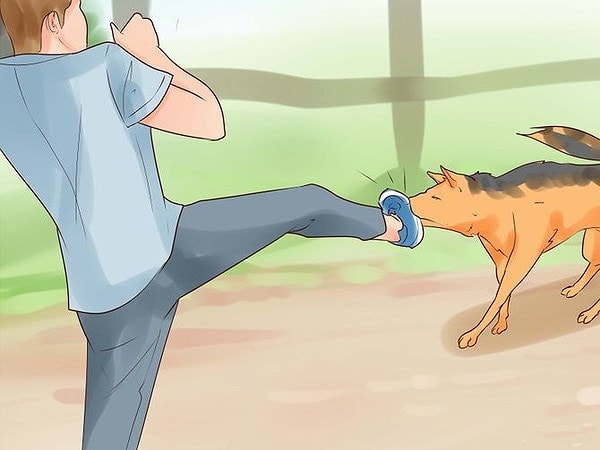
If the dog starts biting, you must defend yourself by hitting or kicking it in the throat, nose, and back of the neck to stun it and give yourself time to escape.
You should call for help while fighting off the dog; however, avoid screaming as this may cause the dog to intensify its attack.
If you have a stick or weapon in your hand, you shouldn't hit the dog on the head, as they have very thick skulls, and this will only make it angrier. If you have pepper spray, perfume, hairspray, etc., available, these are also good self-defense tools against a dog attack.
 |
- Take advantage of your weight.
Use your entire body weight to pin the animal down, especially using hard points like your knees and elbows to press down firmly. Dogs have a very strong bite, but they can't fight back, so try to take advantage of your position and quickly subdue them. Press down on the animal and concentrate your force on areas like the throat or ribs, while keeping your face away from the animal's claws or bites.
You can ride on the dog's back, applying pressure to the back of its neck to keep it still until help arrives.
- Protect your face, chest, and throat.
If you fall to the ground during an attack, your head and neck are the most critical areas to protect; bites in these areas cause severe injury and have a high risk of death.
Protect vital areas by lying face down, bending your knees, and covering your ears with your hands (clenched fists). Try not to yell or roll away, as these actions may further agitate the dog.
- Leave slowly and carefully.
When the dog's attention is diverted, you need to leave the area by slowly backing away without making any sudden movements. Staying calm can be a test of your nerves in such a stressful situation, but it's the best response when the dog isn't actually biting.


