
The challenges of pilot communes
(Baonghean)Anh Son district has four communes registered as pilot areas for the province's New Rural Development program: Tao Son, Linh Son, Hung Son, and Cam Son, and one commune registered as a pilot area for the district: Dinh Son. The goal is for these communes to complete all 19 criteria for New Rural Development by 2015. However, in reality, these localities are facing many difficulties…
Tao Son is one of the four pilot communes, and the district has assessed it as having achieved the most results in the New Rural Development movement, with 9 out of 19 criteria met: Planning, education, political system, rural market, culture, security and order, labor structure, post office, and housing. Tao Son's goal is to complete all 19 criteria by the end of 2015. Therefore, from now until the end of 2015, with only a little over two years remaining, the commune must complete 10 criteria. This is a huge burden for Tao Son – a locality that prioritizes agricultural production.
Speaking with us, Mr. Hoang Dinh Son – Chairman of the People's Committee of Tao Son commune, said: Of the 10 criteria that the locality must implement in the coming time, we have identified three as the most difficult: poverty reduction; environmental management; and transportation infrastructure. For a midland and mountainous locality like Tao Son, reducing the poverty rate to 10% is the criterion. However, at this time, the poverty rate in Tao Son is still as high as 21%.
While a 5% annual reduction in poverty was achievable in the past, it will be very difficult in the future because, among the 21% of poor households, two-thirds are elderly people living alone who are no longer able to work. Eradicating poverty for these households is impossible. Why are there so many elderly people living alone in the area? Mr. Son pondered, a very difficult problem to address is that many families have parents, children, and grandchildren living together in one house, but for various reasons, they separate into different households, leaving the elderly parents to live separately.
There is also a very real situation where the Party and the State have many policies for poor households, so they have a mentality of separating households to benefit from these policies. Therefore, in order to reduce the poverty rate in Tao Son to 10% by 2015, according to Mr. Son, the commune will soon review and encourage families living in the same house but separated into two households to merge into one household, thus eradicating poverty for elderly households.
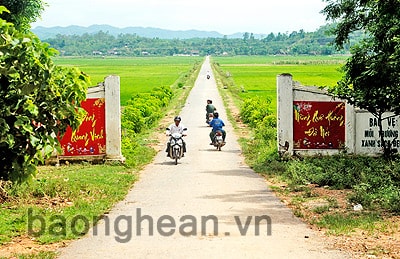
Rural roads in Tao Son commune (Anh Son district).
Environmental criteria also present a challenge. According to the principles of building new rural areas, local household waste treatment sites must be located 2 km from residential areas and 1 km from water sources. Despite being a rural area with over 2,500 hectares of natural land, the local authorities have struggled for many years to find a suitable location for a centralized waste treatment site. And currently, although regulations on household waste collection exist, waste treatment remains inadequate.
Transportation infrastructure is also a challenging criterion, but the goal is achievable because the people understand and recognize that road construction benefits them first and foremost, and the vast majority of people support it. In Tao Son commune, the total length of rural roads is over 44 km, and to date, the locality has paved 14 km with asphalt and concrete (including 10 km of concrete). Tao Son's approach is to pave roads as soon as they are cleared, and during the construction process, the commune assigns each village to manage its own finances and supervision, ensuring transparency in management, so the people contribute money actively.
In 2012, with state support for cement, the district provided 100% of the gravel, the commune provided 40% of the sand, and the rest was contributed by the people. The amount contributed by the people depended on the consensus of each village, so the entire commune was able to pave 10 km of inter-village roads with concrete. According to regulations, mountainous communes need 70% of their roads paved to meet the New Rural Area criteria. For Tao Son, there are still nearly 20 km left to complete the rural transportation infrastructure criteria. If the commune could pave 10 km each year, it would have completed the transportation criteria by 2015. However, this year, although Tao Son registered with the district to clear and pave 10 km, the district only allocated 1.8 km. Perhaps the district's scattered allocation will create difficulties for model communes, given the very short time remaining to achieve the New Rural Area construction goals.
According to Mr. Nguyen Cong The, Head of the Agriculture Department and Deputy Head of the New Rural Development Steering Committee of Anh Son district, the pilot communes have only achieved 8-10 criteria so far. Among the uncompleted criteria, the most difficult are those related to environmental management, poverty reduction, transportation infrastructure, and cultural institutions. This year, the district plans to pave 45 km of rural roads with concrete, and the district will distribute the work across many communes.
Text and photos: Xuan Hoang


