
The honesty, straightforwardness, and decisiveness of the people of Nghe An.
Nguyen The Binh was born in the rural area of Cat Ngan (Thanh Chuong - Nghe An), and possessed exceptional intelligence. He earned a doctorate and his name is inscribed on the stele at the Temple of Literature.
In those turbulent times, the country was in turmoil. Consort Dang Thi Hue, favored by Lord Trinh, abused her power and engaged in reckless behavior, causing widespread resentment, yet no one dared to intervene. Dang Mau Lan, Dang Thi Hue's younger brother, indulged in excessive pleasures and disregarded the law. The situation became unacceptable, and Mau Lan had to be brought to trial. Everyone hated the Mau Lan siblings, but when they were appointed to preside over the trial, it was like "a mouse hanging a bell from a cat's neck." Some feigned illness, others used various excuses to withdraw. In truth, everyone was afraid; a lenient sentence would be against the law, while a just sentence would risk the powerful influence of Thi Hue and Mau Lan.
The scholar Cát Ngạn was appointed to preside over the trial. Nguyễn Thế Bình was meticulous, honest, and straightforward. He punished Mậu Lân by banishing him to his hometown. The courtiers rejoiced, but were also terrified and impressed. Later, Mậu Lân sought revenge, sending troops to assassinate him!
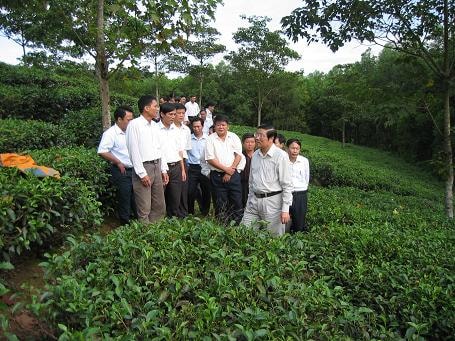 |
Provincial leaders visit tea growing areas. |
Mr. Dinh Nhat Than, a scholar from Tien Hoi village, Thanh Tien commune (now Thanh Chuong district), passed the doctoral examination and his name is inscribed on the stele at the Temple of Literature. He was a free-spirited, romantic man, skilled in literature and poetry, and a renowned physician, famous for his unique prescriptions. He was also a close friend of Cao Ba Quat and Nguyen Ham Ninh. When Cao Ba Quat raised an army to revolt, due to the jealousy and slander of certain forces, Dinh Nhat Than was imprisoned by the imperial court.
During that time, Empress Dowager Từ Dũ, the King's mother, fell ill and was not cured despite prolonged treatment. The King summoned a scholar to examine his mother (Emperor Tự Đức was very filial to his mother). Upon hearing the summons, the scholar replied, "Traditionally, we only invite doctors to treat illnesses; no one would ever force a doctor to treat an illness." The King was very angry, but because Empress Dowager Từ Dũ's condition did not improve, he had to condescend to invite the scholar. After the examination, the scholar prescribed a single-ingredient medicine, and Empress Dowager Từ Dũ recovered after only taking that medicine! (Some documents also state that he treated the mother of a high-ranking official in the court).
Nguyen Si Sach, from Tu Vien village, Thanh Luong commune (Thanh Chuong district), was known for his intelligence and academic excellence. He was a close friend of Dang Thai Mai and Ton Quang Phiệt. He joined the revolutionary movement early on, and by the age of just over 20, he had already become the Secretary of the Central Vietnam Regional Party Committee.
In 1929, he was arrested by secret police and transferred through various prisons. Wherever he went, he was the driving force behind the "transforming prisons into schools" movement, fighting against the harsh regimes of imperialism and feudalism. Knowing he was an important figure, Công Bơ, the notorious French chief of secret police at Lao Bảo Prison, resorted to all sorts of cunning tactics. When sweet talk and bribery failed, they subjected him to extremely brutal interrogations.
Unable to subdue the young communist, they took him to solitary confinement. Nguyen Sy Sach carried a mat ahead, followed by Cong Bo, gun in hand, to the cell. Cong Bo incessantly muttered insults in French... Being fluent in French, he retaliated in French. Filled with intense hatred, he used the prison mat to strike Cong Bo directly in the face. The cruel man then cowardly shot and killed him!
Poet and teacher Nguyen Bui Voi, from Tho Son village, Cat Ngan region (the same village as the scholar Nguyen The Binh), at the age of 17 followed Xuan Dieu to read poems promoting rent reduction. Later, he went to study at the Chinese University Campus. In 1956, he returned to work as a subject group leader and taught Literature at the Hanoi Teacher Training College.
Once, the Director of the Department of Pedagogical Education came to observe a teacher's lesson in the group. Everyone thought it was a good lesson, but the Director criticized it harshly, completely rejecting both the content and the methods. Everyone was surprised, scared, and timid, looking at each other, not daring to say anything. Nguyen Bui Voi disagreed.
He politely asked for permission: "In terms of age, we are your descendants; in terms of status, we are your subordinates; in terms of academics, you are a doctor... But in terms of science, please allow us to be equal, to debate in order to arrive at the truth!" The Director, annoyed, grabbed his briefcase and went back to report to the Ministry.
A few days later, Minister Nguyen Van Huyen personally visited the school to attend a lesson on the Tale of Kieu taught by "the scholar from Nghe An - Nguyen Bui Voi". Immediately after the bell rang signaling the end of class, the Minister went up to the podium, emotionally embraced the teacher, praised him, and expressed his wish that all literature teachers could teach like him!
Strictly dealing with even "royalty and nobility," refusing to grovel before violence and tyranny; proudly and defiantly accepting death before the enemy; engaging in frank debates with superiors, often accepting losses themselves in every era. Not everyone can do that. It requires courage, unwavering character, sufficient resources, and boldness to dare to confront challenges. People respect and are proud of these actions, but some also argue that they are too extreme, too decisive, lacking in flexibility, and that they should have chosen a gentler, more advantageous approach. That is each person's perspective!
These stories are recorded in historical texts or passed down through generations. In reality, there are many similar stories... I keep wondering: Why do the people of my homeland possess such a "truthfulness that will not be abandoned even in the face of death"? Is it because they were born and raised in a harsh land, having to contend with severe natural disasters, enemy threats, and tyranny, that only this "essence" can survive and thrive? And if so, then even Ton That Dan's principle of "Having Nghe An and Ha Tinh means no wealth, not having Nghe An and Ha Tinh means no poverty" could not suppress the patriotic movement of a revolutionary homeland?!
Our country and homeland are continuing to integrate with all parts of the country and the international community. We need to clearly see the "limitations and things that shouldn't be done," but if people from Nghe An lack honesty, straightforwardness, and decisiveness, would they still be considered people from Nghe An?!
A small aspect of the character and temperament of the people of our homeland is worth remembering, being proud of, studying, and discussing.
Dang Anh Dung


