Improving the rural environment
(Baonghean) - The environment in rural areas has improved significantly in recent years, especially since the implementation of the New Rural Development program. This result is thanks to the efforts of all levels and sectors, and the active participation of the local people themselves.
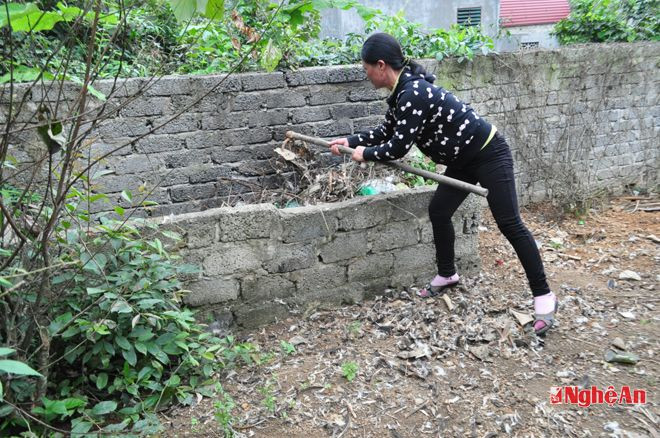 |
| Many households in Yen Thanh have built private pits at home to sort and process waste. |
In previous years, rural environmental issues became alarming as household waste overflowed everywhere—along riverbanks, streams, canals, ponds, lakes, roads, residential areas, and in many places without proper waste collection points. Many localities were truly at a standstill and had not found solutions in rural environmental protection. However, nowadays, in many communes, along with the New Rural Development movement, environmental issues have improved in a positive direction.
To implement the New Rural Development program, Nhan Thanh commune (Yen Thanh district) has actively directed and cared for environmental protection. Accordingly, the commune's environmental protection plan has been issued with specific contents such as building a centralized waste disposal site with an area of 5,000 m2; establishing waste collection and transportation teams in all 16 hamlets. Nhan Thanh also built a financial mechanism of "the State and the people working together" in environmental protection, in which the commune supports the provision of vehicles and equipment for waste collection, and the construction of more than 15 concrete roads connecting to the waste disposal site, while the people contribute to paying for labor, materials, and chemicals for waste treatment, with an average contribution of 5,000 - 7,000 VND per family per month.
In Nhan Thanh commune, environmental protection work in the commune and in each hamlet and residential area is entrusted to the Women's Union, which plays a core role. Every month on the 22nd, families and teenagers in each hamlet are mobilized to clean up, collect waste, and clean village roads, alleys, and public areas. According to Mr. Phan Van Thanh – Chairman of the People's Committee of Nhan Thanh commune, the results achieved today are due to the great efforts of the Party committee, the government, the political system, and especially the improved awareness of the people. In addition to consciously keeping and collecting household waste in one place, households strictly adhere to the regulations on waste disposal on the designated days and times, eliminating the situation where people only dispose of waste after collection, resulting in a waste collection rate of 90% for the entire commune. Along with waste collection, other aspects related to environmental sanitation criteria in the New Rural Development program, such as beautifying the landscape of village roads and alleys; the percentage of households using clean water; The construction of hygienic sanitation facilities... has also been a focus of local efforts, integrating various programs to achieve environmental criteria, bringing the commune to the finish line and receiving the New Rural Area standard in early March.
According to a report from the Department of Natural Resources and Environment of Yen Thanh District, through the District's Environmental Protection Project, 2011-2015, currently 22 communes and towns in the district have built centralized waste collection and treatment sites; 9 units do not yet have centralized waste disposal sites but have waste collection points in hamlets (only 8 communes still lack centralized waste disposal sites). More than 300 waste collection teams have been established throughout the district, with the rate of solid waste and household waste collection reaching 83%. Many communes have achieved collection rates of 90% or higher, such as Do Thanh, Hoa Thanh, Hong Thanh, Hop Thanh, Phuc Thanh, and Xuan Thanh; the remaining communes have achieved rates of 70% or higher. Many communes and towns have established environmental sanitation days, or "Green Saturdays and Sundays," to mobilize the entire population to clean up roads and public areas, maintaining a clean local environment.
In Thanh Chuong district, many effective models and practices in environmental protection have been replicated. The communes of Thanh Linh, Thanh Hung, Thanh Tien, Thanh Lien, Dong Van, Thanh Huong, etc., have encouraged each household to build household waste pits for sorting and processing waste at the source. Waste such as leaves, plant debris, and animal carcasses are burned and buried. Non-biodegradable waste such as bottles and broken pottery are collected monthly by the hamlets and transported to the commune's central waste disposal site. To date, Thanh Chuong district has built 6,317 household waste pits. Local areas have also constructed 178 waste pits in the fields for disposing of pesticide packaging and bottles. These practices have significantly reduced the amount of waste released into the environment, and, coupled with the beautification and paving of village roads and alleys, have contributed to raising people's awareness of environmental protection and improving the surrounding landscape.
In the districts of Nam Dan, Hung Nguyen, Nghi Loc, and Cua Lo town, local authorities have contracted with Vinh City Urban Environment One-Member Limited Company to collect, transport, and process waste at the Nghi Yen landfill, contributing to keeping each residential area clean and beautiful. To date, out of a total of 431 communes implementing the New Rural Development program, 120 have completed the criteria for environmental sanitation. However, generally speaking, many localities still do not pay enough attention to the environment. The communes that are "slow" in building New Rural Development are those that still face difficulties in planning or dealing with stagnant ponds and waterlogged areas that breed mosquitoes and diseases, narrow village roads, overgrown bushes that have not been cleared, and indiscriminately dumped waste.
According to Mr. Hoang Quoc Ky, Deputy Head of the General Affairs Department of the Provincial Environmental Protection Agency, the fundamental solution to the problem is for localities to develop specific environmental protection plans, including planning for waste disposal sites, collection methods, waste treatment solutions, and funding sources for environmental protection. In reality, many localities in the province have not yet developed environmental protection plans. Some localities are implementing environmental protection measures through administrative orders rather than in-depth public awareness campaigns to educate people and foster a sustainable sense of responsibility for environmental protection. Mr. Tran Ngoc Thanh, Head of the Department of Natural Resources and Environment of Thanh Chuong District, also acknowledged that Thanh Chuong has not achieved uniformity in environmental protection across all localities in the district. In some areas, especially in border regions between communes, indiscriminate dumping of waste still occurs, and many spontaneous waste collection points remain. The challenge is that localities must develop environmental protection plans, which is a decisive factor in the success or failure of environmental protection efforts and the construction of progressive residential areas in the new era.
Minh Chi