
Improvements to pesticide sprayers for safer and more effective operation.
In rice cultivation, pesticides, including herbicides, fungicides, and other preparations, are crucial components for protecting crops and maintaining yields.
However, in many cases, due to incorrect application of pesticides, pest control effectiveness is low and the health of those spraying is negatively affected; especially for hired workers specializing in spraying plant protection products.
This team, as well as some farmers, have not adequately understood and seriously followed recommendations on occupational safety during pesticide spraying. Currently, most shoulder-mounted sprayers, whether manually pulled or motorized, spray droplets of pesticide in front of the sprayer's path. Therefore, the sprayer always walks into the sprayed field, resulting in a very high risk of exposure to toxic substances.
In recent agricultural practices in the Mekong Delta, some innovative farmers and mechanical engineers have designed and manufactured tools and machines for spraying pesticides behind the sprayer. The fine, evenly distributed droplets increase pesticide effectiveness and safety for the sprayer. The following are some of the latest typical improvements.
Improved spray system
Engineer Le Quang Phuoc, currently working at the Ta Danh seed farm under the Binh Duc Seed Research & Production Center (An Giang Plant Protection Joint Stock Company (AGPPS)), invented an improved spraying system. The machine consists of two wheels welded from iron water pipes. The wheels have a diameter of 1.9 m and a 6.5 horsepower gasoline engine mounted on the frame.
This engine provides power for two purposes: creating pressure in the pesticide solution tank and powering the wheels, reducing the effort required from the operator. The sprayer's wingspan, carrying 22 nozzles, is 8 meters wide. It sprays 600 liters of water per hectare, with a capacity of 10 hectares per day. Currently, the Ta Danh farm has 4 machines in operation. In addition, the farm collaborates with several mechanical workshops in Tri Ton district (An Giang province) to produce dozens more machines to fulfill orders from farmers in the surrounding area. Each machine costs approximately 12-13 million VND.
Solution sprayer
Mr. Pham Hoang Thang from Can Tho City invented a liquid spraying machine. Previously, about 10 years ago, the first machine had a liquid container that was pressurized by levers connected to the rotation of two wheels. Therefore, the operator had to work very hard.
Later, thanks to the advice and suggestions from scientists at the Mekong Delta Rice Research Institute regarding the installation of a gasoline engine to create pressure for spraying pesticides, the sprayer only needed to pull the machine and adjust the spray path, making the work much easier.
The current model is made of a combination of metal and plastic, resulting in a lightweight design. It has two plastic wheels with a diameter of 90 cm. The solution tank has a capacity of 32 liters. The spray boom is 5 meters long and is equipped with 10 spray nozzles. The engine is a 1 horsepower, gasoline-oil mixture. The spray boom can be adjusted according to the height of the plants.
With a spraying capacity of 3 hectares per day, it can spray rice plants at all stages from seedling to heading. The machine can also be used to spray other crops such as vegetables, sesame, mung beans, soybeans, peanuts, and young corn. The machine is priced at 5 million VND. Recently, Hoang Thang Plastic Enterprise sold 2,000 machines nationwide.
Bat-wing sprinkler system
The bat-wing sprayer was invented by Ms. Nguyen Thi Tim in Tan Hung (Long An). Her family specializes in spraying pesticides for farmers using shoulder-mounted sprayers, which are inefficient and laborious. Because many farmers work under contract for rice cultivation, she considered improving the equipment to increase productivity and boost her family's income.
Her first innovative tool was a rake-shaped sprayer with nozzles that had long 35 cm stalks, allowing for precise spraying of insecticide to kill rice planthoppers. The sprayer was made of 12 mm diameter, 6 m long stainless steel pipes, fitted with 30 nozzles. A 500 m long rubber hose carrying the insecticide solution was connected to a high-pressure compressor mounted on a boat that moved along the canal bank. The sprayer required four people to operate: two holding the ends of the sprayer, one lifting the hose, and one operating the compressor and moving the boat.
Recently, Ms. Tim improved the system to reduce the number of workers in the team by one. This is the bat-wing sprinkler system. The pyramid-shaped bat-wing system is made of bamboo, making it lightweight. The bamboo frame serves as a support for the stainless steel pipes carrying the spray nozzles. The sprinkler system is 10 meters long and has 44 nozzles. The bat-wing system weighs only about 15 kg.
One person carries the sprayer, another lifts the rubber hose, and a third operates the compressor and moves the boat. The pesticide is sprayed backwards, making it safe for the operators. Each day, the group of three sprays 8-10 hectares, earning an average income of 200,000 VND per person.
Tím's team sprayed pesticides according to technical requirements and the landowner's specifications, resulting in high pest control effectiveness and gaining recognition among many farmers. Therefore, Tím's team has regular and stable employment in their pesticide spraying service.
4-wheel sprayer
Several examples of improved pesticide sprayers demonstrate good performance, with pesticide droplets dispersed behind the machine, ensuring operator safety. This inspires local mechanical engineering businesses to improve and produce more types of machines to widely serve farmers, increase labor productivity, improve the efficiency of pesticide use, and ensure operator safety, especially for those involved in pesticide spraying services. |
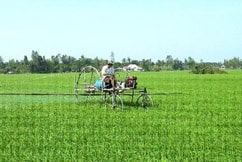
This is a pesticide sprayer with an operator sitting atop the machine. The machine sprays at any stage of rice growth, from sowing to heading. The machine's wheels remain stationary throughout the season, and the distance of damaged rice plants is less than 15 cm, thus not affecting or reducing rice yield. The machine was invented by farmer Ho Van Nam from Tan Hiep district (Kien Giang province).
The machine has a frame 3 meters long and 1.8 meters wide. It has four round wheels made of steel water pipes; the rear wheels are 2 meters in diameter and made of 4.2 cm diameter water pipes. The front wheels are 1 meter in diameter and made of 3.2 cm diameter steel pipes. The wheels have 1 cm diameter nylon rope wrapped in a spiral around the rim to increase friction and grip on muddy ground during operation. The machine is equipped with a 6-horsepower gasoline engine. The engine provides pressure for the sprayer and propels the machine.
The solution tank has a capacity of 120 liters of water. The spraying system is 15 meters long, with each nozzle spaced 20 cm apart. The spraying system can be adjusted up and down depending on the height of the rice plants and the behavior of the pests being controlled.
In Tan Hiep (Kien Giang), each rice field is 30 meters wide and 1,000 meters long, with a total area of 3 hectares. The spraying machine can finish spraying one field in 2 hours and can provide services to surrounding farmers on 12 hectares per day.
According to (NNVN) - LC


