
Traffic sign placement: Still haphazard and confusing!
In addition to educating people about traffic safety, infrastructure and traffic organization also play a significant role in reducing traffic accidents.
The application of technology is both a goal and a solution to control and minimize shortcomings in ensuring traffic safety and order. Scientific research results on transportation infrastructure by experts show great potential for application to the current state of road traffic in Vietnam.
Standard road design isn't necessarily the best.
Many researchers have stated that, in addition to direct causes related to human error and vehicles, traffic accidents are also significantly impacted by transportation infrastructure. Currently, many highways are being built, however, the standards for roads, lane allocation, and road surface lifespan are not yet high enough, causing considerable harm to driving and posing a potential risk of traffic accidents.
According to Master Nguyen Dinh Thao, Department of Road and Airport Engineering (University of Transport and Communications), monitoring, evaluating, and maintaining roads plays an extremely important role and is a crucial factor affecting driving conditions and road safety for traffic participants. Driving quality, driving safety, and traffic accidents are all closely related to the quality of road maintenance.
“Many roads have wheel ruts up to 30 cm high, which directly impacts traffic safety. Although a road maintenance management system has been established, the assessment of road quality and degradation is still largely piecemeal, not forming a complete and modern system. This leads to unsatisfactory road surface quality, even posing a significant risk to vehicle safety,” said Master Nguyen Dinh Thao.
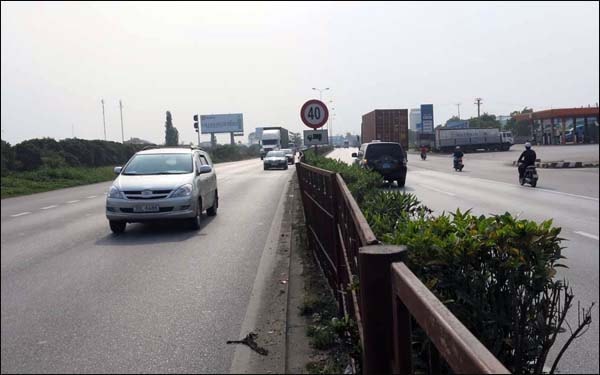 |
| The Vietnam Road Administration has had to replace a series of inappropriate traffic signs. Photo: Internet |
According to Master's degree holder Le Van Dat from the Institute of Transport Strategy and Development, in recent years, the main cause of road traffic accidents has been attributed to human awareness. The role of road infrastructure and structure accounts for too small a proportion and has therefore not been thoroughly analyzed. However, analysis of the causes shows that awareness and road infrastructure, when combined, account for up to 50% of accidents.
Therefore, Master Dat emphasized the role of technical standard design. While the current design standards system is comprehensive, solutions are needed in the design selection to ensure mobility, transport density, connectivity, etc. Incorrect design will affect the transportation infrastructure and directly impact vehicles participating in traffic.
“Most standards lack guidance on road classification design, and the selection of design speeds is too easy and doesn't reflect actual operating conditions. Some countries assess operating speeds to adjust them accordingly, while one-way visibility is regulated by design speed, and in calculations, the value is often below the average human level, which is rigid. In Vietnam, traffic flow is a mix of 1 meter and various objects, which is illogical, and visibility height doesn't have a specific value,” Master Dat pointed out.
Proposing solutions in the criteria for designing transportation infrastructure, Master's degree holder Dat noted the need to focus on the human factor, with habits and customs, to consider flexible infrastructure design suitable to the conditions of each locality. "A standard design is not necessarily good. Standards cannot be an obstacle to the creativity and experience of professional designers," said Mr. Dat.
Many traffic signs pose a safety hazard.
One current concern for road users is the placement and use of traffic signs. The positioning and placement of signs on roads is a form of traffic organization aimed at ensuring traffic safety. The signage system must meet the objective of enabling road users to proactively respond to traffic situations, avoiding passive responses that could lead to traffic accidents.
However, according to Dr. Do Quoc Cuong (University of Transport and Communications), the current regulations for placing traffic signs are being misinterpreted by everyone, making them difficult to apply and leading to arbitrariness in sign placement. The placement of signs on national highways and expressways that do not match vehicle speeds has resulted in drivers not having enough time to grasp the information on the signs.
Furthermore, in line with the current trend of international integration, traffic signs should be installed according to a common standard with the rest of the world. However, Vietnam's issuance of international driving permits is inconsistent with local regulations and is illogical.
“Drivers traveling at 80 km/h need to see the sign from a distance of 75 meters within 2.5 seconds, therefore the height of the lettering on the sign must be at least 20 cm. In addition, there needs to be a standardized speed limit chart and minimum distance between signs placed before the warning location so that road users can easily understand the information and control their vehicles to avoid unfortunate accidents,” said Dr. Do Quoc Cuong.
Regarding the Vietnam Road Administration, a representative stated that the agency is currently proposing adjustments to Regulation 41 on traffic sign placement, aiming to help road users easily understand and comply with the instructions. Simultaneously, the Road Administration is continuing to update the regulations of the Vienna Convention on Road Traffic into a standardized framework.
Mr. Nguyen Van Huyen - Director General of the Vietnam Road Administration: By the end of 2013, nearly 62,500 road signs nationwide needed replacing due to content and form not conforming to regulations. In addition, nearly 18,500 more road signs needed to be added on national highways.
These figures speak volumes about the inadequacies of current road signage. Many drivers have complained that the spacing of speed limit warning signs on many national highways is inappropriate, failing to provide sufficient distance for drivers to adjust their speed according to regulations. The situation of inadequate road signage, causing frustration for road users, even compromising traffic safety and leading to unfair fines for drivers, remains common in many areas.
According to VOV


