
Frontline officials encouraged people to grow sugarcane to get rich.
(Baonghean) - Previously, dozens of households belonging to ethnic groups such as Thai, Dan Lai, and Kho Mu... in Bai Gao village, Chau Khe commune, Con Cuong district, suffered from food shortages year-round and had to rely on government assistance. Those difficulties are now a thing of the past, because they now have a Front Committee official who knows how to encourage the villagers to engage in economic activities. That official is Ms. Loc Thi Hoang - a Front Committee official in Bai Gao village.
"If I lead the way, the people will follow."
The village of Bai Gao (Chau Khe commune) has 87 households with over 362 inhabitants. In previous years, the people here only knew how to grow crops such as corn, beans, and peanuts...; these agricultural products were only enough to serve their families. The vicious cycle of poverty clung to the ethnic minority people here.
Then, a glimmer of hope for prosperity appeared when sugarcane was introduced to the village. People changed their perceptions, switching from traditional crops to sugarcane. The person behind this transformation was "Ms. Hoang, the head of the Fatherland Front." "In 1999, only a few households in the village tried planting sugarcane. In the beginning, due to a lack of understanding of planting and fertilizing techniques, the sugarcane grew unevenly and had stunted stalks. Then, with guidance from the technical staff of the sugar factory, my fellow villagers and I have now earned enough to eat and live comfortably," shared Ms. Loc Thi Hoang, Head of the Fatherland Front Committee of Bai Gao village, Chau Khe commune, Con Cuong district.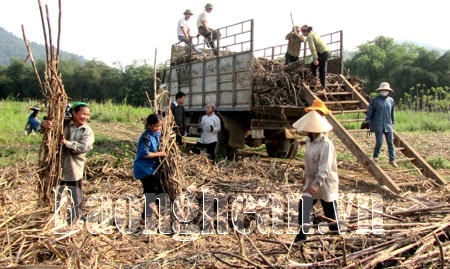
Trucks carrying sugarcane from the Song Lam sugar factory have gone right into the fields to sell the produce.
Products for the local people.
According to Ms. Hoang, as a local official, she felt she had to set an example for the villagers to follow. At that time, many people disagreed with the idea of switching to sugarcane cultivation, arguing that if they didn't grow corn and cassava, they wouldn't have anything to eat. Previously, they cultivated crops three times a year, growing corn and cassava, but it wasn't effective, and food shortages persisted. Therefore, when they switched to sugarcane, many were still skeptical, thinking that if they were already starving with existing crops like corn, beans, peanuts, and cassava, where would they get corn to cook every day if they planted sugarcane? However, overcoming these outdated mindsets, Ms. Hoang, along with other village officials, successfully persuaded and encouraged the people to gradually shift their corn and cassava cultivation to sugarcane. Today, sugarcane has transformed the lives of the Thai, Dan Lai, and Khmu ethnic groups in this area.
The 13-year policy of "saying no to having a third child"
According to statistics, the entire Bai Gao village now has over 30 hectares of land planted with sugarcane, and up to 95% of households cultivate this crop. Although only one harvest is obtained per year, sugarcane cultivation yields higher economic returns compared to growing other crops, with each household earning an average income of 30-45 million VND.
The family of Mr. Loc Van Ung, who cultivates over 5 acres of sugarcane, said: "Since we started growing sugarcane, our family is no longer hungry. Sugarcane is better than corn or cassava, and when we have food, we can send our children to school so they can learn to read and write and use that knowledge to help the people in our village."
With economic development, Bai Gao village has the resources to focus on cultural and social activities, becoming the first unit in the mountainous district of Con Cuong to achieve the title of "Cultural Village" nearly a decade ago. Remarkably, for over 13 years, no couple has had a third child. Currently, the village has 9 students attending universities and colleges, 3 students attending vocational schools, and dozens more attending school from kindergarten to high school, with no school dropout rates.
Regarding the issue of villagers not having a third child, Ms. Hoang explained: "Our people listened to the officials' propaganda, saying that having many children is very difficult, they don't have enough to wear, and they can't go to school. So for the past 13 years, no couple in our village has had a third child." In conversation with us, Ms. Vi Thi Kham, Chairwoman of the Fatherland Front of Chau Khe commune, assessed: "This is the most economically developed village in the commune, thanks to the application of a sugarcane cultivation plan that yields high economic efficiency. In particular, Bai Gao village has been free of social vices for the past ten years."
North Vu


