
Attention should be paid right from the production stage.
(Baonghean)Food safety and hygiene in agricultural products is always a matter of concern, especially during the period leading up to the Lunar New Year, when the demand for food increases. However, many shortcomings have existed in this area over the years.
As a meticulous housewife, Ms. Nguyen Thi Vinh (Le Mao Ward, Vinh City) always tries to minimize her use of food of unknown origin. Besides the vegetables she grows at home, which are almost always enough for her family, she always chooses familiar vendors when buying meat at the market. She also makes time to go to the supermarket a few times a week, stocking up on all sorts of ready-made food. However, according to her, her family still often insists that she go to the market to buy "fresh" food.
Considered the province's major vegetable producing area, Quynh Luong supplies hundreds of thousands of tons of vegetables to the market each year. However, out of nearly 200 hectares of vegetable fields, less than 10 hectares are cultivated according to VietGAP standards, meaning they are considered safe vegetables. According to Mr. Nguyen Van Tue, Vice Chairman of the Commune People's Committee, producing safe vegetables requires higher standards in terms of investment and care, yet there is currently no market outlet that meets the requirements and attracts consumers. Currently, Quynh Luong has only signed contracts with Metro and BigC supermarkets, but the consumption volume is very small, only a few hundred kilograms per day, while the total vegetable production of the commune is tens of tons.
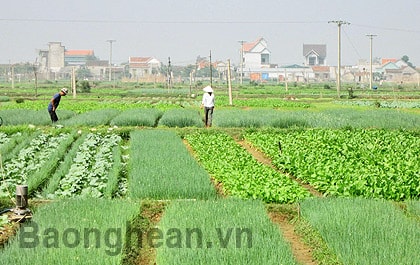
Taking care of vegetables in Quynh Luong (Quynh Luu).
The total annual vegetable and fruit production area in Nghe An province is currently about 15,137 hectares. This area not only meets the consumption needs within the province but also supplies many localities nationwide. According to the survey results of the Plant Protection Sub-Department, every year up to 60.8% of farmers use pesticides incorrectly. In 2011, out of 90 samples analyzed for pesticide residue on vegetables, 20% of the samples showed residue, 57% of the samples contained two types of chemicals, and the number of samples exceeding permissible levels in all groups reached over 61%. Discussing this issue, Mr. Nguyen Dinh Huong (Deputy Head of the Provincial Plant Protection Department) said: With over 3 million people, Nghe An's agricultural production, although large, is not diverse enough and does not meet consumer demand. Therefore, we have to both produce and import products from northern provinces, and even from Thailand and China..., making food safety management very difficult. In recent times, recognizing that the management of circulation, trade, and use of pesticides has a significant impact on food safety in agricultural products, the Plant Protection Department has implemented many measures to tighten control over this issue. These include focusing on educating and training people on safe production processes, especially for vegetable production. Annually, samples are taken to analyze pesticide residues in products to develop effective management measures. Simultaneously, focus is being placed on building safe production models according to VietGAP standards, expanding integrated pest management (IPM) and sustainable infiltration (SRI) programs to replicate safe vegetable production models. However, currently, authorities cannot fully control the trading and use of pesticides, while coordination among localities is very limited.
With over 700,000 cattle and buffaloes and 17 million poultry, Nghe An is considered one of the provinces with the largest livestock population in the country. However, according to Mr. Bui Van Doan (Head of the Animal Quarantine Department - Provincial Veterinary Sub-Department), despite the efforts of relevant agencies, inspections at livestock breeding, slaughtering, processing, and consumption facilities still reveal many shortcomings, both in disease control and food safety and hygiene. Products that do not meet safety standards are freely sold on the market, posing a safety risk and increasing the risk of disease spread. In small-scale livestock farming – a common practice today – vaccines, chemicals, and antibiotics are often used indiscriminately. Furthermore, although considered an important measure to prevent "unsafe" food, the number of livestock and poultry slaughtered in centralized facilities currently only reaches about 15-20%, meaning that 80-85% of livestock and poultry cannot be controlled during slaughter. This poses a significant risk to veterinary hygiene and safety, and even the possibility of slaughtering and consuming diseased animals.
According to Mr. Tu Trong Kim (Head of the Crop Production Department - Department of Agriculture and Rural Development), in recent times, although the agricultural sector and related agencies have implemented many measures to "tighten" the management of food safety and hygiene in agricultural products, the results have not met many of the actual requirements. Compliance with VietGAP production processes following good agricultural practices is still limited, resulting in low-quality products, especially in terms of food safety and hygiene. Most producers always try to protect their yields at all costs, including the indiscriminate use of pesticides and unsafe feed in farming and livestock raising. Meanwhile, consumers are still not truly concerned about the safety of the products they use and still have a "cheap" mentality. In recent times, the agricultural sector has focused on selecting suitable varieties and emphasizing cultivation techniques, expanding the area of crops and livestock that are both productive and high-quality, while limiting and avoiding intensive farming practices involving the use of inappropriate chemicals and preparations. Simultaneously, the Sub-Department of Agricultural, Forestry, and Fisheries Product Quality Management has made significant efforts in monitoring production processes to create safe products. However, according to Mr. Kim, to achieve truly safe products, the most important factor is monitoring input investments from seeds, fertilizers, pest and disease management, and other techniques. This aspect remains limited, while product monitoring is also not yet truly effective. Sharing the same viewpoint, Mr. Bui Duy Hung (Deputy Head of the Sub-Department of Quality Management of Agricultural, Forestry and Fishery Products) stated: While ensuring product safety requires guarantees at all stages, we are currently mainly focusing on control at the final stage. Many products are consumed before they are even found to be unsafe, especially given the lack of necessary machinery and equipment in the units responsible for this task. Only a few locations nationwide are adequately equipped with the necessary equipment, while all provinces and cities have a need for it. The main reason why food safety and hygiene on agricultural products currently do not meet requirements is, first and foremost, our production is still small-scale and not a closed-loop process. Instead, it involves many stages, from production, harvesting, processing, preservation, and consumption, throughout which factors that compromise food safety and hygiene are significant. To ensure food safety and hygiene, in the long term, we need to gradually control household production, reduce small-scale production, and increase commercial production.
Text and photos: Phu Huong


