
The Thành - Bình - Thọ fuel supply route needs to be upgraded urgently.
This is the road connecting the Cay Chanh bridge in Dinh Son commune, crossing the Ca River and passing through three communes: Thanh Son, Binh Son, and Tho Son (Anh Son district), located on the left bank. It is often referred to as the "Thanh-Binh-Tho raw material road". The total length of the road through the three communes is approximately 20 km, and it has seriously deteriorated, significantly affecting the lives of the local people.
(Baonghean)This is the road connecting the Cay Chanh bridge in Dinh Son commune, crossing the Ca River and passing through three communes: Thanh Son, Binh Son, and Tho Son (Anh Son district), located on the left bank. It is often referred to as the "Thanh-Binh-Tho raw material road". The total length of the road through the three communes is approximately 20 km, and it has seriously deteriorated, significantly affecting the lives of the local people.
The persistent, drizzling rains throughout the cold spell made the road muddy and slippery, forcing most motorbikes to move very slowly to avoid accidents. Occasionally, a truck carrying sugarcane or cassava would come from the opposite direction, forcing all the motorbikes to stop and give way. These were the scenes I witnessed while traveling along this "miserable" road to Tho Son commune. Nearly 10 years ago, when it was put into use, this road, invested in by the Nghe An Department of Transport, had truly proven effective not only for the people of the three communes but also for other localities in Con Cuong and Tan Ky districts in terms of trade and transportation, especially the transport of sugarcane from Thanh Son, Binh Son, and Tho Son to the Song Lam Sugarcane Company's sugar factory located in Dinh Son commune, Anh Son district.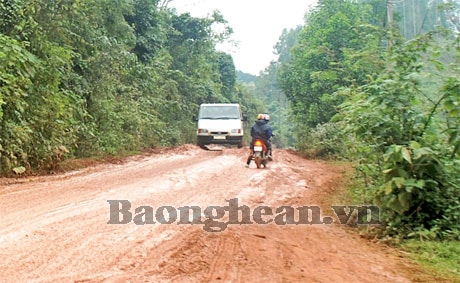
The Class V asphalt roads in the mountainous area are in serious disrepair.
However, over the past three years, the road, constructed to mountainous road standards (Class V with a load capacity of 13 tons), has rapidly deteriorated. In many sections, the road surface is uneven, the asphalt layer has almost completely peeled off, replaced by dirt, making travel extremely difficult. Mr. Pham Ngoc Canh, Vice Chairman of the Thọ Sơn Commune People's Committee, stated: "The main reason is still the frequent use of overloaded vehicles. In addition, since the Cây Chanh bridge was inaugurated and put into use, the volume of traffic has increased compared to before. All these factors have led to the rapid deterioration of the road." According to our research, in Tho Son alone, with 400 hectares of sugarcane, an average harvest of 14,000-15,000 tons of sugarcane per season means a huge volume of trucks transporting raw materials in and out each season, along with trucks carrying acacia and minerals. Therefore, it is understandable that this vital raw material route is rapidly deteriorating.
For several years now, this deterioration has not only affected the transportation of raw materials for the sugar factory but also significantly impacted the lives of local residents. In Tho Son commune alone, there are 810 households with over 3,700 people. Ms. Nguyen Thi Thai from Hamlet 5, Tho Son, expressed her frustration: "When it rains, many sections of the road turn into muddy pools, making travel very difficult. Before, there was a road, but no Cay Chanh bridge; now that there is a bridge, the road is damaged. We only dare to travel on it when it's absolutely necessary." "The most difficult situation is for the high school students, who have to travel 12 kilometers through the forest in such poor road conditions to get to school." According to Mr. Pham Ngoc Canh, Vice Chairman of the Thọ Sơn Commune People's Committee, the commune currently has more than 150 students attending Anh Sơn 3 High School. Most of them have to rent accommodation to attend school because the road is in poor condition. Many families, already struggling, are now facing even greater difficulties due to the additional cost of rent and monthly living expenses. Therefore, the people hope for a plan to upgrade and repair the road to facilitate convenient travel.
Leaving Tho Son, I headed back to Thanh Son – the area with the most deteriorated roads. Mr. Do Minh Duc, Deputy Head of the Thanh Son Commune Police, said: “Since the roads deteriorated, the number of traffic accidents we have recorded has been increasing. Fortunately, there haven't been any serious incidents because most people are aware of the need to slow down when traveling on this road. It's dusty in the dry season and muddy in the rainy season, making travel very difficult!”
Faced with this situation, the people have complained many times, and the Anh Son District People's Committee has had to provide budget support to Thanh, Binh, and Tho communes twice to coordinate with the people in repairing the roads. In 2011, the district supported each commune with an average of 40-70 million VND. In 2012, the District People's Committee also supported Thanh Son commune with 120 million VND, and Binh Son and Tho Son with 60 million VND each. In addition, Song Lam Sugar Company also supported 150 million VND to the above communes to clear the raw material roads. However, the above solutions are still only temporary, because many sections of the road surface are severely degraded. Recently, the Provincial People's Committee has approved the Anh Son District People's Committee as the investor to renovate and upgrade 3 km of the raw material road (these are the sections that are severely damaged and difficult for vehicles to travel on). Anh Son District plans to carry out repairs and renovations in the first quarter of 2013. This is good news for the voters and people of the three communes of Thanh, Binh, and Tho, because their desire for a road that meets standards, contributing to improved trade and travel conditions and reducing hardship for the people, is entirely legitimate.
Thanh Duy


