
The water storage capacity of the reservoir system needs to be increased.
(Baonghean) - After more than 10 years of implementing the reservoir safety program, large reservoirs and dams in the province with capacities ranging from 10 to 70 million cubic meters have been repaired and upgraded to ensure safety. However, reservoirs with capacities from 1 to 3 million cubic meters (mainly managed by local authorities) have not been regularly repaired, resulting in many structures deteriorating and leaking, causing water loss.
(Baonghean) - After more than 10 years of implementing the reservoir safety program, large reservoirs and dams in the province with capacities ranging from 10 to 70 million cubic meters have been repaired and upgraded to ensure safety. However, reservoirs with capacities from 1 to 3 million cubic meters (mainly managed by local authorities) have not been regularly repaired, resulting in many structures deteriorating and leaking, causing water loss.
Many reservoirs and dams are in disrepair.
The Thi Long reservoir in Quang Nhan hamlet, Quang Thanh commune, Yen Thanh district, has a capacity of approximately 700,000 m3, but for many years it has failed to provide sufficient irrigation water, causing many difficulties for the local people. Ms. Nguyen Thi Minh, a resident of Quang Nhan hamlet, said: “The dam here only provides irrigation until the rice plants are about to flower and develop their ears; then the water runs dry, and we have to pump water from ponds to ‘save’ the rice…”
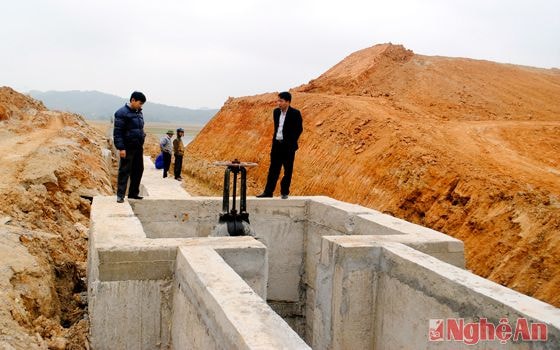 |
| The drainage system for drawing water from Nha Tro Lake (Tan Thanh - Yen Thanh). |
It is known that the reservoir has not been upgraded for a long time, the embankment is made of earth, and there are many leaks causing significant water loss, with the water level in the dam only at 30%. Mr. Hoang Van Bay, Chairman of the People's Committee of Quang Thanh commune, said: The entire commune has 31 small reservoirs, but only 4 have been upgraded and repaired, the rest are in disrepair, and the water level in the reservoirs only reaches 30-40%. This spring, the commune planted 240 hectares of rice, but according to forecasts, about 70% of the rice area in the heading and flowering stages will lack water.
Yen Thanh district has over 200 small reservoirs and dams, irrigating over 3,000 hectares of rice fields concentrated in the communes of Minh Thanh, Quang Thanh, Thinh Thanh, etc. From 2010 to the present, using government bonds, the district has only upgraded and repaired 14 small reservoirs and dams. The rest are maintained and repaired rudimentary by local authorities, resulting in most of them being dilapidated and unable to meet the water storage needs for production. Specifically, only about 2,000 hectares can be irrigated, while the rest suffer from water shortages, forcing farmers in the communes to proactively irrigate their rice fields by pumping water from ponds and lakes.
The Bac Irrigation Company Limited, operating in the district, manages 17 large and small reservoirs and dams across four districts: Do Luong, Yen Thanh, Quynh Luu, and Dien Chau, irrigating over 7,000 hectares of rice fields. However, ensuring sufficient irrigation water, especially during the rice heading and flowering stages, is challenging due to low water storage capacity, leaks, and water loss in the reservoirs and dams. Due to limited funding, the company has only been able to upgrade 10 large reservoirs; medium-sized reservoirs remain unupgraded, with water levels only reaching 30-50%. For example, the Ke Sat reservoir in Tien Thanh, Yen Thanh district, has only reached 45% capacity due to leaks on the upstream slope, making it difficult to irrigate 179 hectares of rice in the spring crop. The Don Hung reservoir in Hau Thanh, irrigating over 200 hectares of rice, only reaches 50% of its capacity, with numerous cracks in the dam body, seepage downstream, and leaks in three locations. The Doi Tuong reservoir in Quynh Vinh (Hoang Mai town) only has a water level of 40%; the Khe Da Mai reservoir only has a water level of 35%…
Nghe An province has the highest number of reservoirs and dams in the country, with 625 large reservoirs and dams, of which over 60 are managed by enterprises. In the past 10 years, the province has upgraded and repaired over 90 reservoirs and dams. The majority of the remaining smaller reservoirs and dams managed by local authorities have been in use for 30-40 years, with some even built over 50 years ago. Their construction was inconsistent, and they have not been upgraded or repaired, leading to serious deterioration…
Mr. Pham Huu Van, Deputy Head of the Provincial Irrigation Department, stated: Reservoirs are experiencing water leaks, seepage through the dam body and slopes, and leaks through culverts; the reservoir beds are silted up, and the spillways are narrow… Meanwhile, reservoir operation and management also have many limitations. For example, with small reservoirs managed by communes and cooperatives, regular maintenance and repair are not carried out, or management is done without project documentation or initial design documents; managers have not received training, are not specialized, and only know how to open and close sluice gates. This is also a reason for the deterioration of the structures.
For example, the Central Highlands reservoir (Quynh Thang, Quynh Luu), with a capacity of 1.2 million m3, irrigating over 200 hectares, was built in 1966 and renovated and upgraded in 2009. The facility was managed by the Quynh Thang Agricultural Service Cooperative. This cooperative then entrusted the maintenance and operation of the sluice gates to a private company without any training or instruction on reservoir operation and use, making reservoir management very difficult. Consequently, this led to the reservoir breach in September 2012.
According to Mr. Van, the reservoir system in our province irrigates over 20,000 hectares of rice, but this spring, the smaller reservoirs managed by the local authorities only reached 30-45% of their capacity. The water supply is only sufficient to irrigate about 12,000-14,000 hectares of rice, mainly from larger reservoirs. The remaining rice fields are severely lacking water during the heading and flowering stages. Therefore, this spring, many communes are encouraging farmers to convert 30 hectares of rice to other crops.
Actively implement solutions
To overcome the limitations of small reservoirs, localities have implemented remedial solutions. In Quang Thanh commune, at the beginning of the production season, over 800 laborers were mobilized to focus on maintaining and repairing the dam body, sluice gates, and the canal system leading from the reservoir. Meanwhile, the Northern Irrigation Company Limited is upgrading the Nha Tro reservoir in Tan Thanh (Yen Thanh) and the Ba Tuy reservoir in Quynh Tan (Quynh Luu) with a total value of over 30 billion VND. Taking advantage of the low water levels during this season, the construction unit has focused on carrying out the repair work. Currently, the Nha Tro reservoir has completed over 50% of the construction work, with the water intake sluice gate and dam body finished.
Mr. Tran Manh Dung, a land administration officer in Tan Thanh commune, Yen Thanh district, shared: "The Nha Tro dam has been severely degraded for a long time, so when the upgrading project was undertaken, the local people unanimously agreed to switch from growing two rice crops on an area of 131 hectares to growing cash crops (Yen Thanh district supported the people with 50% of the cost of seeds). To ensure stable production for the people, the construction unit needs to speed up the progress so that water can be stored during this year's rainy season."
Mr. Phung Thanh Vinh, Director of the Project Management Board for Agriculture and Rural Development of Nghe An province, added: Many reservoirs were not built according to standards and quality, therefore upgrading, maintaining, and repairing them is very urgent. From 2007 to the present, projects managed by the Board have maintained and upgraded 7 reservoirs with a total cost of over 350 billion VND. Currently, the Thach Tien reservoir in Hung Nguyen and the Da Mai reservoir in Do Luong are under construction, worth over 40 billion VND. In 2015, Nghe An received a loan of over 160 billion VND from the WB 5 Project (World Bank funding) to upgrade reservoirs and dams. In 2016, the World Bank continued to provide a loan of over 1,100 billion VND to maintain and upgrade the reservoir and dam system for the period 2016-2020. The project is divided into 3 phases, with the construction and upgrading of 90 reservoirs and dams in a coordinated manner. The World Bank and its consultants' criteria is to assess and review the most vulnerable and severely damaged dams and reservoirs for construction.
To proactively cope with the drought situation in this year's spring crop, before planting, the Department of Agriculture and Rural Development assigned localities to balance water resources for rice cultivation; and encouraged people to convert highland rice fields to other crops. While state investment is limited and many reservoirs have not been upgraded, localities need to mobilize people's efforts to maintain, excavate, and repair weak small reservoirs and dams. Focus on setting up temporary pumping stations to pump "recirculated" water from streams and dead-end rivers to reserve reservoir water for the summer-autumn crop.
Van Truong


