
The management of domestic water supply facilities is necessary.
(Baonghean) - With various funding sources, hundreds of gravity-fed water systems have been built in the mountainous region of Ky Son over the years to serve the daily water needs of the people. However, managing and utilizing them effectively after investment requires efforts from many sides, especially the sense of responsibility of the people in each village and hamlet.
Many years ago, to get water, the people of Ta Ca border commune had to trek through the forest daily to streams and springs. Few people imagined that one day, water would be piped directly to their villages and homes for convenient daily use. Today, all 11 villages in Ta Ca commune have at least one self-piped water system. Unlike other highland villages where the worry about water is ever-present, especially during the dry season, all the people in Ta Ca have enough water for daily use. From 1998 to the present, following investment projects from OXFAM, 134CP, and 135CP, all the villages have gradually had self-piped water systems. The water storage tanks are now full of water piped in from large streams such as Huoi Gian, Huoi Cau, and Ca Nhang…
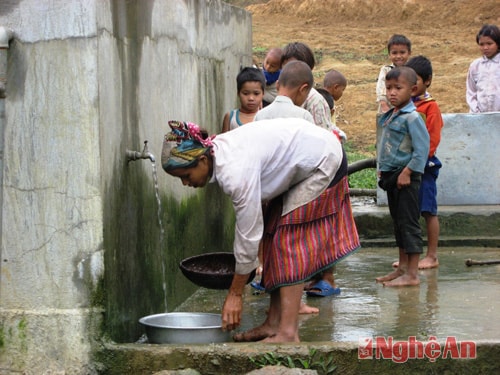
| Students from Trung Tam village, Huoi Tu commune, fetch water for daily use after school. |
To protect the water source and keep it clean, the local people have unanimously agreed with the authorities to abide by the "three no's": no deforestation in the headwaters, no use of pesticides in fields near the water source, and no livestock grazing. Those who violate these regulations will be reprimanded, warned, or even have their water supply completely cut off. Speaking about these regulations, Mr. La Tuan Ba – Secretary of the Party Committee of the commune – shared: “In the highlands, having your water supply cut off is like having your livelihood cut off, so the people are always conscious of protecting these infrastructures. Every year, after heavy rains, the water pipes often break at the joints, drift away, or get lost, so the people here contribute rice and money to repair them immediately…”
Upon investigation, it was found that in each village, the residents elect a water management team of 3 to 4 people to carry out tasks such as distributing and regulating water flow to reservoirs, as well as maintaining the pipeline system. This is not an overly difficult job, but it requires meticulousness and a high sense of responsibility from each member. This is most evident in the two villages of Cau Tam and Vinh Son 1. Because they share a water source from Khe Hia – the stream with the weakest water flow in the commune – the water management teams must coordinate and divide their time to draw water throughout the day to balance the water supply for the two villages. This work has been maintained by the team members for many years, even though the wages they receive are only a token amount.
Besides maintaining and utilizing water infrastructure with a high level of awareness, in some villages such as Hoa Son, Son Ha, and Son Thanh, people have also formed their own water groups to build water distribution systems themselves, instead of waiting for support from projects or the district budget. Each group usually consists of 10 to 15 households contributing between 2 and 4 million VND per household. This is a considerable amount compared to the income of the people here, but they are still determined to carry it out. Thanks to the efforts of the people and the commune government to protect and use the water resources rationally, all the water infrastructure in Ta Ca commune is functioning very well after decades of construction.
Following a recommendation from the Party Secretary of Ta Ca commune, we visited Hoa Son village to learn more about the self-contained water supply systems there. Currently, 190 households in the village use water from 9 reservoirs with capacities ranging from 8 to 10 cubic meters.3Because flat land is scarce, water tanks are built in people's gardens. However, families happily give up their land for the construction of these tanks. Mr. Lo Xuan Viet's family dedicated a plot of land in their yard to build a water tank for the group of households. He shared: "Giving up a little land from our family to build a tank is nothing to worry about. In our village, water is more precious than rice, so the whole village agrees to try to maintain these water facilities. We only need to pay 6,000 dong per person per month to use it freely. For families with students studying far from home, the fee is halved…"
 |
| Clean water has arrived in the village. |
Upon investigation, it was learned that the village has two water supply groups, built under two funding programs: one from OXFAM in 2010 and another from the program for border and highland communes in 1999. In addition, there is a group of 15 households who pooled their money to independently bring water to their homes. Since its construction, the pipeline system has cracked and broken several times. The villagers still remember the two major floods in 2005 and 2011, which caused the plastic water pipes to crack and almost completely break, even burying the water source under mud and rocks. However, the villagers are always proactive in maintaining the water system, contributing money, rice, and labor to repair the damage. Only in areas where the costs are too high do they seek assistance from the district. Each water supply group in the village has appointed four people to manage and protect the pipeline system, and at the end of the harvest season, the villagers contribute rice or money to partially support them. Thanks to this, the people here are always proactive in using and managing water resources.
However, for various reasons, not all of Ky Son's gravity-fed water systems are used as effectively as in Ta Ca. Especially after the major flood of 2011, 60% of the systems were damaged. For minor damage, the communes can mobilize residents to help repair it themselves, but for severe damage requiring hundreds of millions of dong in repair costs, the repair process is far from simple. Communes like Huoi Tu, Pha Danh, and Keng Du are three of many names that are literally "thirsty." Many of the communes' water supply systems have run dry, and during the long dry season from October to April, the worry about water shortage is even greater than the worry about food shortage.
In Huoi Tu commune, right in Trung Tam village, the sight of students crowding around weak water taps to collect small cans of water after school is no longer uncommon. Huoi Tu's 13 villages currently have 836 households with 4,207 inhabitants and 22 water tanks, three-quarters of which are severely dilapidated. The remaining villages have no water, due to the low water levels in the reservoirs, causing the pipes and tanks to be constantly dry. Some streams are now drying up due to deforestation in the headwaters; for example, Khe Y Bun – once considered a "savior" for the people of Huoi Tu – now has significantly depleted water. Improving the quality of management, operation, and use of water supply facilities in mountainous areas remains a very difficult task. Therefore, it requires the concerted efforts of the people and all levels of government so that the worry about water supply no longer "haunts" the people here.
Thanh Quynh


