
We need to act in accordance with the principle of "drinking water and remembering the source."
(Baonghean) - The belief in ancestor worship is considered a beautiful traditional cultural feature of the Vietnamese people. However, the fact that Ms. Tran Thi Thi in Quan Bau ward (Vinh City) is demanding land to build a memorial for martyrs has somewhat diminished the value of that beautiful cultural feature...
The Truong Son Martyrs' Cemetery (in Vinh Truong commune, Gio Linh district, Quang Tri province) is the resting place of over 10,000 martyrs who bravely fought and sacrificed their lives on the legendary Ho Chi Minh Trail during the resistance war against the US. Among them, the section with the largest number of martyrs from Nghe An province, with over 1,000 graves, is located near the center of the cemetery, on a spacious hill. These men were relatively young; they went to war when the country needed them, without considering personal gain, driven only by a single will and belief that their country would be liberated and unified. Their heroic sacrifice has made them immortal, forever remembered by the Party, the State, and the Vietnamese people, who have dedicated a solemn, sacred, and peaceful place for their eternal rest.
Kneeling before the grave of her uncle, Martyr Tran Cong Hanh (from Thanh Long commune, Thanh Chuong district), Mrs. Tran Thi Thi broke the silence with documents from relevant authorities requesting land allocation for a memorial temple dedicated to him. In her story, Mrs. Thi told us that Martyr Tran Cong Hanh was orphaned at the age of 5. He was then raised by Mr. and Mrs. Tran Van Lien (Mrs. Thi's father, Mr. Hanh's half-brother). In 1967, Mr. Hanh married Mrs. Phan Thi Hong Dien (from the same commune), but they only lived together for 10 days before he volunteered for the army and died in 1970. In 1977, Mrs. Dien remarried, and the land of the martyr's parents was left abandoned, unattended and uncared for. In 2008, Mr. Tran Van Lien submitted an application to the Thanh Long Commune People's Committee requesting land allocation for a memorial temple for the martyr. According to Ms. Thi, the family's wish is to have a place to build a memorial for the martyrs and their parents, because it is impossible to worship two brothers from the same family, sharing the same mother but different fathers.
While acknowledging the legitimate wishes of Mrs. Thi's family, it is regrettable that, according to current regulations, there is no basis for resolving the matter. Based on existing records and the opinions of local residents, before 1951, on the land belonging to Mr. Tru and Mrs. Loc (the parents of martyr Hanh), there was a two-room house with a thatched roof. However, in 1951, the house was destroyed by bombs. Mr. Hanh's father died when he was only three years old, and his mother died in that bombing. From then on, Mr. Hanh was taken in and raised by Mr. Tran Van Lien, who worked as a laborer. In 1967, Mr. Hanh married Mrs. Phan Thi Hong Dien, but ten days later, he joined the army and remained there until his death in 1970. When they got married, there was no house on the land, and they temporarily lived at Mr. Lien's house. After her husband's death, Mrs. Dien returned to live with her parents in Hamlet 12 (Thanh Long Commune). The plot of land was abandoned and allocated by the Thanh Long Cooperative to households for vegetable cultivation (land %). In 1979, the Thanh Long Commune People's Committee allocated it to Ms. Tran Thi Huong for residential use, which she has maintained to this day. Based on Clause 2, Article 10 of the 2003 Land Law: "The State does not recognize claims for the return of land that has been allocated to others for use under State regulations during the implementation of land policies of the Democratic Republic of Vietnam, the Provisional Revolutionary Government of the Republic of South Vietnam, and the Socialist Republic of Vietnam," Ms. Thi's family's claim for the land is unfounded and cannot be resolved.
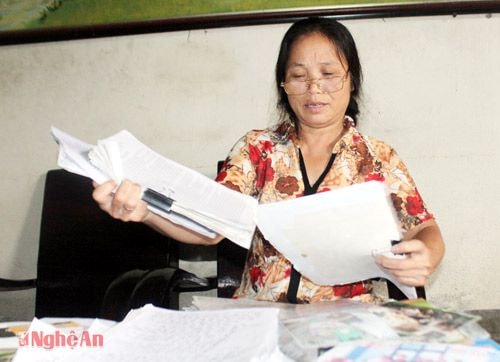 |
| Ms. Thi and her complaint letters were used to reclaim the land. |
Previously, in 2008, while Mr. Tran Van Lien was still alive, he submitted a petition to the authorities requesting a plot of land to build a memorial for fallen soldiers. After receiving the petition, the Provincial People's Committee directed the Department of Natural Resources and Environment and the Thanh Chuong District People's Committee to guide Mr. Tran Van Lien in preparing the necessary documents and to organize the land allocation process through valuation in accordance with regulations. However, Mr. Lien did not meet the criteria for land allocation through valuation. The reason was that his family already owned land and a house in Hamlet 3, Thanh Long Commune, Thanh Chuong District. Now that Mr. and Mrs. Lien have passed away, the house remains uninhabited and has become increasingly desolate. Only during ancestral commemoration ceremonies do Mrs. Thi's siblings open the house to clean it.
Currently, the former land of the parents of martyr Hanh in Hamlet 4, Thanh Long Commune, has been allocated to Ms. Tran Thi Huong, a resident of the commune. Ms. Huong's two children are currently living and working in the South. Upon learning that Ms. Thi was reclaiming the land for the martyr's memorial, Ms. Tran Thi Huong voluntarily offered to donate 300 square meters of land to Ms. Tran Thi Thi's family. Ms. Huong shared: "According to the wishes of the martyr Tran Cong Hanh's family to build a memorial to worship him, my family is voluntarily donating a portion of our land to serve as a place of worship for the martyr. Currently, our family's plot of land is 864 square meters."2but it was split into two pieces, one piece being 564m.2, one piece is 300m2"There's a road in the middle. Donating 300 square meters won't affect my family's life, so I hope Ms. Thi will receive the land soon to fulfill her family's wishes," Ms. Huong said.
Following Ms. Huong's act of donating land, and considering her family's extremely difficult circumstances, the Provincial People's Committee decided to provide financial assistance for her to repair her house. This solution by the Provincial People's Committee received strong support from the Government Inspectorate and Deputy Prime Minister Nguyen Xuan Phuc. The case seemed to have a beautiful and compassionate ending, but unfortunately, Ms. Thi disagreed. Ms. Thi continued to file complaints against all officials involved in resolving the case concerning her family and demanded that the authorities at all levels grant her family a plot of land with an area equivalent to 1,000 square meters.2If land couldn't be allocated in Hamlet 4, then another location had to be chosen. Ms. Thi even personally wrote a letter requesting the cancellation of the land donation and gave it to Ms. Huong to sign. According to Ms. Huong, Ms. Thi wrote all the contents of the letter herself, read it aloud to Ms. Huong, and then asked her to sign it. Upon hearing this information, those involved in resolving Ms. Thi's case felt disappointed and couldn't understand why Ms. Thi made such a decision.
It must be affirmed that the request for the return of land by Ms. Tran Thi Thi to build a memorial church for martyr Tran Cong Hanh has been handled fairly and reasonably by the authorities and relevant agencies at all levels, based on legal regulations and the spirit of remembering and showing gratitude to families who have contributed to the revolution. However, Ms. Tran Thi Thi has rejected Ms. Huong's wishes and the efforts of the authorities to resolve the issue. Public opinion is questioning whether Ms. Thi's insistence on reclaiming 1,000 square meters of land for the memorial church is due to the martyr Tran Cong Hanh or for some other reason?
The war is long over, some wounds have healed, but the pain of families who have lost loved ones is irreplaceable. Over the years, the Party and State have issued many policies and guidelines showing deep concern for families of war veterans and those who have contributed to the revolution. However, in a country that is still poor, with people's lives still difficult, and with a large number of war veterans and families of martyrs, no matter how hard the state tries, it cannot fully and completely express its gratitude. Therefore, the sharing and understanding of families of war veterans and those who have contributed to the revolution are essential. But surely, the wounded soldiers and martyrs will be very proud that their blood and sacrifice have been justly rewarded with the independence, freedom, and territorial integrity of the Fatherland.
Nguyen Hung


