
Warning: Incense and candles contain toxic substances harmful to health.
As Tet (Lunar New Year) approaches, every household buys a lot of incense and candles to burn on their ancestral altars. Therefore, incense with special fragrances and attractively designed candles are often chosen by consumers without realizing that these products may contain harmful chemicals.
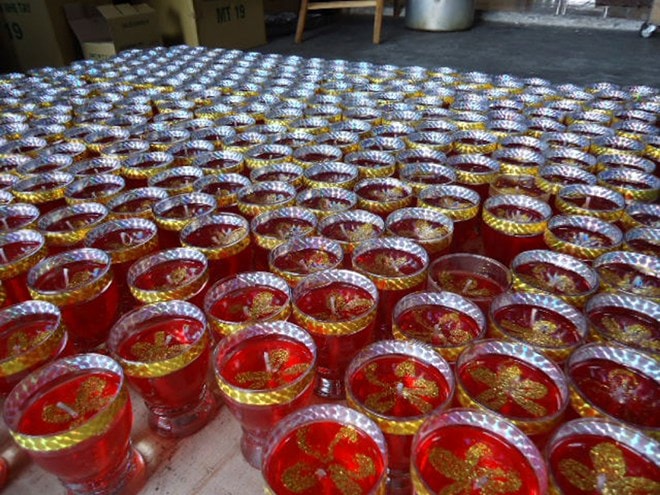 |
The stronger the fragrance, the more chemicals it contains.
These days, the market for Tet incense is quite bustling. Vendors are always introducing customers to new incenses with fragrances of roses, cinnamon, jasmine... and especially those with a long-lasting scent. There are also types of incense that leave a pure white ash after burning, curling up beautifully. Families involved in business believe that incense with a special fragrance and curled ash is considered auspicious and brings good fortune, so they particularly favor this type of incense.
However, scientists have recently warned that these incense sticks with their distinctive fragrance are sprayed with a chemical of unknown origin. This chemical, in liquid form, is stored in white plastic containers, smells like flowers, and is openly sold on Hang Hom Street (Hanoi) for 20,000 VND per liter. Incense manufacturers only need one liter of this chemical to spray on 10,000 incense sticks.
According to scientists, cheap chemical fragrances added to incense can cause shortness of breath, nausea, and dizziness when inhaled, and frequent use can lead to liver and lung poisoning. Incense with snow-white ash is actually made from limestone powder (CaCO3) mixed with sawdust. Limestone often contains heavy metals such as lead, mercury, and cadmium, which can disrupt the respiratory system, cause liver and kidney failure, and pose a serious health risk. Because incense is treated with chemicals and uses contaminated limestone, many people experience allergic reactions from inhaling the smoke, especially at temples and pagodas, often exhibiting symptoms like watery eyes and coughing. Therefore, for safety, people should choose herbal incense made from wood, roots, and leaves, which produces less smoke and has a light, natural fragrance.
Candles in cups also contain toxins.
Currently, the market offers many types of cup candles (soft, jelly-like candles in small cups) in various attractive shapes and designs. Consumers prefer these candles because they are convenient to use, don't require a base, don't melt, and don't cause burns... However, in reality, cup candles pose potential health risks.
According to an analysis by Master's student Nguyen Hong Nhung (Vietnam Academy of Science and Technology), soft, jelly-like candles contain 70-98% paraffin oil and 2-30% synthetic rubber, most commonly SEBS. SEBS molecules contain only hydrogen and carbon atoms, so burning them produces CO2 and H2O. However, similar to paraffin oil, incomplete combustion of SEBS can produce carbon monoxide (CO) and soot, which can affect the respiratory system if inhaled and cause skin and eye irritation.
Candle wicks in glass containers often use lead cores because they are inexpensive, keep the wick upright, and provide a steady, consistent flame. When the candle burns, lead is released into the air as soot. Users who inhale a lot of candle smoke are exposed to lead poisoning, leading to the accumulation of toxins in the body, causing bleeding gums, blackening of the gums, gingivitis, and even affecting the intestines, causing enteritis and digestive disorders.
Experts recommend carefully checking the wick when buying candles. It's best to buy candles with cotton wicks (without a core) or paper core wicks. The wick shouldn't be too long; it should be less than 0.6 cm. The longer the wick, the larger the flame, and the more toxic soot and smoke it produces.
According to Labor


