
Warning: Deadly poisonous seafood dishes.
Seafood is delicious and nutritious. However, some types of seafood contain toxins that can cause food poisoning and even death.
The Nha Trang Institute of Oceanography has recently researched and published a list of 39 species of marine life containing toxins capable of causing death in Vietnamese waters. Most frightening is the striped pufferfish, which contains an incredibly high concentration of toxins; just 100g of its eggs could kill 200 people.
Among the 39 species of organisms containing this toxin, there are 22 species of fish, one species of octopus, two species of snails, three species of crabs, one species of horseshoe crab, and 10 species of sea snakes. In addition, there are two newly discovered species of freshwater pufferfish in several provinces of the Mekong Delta, bringing the total to 41 species of toxic organisms.
Most of the aforementioned poisonous creatures are found in Vietnam's waters, from the Gulf of Tonkin to the Gulf of Thailand, such as pufferfish, cloudfish, sea cucumbers, and sea snakes. However, some species, such as sea snails, crabs, and blue-spotted squid, have only been found in the central and southeastern coastal regions of Vietnam.
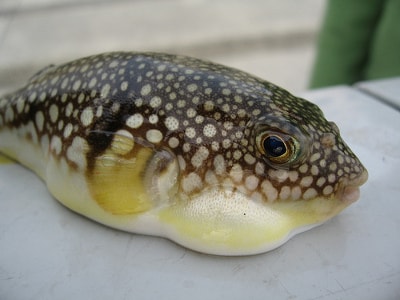 |
| Pufferfish |
Most of these species live both offshore and in coastal areas, bays, lagoons, and large estuaries… However, two freshwater pufferfish species, the green-spotted pufferfish (Chelonodon nigroviridis) and the red-eyed pufferfish (Carinotetraodon lorteti), have only been found in the Mekong Delta.
These poisonous seafood species can harm humans in two main ways: through the digestive tract via dishes made from fish and seafood, and through the animal's self-defense reaction when we accidentally touch them, are bitten, stung, or injected with venom.
Extremely poisonous seafood
Of the 41 poisonous species, five are extremely venomous: the bird-beaked pufferfish, the ash pufferfish, the striped-faced pufferfish, the orange-spotted pufferfish, and the striped-gill mouse pufferfish, with the orange-spotted pufferfish and the striped-gill mouse pufferfish being the two most venomous.
The striped pufferfish (Aronthron immaculatus) has an egg-shaped body, a black-bordered dorsal fin, and a white belly... it doesn't look particularly scary, but its eggs contain a terrifying amount of poison; 100g of eggs can kill 200 people. High levels of the poison are present from April to October.
After the striped pufferfish, the orange-spotted pufferfish (Torquigener gallimaculatus) is also very dangerous; just 100g of its eggs or liver can kill 60-70 people.
The deadly effects of seafood venom.
According to scientific research, the toxins in most of these seafood products belong to the group of neurotoxins. Therefore, when humans are exposed to these toxins, they directly affect the nervous and cardiovascular systems, causing very severe poisoning symptoms.
Most of these are dangerous toxins with a high mortality rate in a very short time, even at low doses. Specifically, the toxin found in pufferfish and many other seafoods such as blue-spotted squid, sea cucumbers, cloudfish, etc., is tetrodotoxin, which has a very strong effect on the central nervous system, paralyzing nerve centers, causing paralysis of the body, circulatory and respiratory arrest, leading to rapid death.
Symptoms of poisoning are as follows:
In cases of mild poisoning: After consuming contaminated seafood, patients experience numbness in the lips, tongue, mouth, face, fingers, hands, toes, and feet within 10 minutes to several hours. They may also experience headache, sweating, abdominal pain, nausea and vomiting, and increased salivation.
Severe cases: Patients experience extreme fatigue, muscle weakness, and progressive muscle paralysis, leading to unsteady gait. The paralysis worsens rapidly, resulting in complete paralysis, including respiratory failure, causing the patient to be unable to breathe, respiratory failure, cessation of breathing, slow pulse, low blood pressure, and coma, ultimately leading to death.
In poisonous fish and seafood, the eggs and liver are usually the two places with the highest concentration of toxins. However, in some poisonous seafood species, the flesh and skin contain even higher concentrations of toxins, such as the spotted goby.
Although the poison in this fish is present in all parts of its body, it is most concentrated in the skin; 100g of skin can kill 9-10 people.
As for the other three poisonous seafood species—the spiny crab, the blue-ringed squid, and the sea cucumber—all different parts of their bodies contain toxins. Therefore, scientists advise consumers to absolutely avoid using these poisonous seafood species in any form of cooking or with any part of their body.
In reality, most cases of severe seafood poisoning are due to consuming fish and seafood containing potent toxins. Additionally, some people are poisoned by touching or accidentally coming into contact with species such as sea snakes, stonefish, blue-ringed octopuses, cone snails, etc., and being bitten, stung, or injected with venomous stingers. The animal's toxins are released through its fangs or stingers, entering the body through the wound and causing poisoning.
According to Health and Life.


