
The first bridge reconnecting Vietnam and the United States!
Nowhere else but in the search for missing American soldiers in Vietnam do people from two opposing sides eat, sleep, and work together for a common goal, creating a bond between former enemies, shared Colonel Dao Xuan Kinh, who has been involved in this work for nearly 10 years.
Colonel Kính, former commander of the Vietnam Missing in Action (MIA) Search Agency and deputy director of the Vietnam Agency for Searching for Missing Persons (VNOSMP), said that since the 1973 Paris Agreement, Vietnam has sent teams of specialists to search for and excavate the remains of American soldiers.
Over the next 14 years, despite the lingering tensions of the war, more than 300 sets of remains were unilaterally returned to the United States by Vietnam. This humanitarian spirit of Vietnam gradually bridged the gap, bringing the two countries closer together and elevating the search for MIAs to a joint operation between the two countries' forces.
In 1988, a Vietnam-US cooperation agreement on MIAs was signed. In 1991, both sides agreed to open a US government office in Hanoi to address MIA issues. Since then, the search for US servicemen has expanded, intensified, and become highly effective, with the participation of thousands of people from both countries.
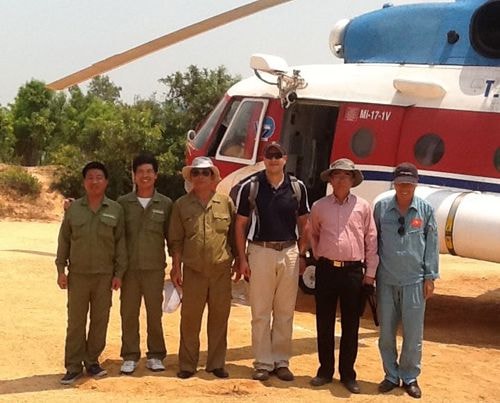 Colonel Kính (second from the right) with American and Vietnamese experts during an excavation site. Photo: Provided by the interviewee. Colonel Kính (second from the right) with American and Vietnamese experts during an excavation site. Photo: Provided by the interviewee. |
Each year, American expert teams visit Vietnam in about four waves, each consisting of several hundred people and lasting from one to two months. During that time, based on personal information and missing person coordinates provided by the US, a joint team led by Mr. Kinh will conduct on-site surveys, investigations, searches, excavations, identification of remains, and finally, return them to the US.
"Once we were on the same team, the Americans were just like the Vietnamese. I can't remember how many times we climbed mountains, crossed streams, trekked through forests, and traversed steep slopes with the American experts," Mr. Kinh recounted. "There were times we had to climb mountains for 12-15 hours to reach the summit, then set up camp to sleep overnight before surveying the site the next morning and returning."
Not only did he lead experts, but Mr. Kính also guided many high-ranking delegations from the US Congress and military to visit the site. They traveled together in the same car, chatted, ate, and rested like brothers, despite the language barrier.
Wherever Mr. Kinh and his American colleagues went, they received support and assistance from the local people because they understood the noble humanitarian significance of this activity.
The excavation was carried out entirely by hand, without the aid of any machinery. 30-40 local workers, along with Vietnamese and American specialists, dug, shoveled, and transported the soil. After decades, most of the remains had naturally decomposed. They had to painstakingly sift through every millimeter of soil under the scorching sun to find any remaining bone fragments or belongings of American soldiers.
Not only on land, they also conducted searches at sea. The combined team used Vietnamese vessels and American support equipment to locate suspicious objects underwater, then deployed divers to excavate. Because most of the missing servicemen were involved in plane crashes far offshore, recovering their remains was no easy task.
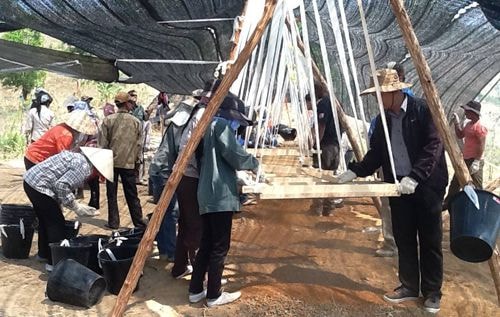 Vietnamese and American experts, along with local residents, sift through the soil searching for the remains of American soldiers in Quang Nam province. (Photo: Provided by the interviewee) Vietnamese and American experts, along with local residents, sift through the soil searching for the remains of American soldiers in Quang Nam province. (Photo: Provided by the interviewee) |
There are cases where they have to search for years before achieving results, like the one in Dong Nai. A helicopter carrying Australian soldiers fighting for the US military crashed into a deep, flooded, densely forested area. However, by the time the team arrived, the site had been transformed into a cornfield.
"Throughout the first day, we searched according to the given coordinates but found nothing. On the second day, we accidentally discovered a shinbone in an eroded ditch," Mr. Kinh recounted. "The next day, the search team found the exact dog tag with the name and identification number of the missing soldier using metal detectors. Excavating the surrounding area, we discovered a portion of his remains. The case, which had seemed to be at a standstill for many years, was quickly resolved in a matter of moments."
The invisible bridge
After 27 years of implementing the Vietnam-US cooperation agreement on MIA search, the two countries have successfully conducted 119 joint operations. On average, each year, Mr. Kinh's team excavates about 25-35 cases and investigates information on hundreds of other cases.
"The MIA cooperation program, more specifically the field trips of specialists from both countries over the years, has fostered a sense of connection between thousands of Americans and the country and people of Vietnam," Mr. Kinh shared. "Upon returning to the US, with the documents, films, and images recorded from their fieldwork, they have contributed to promoting the humanitarian spirit of Vietnam to the American people."
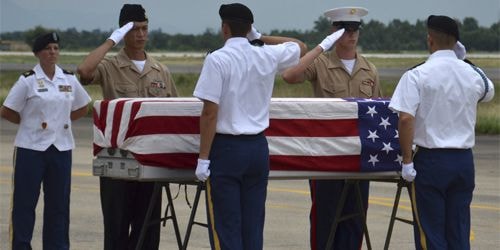 A repatriation ceremony for the remains of American soldiers took place in Da Nang in 2012. Photo: BBC A repatriation ceremony for the remains of American soldiers took place in Da Nang in 2012. Photo: BBC |
In 2012, he led then-US Ambassador David Shear on a visit to an excavation site in Son La. After many hours of climbing mountains and working together, Ambassador Shear expressed admiration for the efforts of the Vietnamese specialists and appreciated the hard work they were doing.
"Indeed, this trip has allowed me to fully understand the difficulties and complexities of searching for MIAs and to gain a deeper insight into Vietnam's humanitarian work. I am very grateful to you all," Mr. Kinh recounted the ambassador's words.
The recognition from comrades and relatives of missing soldiers has always been a great source of motivation for Mr. Kinh and his colleagues to continue their search efforts. After each trip, he receives thank-you letters from American families whose loved ones have been missing in Vietnam for decades.
"I vividly remember a woman who wrote to me saying that her father, who is 85 years old this year, seemed to become young again when he heard the news that his son's remains had been found," Mr. Kinh recounted.
Some people even traveled all the way to Vietnam to retrieve the remains of their loved ones and embraced Mr. Kinh, weeping with emotion. Thanks to unsung heroes like him and his colleagues at the MIA agency, the pain and resentment that had lasted for decades within them were finally resolved.
After 44 years of military service and nearly 10 years as a commander in the MIA (Missing in Action) unit, Mr. Kinh retired with many lingering concerns about unsolved cases. However, he is proud that the search for missing soldiers in Vietnam has always been considered by the US to be the most active and exemplary.
Since 1973, Vietnam has returned more than 950 sets of remains to the United States. The US has examined, identified, and confirmed the identities of over 700 cases. Currently, more than 1,200 American soldiers remain missing in Vietnam. The US is also conducting MIA searches in many areas where it fought battles, but none have yielded results as successful as in Vietnam.
"The role of MIA search operations in normalizing relations between the two countries is undeniable. This is both a bridge and the glue that binds Vietnam and the United States together," Mr. Kinh said.
"There are few relationships in the world quite like the one between Vietnam and the United States. From former enemies to friends, and then to comprehensive partners. I believe that the future of bilateral cooperation remains very bright in many areas, including the MIA issue," he added. "The work of finding MIAs has developed, and I hope that the Vietnam-US relationship will develop in the same way."
(According to VNEpress)
| RELATED NEWS |
|---|


