
Alisma plantago-aquatica cools the liver and treats anemia.
Alisma plantago, also known as water plantain or water chives, has the scientific name Alisma plantago Aqualica L. and belongs to the Alismatalaceae family.
It is an aquatic plant, often growing in clumps in rice fields, shallow ponds and lakes, canals, stream banks, and low-lying areas with year-round water. In many places, people often use this plant as a vegetable (the stems and leaves are washed, blanched, and then stir-fried or used in soups).
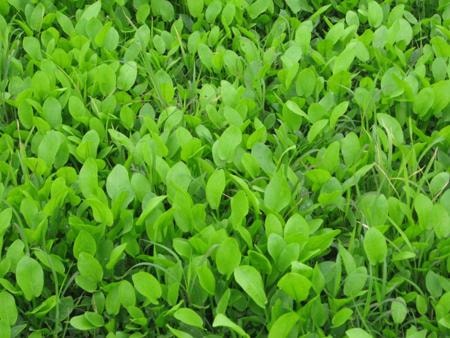
The stem and roots are submerged in mud, the leaves are soft and oval-shaped, growing in clusters at the base. The hermaphrodite flowers grow on long stalks, white, pale purple, or off-white in color. The fruit is spherical. The parts used for medicine are the leaves and rhizomes (commonly called tubers), with the roots removed, washed clean, and then dried.
The dried or sun-dried rhizomes of Alisma Plantago-aquatica L. var. orientalis Samuels, used as medicine, were first recorded in the "Classic of Materia Medica". The best quality rhizomes are large, round, firm, white or slightly yellow, slightly porous; and free from rot, mold, and insect infestation.
 |
According to Traditional Chinese Medicine, Alisma plantago-aquatica has a sweet taste, a cold nature, and is toxic. It helps to promote diuresis, treat edema, gonorrhea, dysentery, diarrhea, etc., and acts on the kidney and bladder meridians. It has the effects of clearing heat, reducing inflammation, promoting diuresis, and expectorant, used to treat diseases such as kidney-related edema, cough due to sore throat, and helps to cool the liver and promote urination. The daily dose is 8-16g.
Here are some folk remedies.
* Treating dizziness and lightheadedness caused by anemia:Alisma orientalis 12g, Rehmannia glutinosa 15g; Gentiana scabra, Gardenia jasminoides, Scutellaria baicalensis, Bupleurum chinense, Paeonia lactiflora, Anemarrhena asphodeloides, Chrysanthemum indicum, 10g each. Decoction to be taken daily, one dose per day. Alternatively, Alisma orientalis 15g, Atractylodes macrocephala 6g, Chrysanthemum indicum 12g. Decoction with 3 bowls of water until 1 bowl remains. Drink throughout the day. Use for 7-10 days.
* Treating coughs caused by sore throats:30g of Alisma plantago leaves, 30g of lemon balm leaves, 5g of fresh ginger. Boil in about 300ml of water until only 50ml remains. Drink throughout the day, preferably while the decoction is still warm. Continue for 5 days.
* Cooling the liver:Alisma orientalis, Poria cocos, Paeonia lactiflora, Cornus officinalis, 10g each; Rehmannia glutinosa and Dioscorea opposita, 12g each. All ingredients are roasted until golden brown, then ground into a powder and made into pills the size of green beans. Take 8-10 pills daily for 10 days.
* Used as a diuretic to relieve urinary tract infections, treat edema, urinary tract infections, and nephritis. Choose one of the following prescriptions:
- 10g Alisma orientalis, 10g Plantago major, 10g Polyporus umbellatus, 10g Lithospermum erythrorhizon, 6g Akebia quinata, 15g Imperata cylindrica, decocted in water and drunk.
- Alisma orientalis, Poria cocos, Polyporus umbellatus, and Plantago major, 12g each, decocted in water and drunk. Treats acute glomerulonephritis.
- Alisma orientalis and Atractylodes macrocephala, 10g each, Chrysanthemum indicum 12g, decocted and drunk to treat chronic nephritis and dizziness.
* Treat diarrhea caused by acute and chronic enteritis. Choose one of the following options:
- 10g Atractylodes macrocephala, 10g Poria cocos, 6g Citrus peel, 3g Glycyrrhiza glabra, 10g Alisma orientalis, 3g Amomum villosum, 10g Fermented wheat, 10g Malt extract, decoct and drink, adjust dosage according to symptoms.
- Alisma orientalis, Polyporus umbellatus, and Poria cocos, 10g each; Pulsatilla chinensis 15g; Plantago major 6g, decocted and drunk to treat acute enteritis.
* Supports the treatment of edema caused by kidney disease:30g of Alisma plantago leaves, 100g of reed stems, 100g of corn silk. Boil with 700ml of water until 150ml remains. Divide into two doses and drink after lunch and dinner. Use for 10 days. Alternatively, use 10g each of Alisma plantago, Poria cocos, Polyporus umbellatus, and Plantago seeds. Boil and drink one dose per day.
* Reduce fever caused by heatstroke:20g of Alisma plantago-aquatica leaves, 25g of Cynodon dactylon grass, 30g of bamboo leaves. Boil these herbs with 3 bowls of water until only 1 bowl remains. Drink the decoction while it is still warm. Use for 2 days.
* Treatment of high blood lipid levels:The author used processed Alisma orientalis tablets (each tablet containing 3g of raw herb), 9 tablets per day divided into 3 doses, for a 1-month course. The results showed that in 110 cases of hyperlipidemia, 44 cases had average cholesterol levels reduced from 258.4mg% to 235.2mg%; 103 cases had triglyceride levels reduced from an average of 337.1mg% to 258.0mg%, an average decrease of 23.5mg%. Of these, 65% experienced a reduction of over 10%, 40.8% a reduction of over 30%, and 18.4% a reduction of over 50% (Report from Zhongshan Hospital of Shanghai No. 1 Medical Institute, Chinese Medical Journal 1976, 11:693).
* Treating dizziness/vertigo:Author Duong Phuc Thanh used a decoction of Alisma orientalis (Zhi Xie Tang) consisting of 30-60g of Alisma orientalis and 10-15g of Atractylodes macrocephala, one decoction per day divided into two doses. In a study of 55 cases, with 1-9 doses administered, the results showed that all patients recovered (Hubei Journal of Traditional Chinese Medicine 1988, 6:14).
Contraindications: Not suitable for those with kidney and liver deficiency without damp heat.
According to Dr. Hoang Xuan Dai - Agriculture


