
Chau Quang: Red mud... attack!
(Baonghean) - Following complaints from many households in Quy Hop about the negative impact of red mud on agricultural production, we visited the Ca hamlet fields in Chau Quang commune. The reality is that, as the residents reported, the water source used for agricultural production in the area is severely polluted.
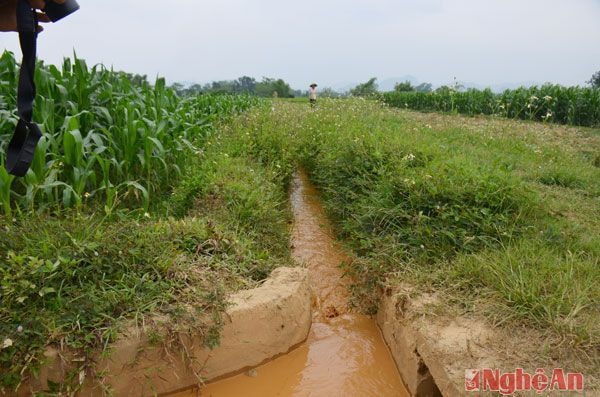 |
| Previously, this irrigation canal system had crystal-clear water, providing year-round irrigation for approximately 12 hectares of rice paddies in Ca hamlet, but now it has been transformed into a stream of red mud. |
In the sweltering April sun, many women were working in the fields, using hoes and buckets to remove the red mud from the irrigation canals that brought water to the rice paddies. From a distance, the spring rice fields of Ca hamlet didn't look as lush as other fields in Chau Quang commune; in fact, many plots had to be left fallow. Some plots were planted, but the rice plants withered despite being in the heading stage. The fields were covered in a thick, reddish mud.
Ms. Vi Thi Phuong reached out and brushed away the thick mud surrounding the rice plants, sighing in frustration: "Previously, the rice fields in Ca hamlet were irrigated by the Doi stream, but for the past few years, the water source has been covered in red mud. The rice cannot grow, even though the lives of the villagers depend entirely on agriculture." Seeing the reporter's presence, many others also came to "complain." Ms. Hoang Thi Hong said that for many years, her family had not had the opportunity to harvest rice from this field. Every rice crop died. Out of desperation, this spring she decided to switch to growing peanuts. However, looking at her two plots of peanuts, it is highly likely that she will have a crop failure. "This land was originally only suitable for rice. In previous years, because we had to use polluted red mud water to irrigate the rice, the soil quality changed, and even grass struggled to grow, let alone peanuts," Ms. Hong said with a sigh.
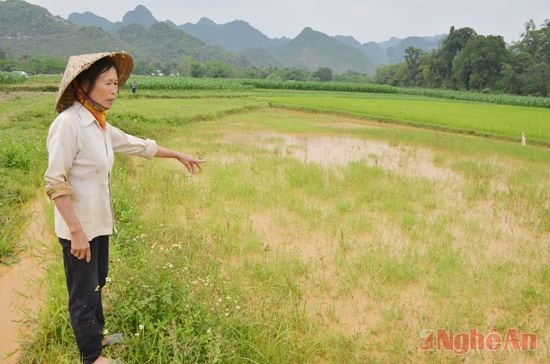 |
| Ms. Nguyen Thi Tuyen stands beside her abandoned rice field, left fallow due to water pollution. |
Following the red mud flowing from the irrigation canals in the fields, we headed upstream. The Doi stream originates from the mountainous area of Tho Hop and Lien Hop communes. The once clear blue water is now just a thick, red muddy creek. From upstream, the red mud flows down the mountain, through residential areas and some mineral mining and processing facilities, before emptying into the fields. Ms. Nguyen Thi Tuyen, originally from the flood-prone area of Hung Nhan, Hung Nguyen district, who has settled in Chau Quang for almost half her life, commented: "In other areas, the mud contains silt, making plants thrive, but the red mud here is 'dead mud'."
The root cause of this situation is illegal mining and ore washing upstream. This phenomenon has been occurring for many years, but the authorities have failed to intervene despite repeated complaints from the public. Voters have also raised this issue with National Assembly and People's Council representatives at all levels during meetings. However, to date, the situation remains unresolved and is even getting worse.
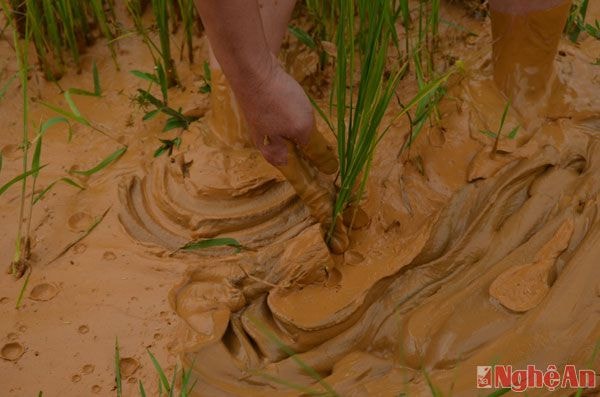 |
| A layer of mud, about half a handspan thick, clung to the rice fields like a red glue. |
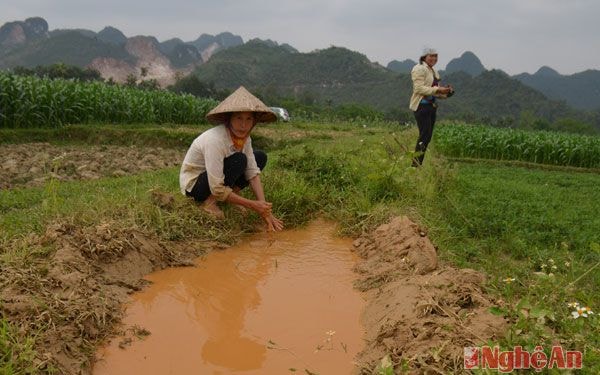 |
| In the fields of Ca village, the villagers have to create pits to allow the red mud to settle. |
In a conversation with us, Mr. Nguyen Ngoc Luyen, Chairman of the Chau Quang Commune People's Committee, acknowledged the aforementioned situation. He also confirmed that this red mud is harmful to rice and other crops. After two days of being introduced into the fields, the mud dries and adheres tightly to the roots, preventing the plants from absorbing nutrients, leading to stunted growth and death. Regarding the extent of the harm caused by the red mud-contaminated water to the daily lives of the people, we cannot yet confirm it because no relevant agency has identified the specific chemicals in the red mud.
Faced with this situation, the commune had to encourage residents to convert three rice fields to other crops due to a lack of water for production. Currently, in addition to being "attacked" by red mud, people in Chau Quang commune are also facing difficulties because their drinking water sources are depleted due to businesses and mining groups using too many underground wells for mineral extraction. "This problem cannot be solved by Chau Quang commune alone; it requires the involvement of all levels and relevant agencies and departments," suggested Mr. Nguyen Ngoc Luyen, Chairman of the People's Committee.
Linh - Nhi
| RELATED NEWS |
|---|


