
Paddling a boat upstream on the Lam River for hundreds of kilometers to establish a village.
(Baonghean.vn) - After a week of tirelessly rowing hundreds of kilometers upstream to establish a village, the fishing community has transformed their lives.
This is the story from 25 years ago of a group of people living right at the confluence of the rivers, where the Nam Non and Nam Mo rivers meet to form the Lam River of Nghe An province.
From National Highway 7, where the Nam Non and Nam Mo rivers meet, we crossed the river via a suspension bridge leading to Van Temple. From there, after a muddy stretch and continuing along a range of low hills, following the Nam Non river with its dense bushes, we reached the fishing village.
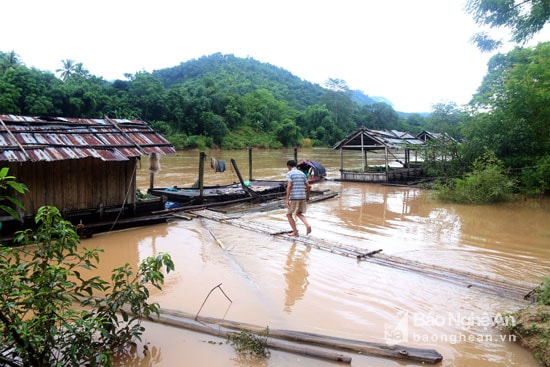 |
| A small fishing village at the confluence of the Nam Mo and Nam Non rivers. Photo: Dao Tho |
The hamlet was eerily quiet. Only three houses remained inhabited. A man in his 50s sat mending fishing nets, a headlamp still attached to his head. Even in broad daylight, he needed the extra light from the lamp to weave the fine mesh. This was Mr. Nguyen Viet Ha. Through conversation, we learned that he was one of the first residents of this small riverside hamlet. They all originated from Hamlet 1, Lang Son Commune (Anh Son District).
Pouring a cup of fresh tea for his guest, Mr. Ha reminisced about his early days settling in the mountainous region. He clearly remembered that in 1992, a woman from his village, married to a man from Cua Rao hamlet, Xa Luong commune (Tuong Duong district), returned to visit her hometown. Through her story, everyone learned about the land, bordered by mountains and hills on one side and rivers on the other, teeming with fish and shrimp. The story suggested a "promised land" for those familiar with fishing, especially since the stretch of the Lam River passing through Lang Son commune had become depleted of fish and shrimp. Initially, only one or two families from his extended family came to survey the area, and later settled there permanently. After a few years, six families moved in, forming a fishing village at the confluence of three rivers. Today, the community comprises 11 households with over 30 inhabitants.
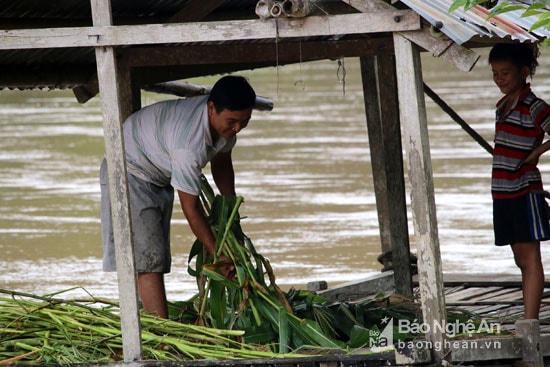 |
| Life in this fishing village still mainly depends on raising fish in cages. Photo: Huu Vi |
“It took us a whole week of rowing to get there,” Mr. Ha recalled the days of traveling upstream on the Lam River to establish the village. At that time, his wife was pregnant with their first child. It was the longest journey of their lives as a family who made their living from fishing. Upon arriving, Mr. Ha realized the land was not as easy to live in as he had imagined. The new village of the fishermen was quite isolated from the outside world. Three sides were surrounded by mountains and hills overgrown with reeds. “They’ll have to leave eventually, at best they’ll only stay for three months. How can they possibly survive malaria?” – the local residents said at the time with a mixture of disdain and concern.
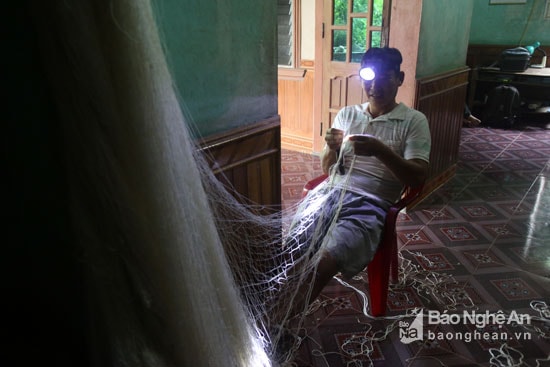 |
| In his free time, Mr. Nguyen Viet Ha sits and weaves fishing nets, both for personal use and to sell to earn extra income. Photo: Dao Tho |
Then the worries of the local residents came true. One by one, they fell ill with malaria. "Fortunately, they all recovered afterwards," Mr. Ha recalled. It took two whole years for those who had traveled hundreds of kilometers by river to establish a village in the mountains to escape living on boats. Although they had to transport building materials by river, gradually everyone was able to build houses to live in.
“Despite the remoteness, once we overcame the initial difficulties, life here was easier than back in our hometown,” Mr. Ha continued. Back then, the stretch of river where the Nam Non and Nam Mo rivers converged was teeming with fish and shrimp. Each day, a person could catch hundreds of kilograms of fish. Species like catfish and carp were incredibly abundant. Life flowed smoothly, and the fishing village gradually escaped hardship.
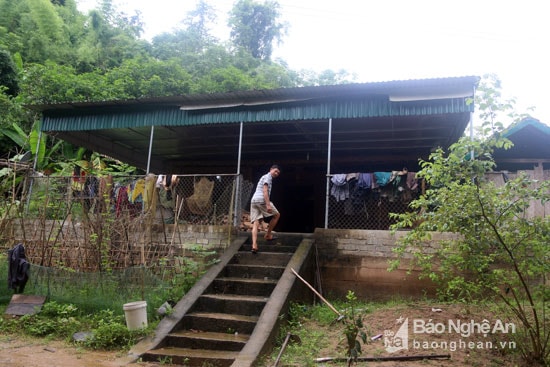 |
| Currently, most households in the fishing village have sturdy houses behind the Van Temple. Photo: Huu Vi |
Mr. Phan Van Thiet, whose family traveled over 100 km by boat to settle here from the early days, sadly recalled: His family, carrying their belongings and a young child, traveled day and night in their small boat, finally reaching this land. A few years ago, before there was a bridge across the river, a relative of his contracted chickenpox, and Mr. Vo Van Vinh and Ms. Nguyen Thi He (Mr. Ha's wife) rowed across to get medicine from Hoa Binh. Unfortunately, just as they crossed the river, the hydroelectric dam released water, and they encountered strong winds, causing the boat to capsize, and Mr. Vinh's wife was swept away by the water. It was incredibly heartbreaking.
Now that life has improved, that small fishing village has blended into the rhythm of life with the local people at the confluence of the rivers, near the sacred Van - Cua Rao temple.
Dao Tho - Huu Vi
| RELATED NEWS |
|---|


