
Starvation in Syria: A war crime.
Famine is the latest and most brutal weapon the Syrian government is using to punish people in opposition-held areas. Children with swollen heads, mothers with depleted milk, and walking skeletons are what doctors and humanitarian workers witness in the suburbs of Damascus.
(Baonghean)Famine is the latest and most brutal weapon the Syrian government is using to punish people in opposition-held areas. Children with swollen heads, mothers with depleted milk, and walking skeletons are what doctors and humanitarian workers witness in the suburbs of Damascus.
One of the first deaths from starvation was that of one-year-old Farah Atout, brought to the Maliha Medical Center in a state of severe emaciation, moaning as doctors struggled to find a vein to administer intravenous nutrition. Dr. Mazin Ramadan, who treated Atout last November, said, "I remember the child very clearly, about one year old and weighing only 4 kg." Her family had left their village, fleeing with only a few clothes and virtually no food. "They came, placed the child in our arms with the fervent hope that with just a few doses of medicine, she would recover." After 48 hours, she was nothing but a skeleton, wrapped in bandages and a frame, revealing only her pale, trembling face. But this once horrific and striking scene has now become all too familiar, a recurring event in the Damascus suburbs.
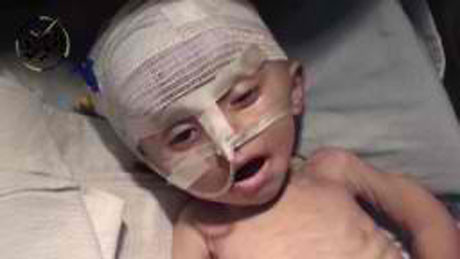 |
| A malnourished child at the Yarmouk refugee camp. |
An unnamed nurse, fearing retaliation, at the Yarmouk Palestinian refugee camp said that about four adults are injured each day. These civilians, simply trying to find food in the fields near Damascus, are targeted by snipers and some are even killed. Established in 1957, the Yarmouk camp has been an unofficial refuge for thousands of Palestinians for decades – victims of the Israeli-Islamic War.
At the National Hospital in South Damascus, near Yarmouk, 43 people die of starvation every day, including 22 children. The youngest was only 23 days old. Most deaths have occurred within the last month, and the number continues to rise rapidly, according to a medical worker. "Sometimes it's just malnutrition or lack of medicine, but we are completely desperate because we can't do anything for the children. We've reached a point where it's normal for a child to die every two or three days," said a doctor, speaking anonymously for fear of retaliation from the authorities. Parents are also distraught and desperate about their children's condition. "A few days ago I had a two-year-old patient in critical condition. When informed, the father calmly said without hesitation, 'Okay, I'll take him home, what else can I do? There's no food and no medicine.'"
Greg Barrow, spokesperson for the United Nations World Food Programme, said, "The first 1,000 days of life are incredibly crucial for a person's development. If a child is in the womb and the mother is not receiving enough nutrition, the child will not develop properly, and this deficiency is irreparable."
A widely circulated YouTube video shows a 10-year-old boy, Bashar Kaboush, with a skeletal body, in the eastern town of Ghouta. A man claiming to be a relative of the boy shouts in the video, "Will God accept this? Look at this child. Will the world accept this? Is this even a human body? Are these even human arms? He's only 10 years old."
The famine was caused by the government's blockade of the food supply belt for the opposition-controlled area. The rebel-held territory was now left with only war-ravaged fields and meager food reserves insufficient for the thousands of people besieged by government tanks. Many believed this was a punitive measure by the government against the opposition.
The intense fighting makes it difficult to estimate the current situation, but the figure being given is 800,000 civilians under blockade. Amnesty International stated, "The Syrian government is brutally punishing civilians in rebel-held areas. This is a war crime, and the blockade must be lifted immediately. Humanitarian aid must not be exploited for political or military purposes."
The Geneva II peace talks are likely to lead to some agreements on humanitarian aid, but will that be enough to improve the situation in Syria, where innocent people are dying while humanitarian aid is available throughout the country? War is bloodshed and gunfire, but it is also a war that tramples on humanity and compassion. This is a question that the Syrian authorities must answer, especially when those who die are merely victims of the war.
Reishi Mushroom


