
"Drowning on dry land!"
(Baonghean) - In recent days, the world has been astonished by the deceptive tactics of Chinese media in distorting the truth. China deployed an oil rig into Vietnam's exclusive economic zone, mobilized over 80 ships and aircraft for "protection," and proactively provoked conflict, using water cannons, water guns, and ramming Vietnamese vessels... yet still held a press conference to "denounce" Vietnam, claiming that Vietnam had "attacked" and obstructed the Chinese oil rig, and even demanding to "teach Vietnam a lesson"...
The world is surprised and astonished because this is no longer ancient times where old-fashioned schemes from "Chinese books" could be easily used to manipulate 21st-century citizens like donkeys. Chinese media, despite its cunning and deviousness, seems absurd in forgetting that we now live in a "flat world," where everyone can access information from the source anytime, anywhere, and it's easy to find and verify the truth with just a few clicks. Therefore, despite mobilizing the "world's largest deceptive media machine" to work tirelessly, upon realizing that their actions were only causing more harm than good, on May 11th, China's Xinhua News Agency issued a ridiculous statement: "Vietnam is using the HD 981 oil rig incident to tarnish China's image." This is nothing short of "robbing while shouting for help."
If there were legal grounds for the "nine-dash line," why would China be afraid and prevent the Philippines from suing in the International Court of Justice? Despite being a major power, China avoided participating in the lawsuit, forcing the Philippines to file unilaterally. If there were historical evidence, why is there no basis in the hundreds of ancient Chinese historical records and thousands of archives that prove the Paracel and Spratly Islands belong to China? Meanwhile, all Vietnamese historical documents and maps clearly acknowledge and provide detailed information on Vietnam's sovereignty. If China truly has sovereignty over the South China Sea according to the 1982 United Nations Convention on the Law of the Sea (which China is also a signatory to), why does China always try to oppose ASEAN bringing the South China Sea issue up for discussion at multilateral conferences, instead always "forcing" ASEAN to limit discussions to unilateral and bilateral meetings?... These questions, in themselves, create a natural logical understanding so that anyone can find the answers readily available.
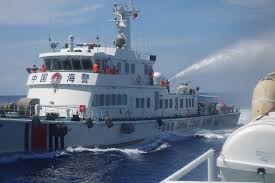 |
| The photo has led Chinese citizens to distrust the explanation given by the Chinese Foreign Ministry. |
Why would China deploy over 80 vessels of various types, including warships, missile frigates, and fighter jets, to monitor the situation when it placed an oil rig "in its sovereign territory"? Given the images and videos showing Vietnamese fisheries patrol and coast guard vessels being aggressively and recklessly attacked by Chinese ships while enforcing the law, which have been widely shared by the press and social media, why can't China offer any justification?
China's attempts to provoke and provoke, aiming to trap Vietnam with the slightest mistake so that it could launch a full-scale attack, transforming itself from an aggressor into a "hero" counterattacking and "opposing war," mobilizing vast armies to seize control of the entire South China Sea, have been seen through by the Vietnamese. They have advised each other to remain calm and composed, causing China to show signs of being cornered.
Unlike previous occasions, this time Vietnam took steps to escalate the struggle with a resolute attitude and a peaceful, benevolent approach. Relevant organizations and trade unions simultaneously expressed their stance, and a large number of Vietnamese people both domestically and abroad took to the streets to protest China's illegal actions. Not only did the Ministry of Foreign Affairs spokesperson voice their opposition, but Deputy Prime Minister and Minister of Foreign Affairs Pham Binh Minh also telephoned China, demanding respect for Vietnam's sovereignty and international law. Following this, at the ASEAN Summit on May 11th, Prime Minister Nguyen Tan Dung delivered a speech directly addressing China's dangerous actions in the South China Sea, creating a significant impact on international newspapers and websites. And after decades of "silence," the ASEAN community for the first time issued a joint statement on the tense situation in the South China Sea, a truly powerful "aftershock" that strongly influenced the international community.
On the information front, China is clearly in a "dilemma," while on the ground, for the first time, Vietnamese law enforcement forces have taken retaliatory action. At this time, Vietnamese journalists are also present alongside law enforcement on the ship to provide accurate and direct updates on China's aggressive behavior to domestic and international audiences. Certainly, China will have to reconsider its actions, because with the overwhelming power of the internet, every move cannot be concealed.
In an era where any ordinary citizen of the world can objectively and accurately search, verify, and investigate information, it is difficult for malicious actors to completely silence dissent. Indeed, the "flat world" has created vulnerabilities that even China, a superpower in information technology and hacking, is powerless to prevent, leaving it to "drown on dry land."
Chi Linh Son


