
The Thổ people's zither
(Baonghean) - The Tho ethnic group has a very rich spiritual life with folk songs, folk music, and folk dances that are distinctly their own; since ancient times, from bamboo and reeds, they have created the Tinh lute. And then the sound of the lute became an indispensable part of their joyful celebrations...
It is unknown when and who invented the đàn tính (a type of stringed instrument). According to elders, the đàn tính of
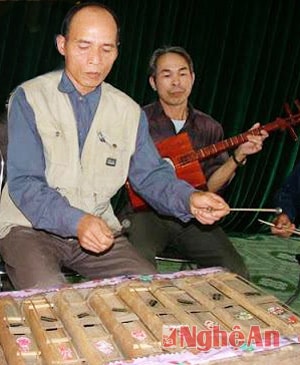 |
| Artist Truong Song Huong with his traditional Tinh lute ensemble. |
Once the bamboo tube is selected, the crafting process begins. The bamboo tube is meticulously trimmed at both ends to ensure a smooth surface, the inner core is scraped away, leaving only the outer layer. Then, a portion of the bottom is cut lengthwise, usually about one-third, to create the base of the instrument. When creating the base, care must always be taken to ensure the bamboo nodes are staggered on either side, preventing the strings from "falling" onto the nodes and breaking easily.
After completing the above steps, a crucial part requiring the skill of the zither maker comes: making the strings. Many mistakenly believe the strings are made from the same bamboo stalk used for the zither body. In reality, this is not the case. The strings are made from the same bamboo tube that forms the zither body. The zither maker meticulously carves away at the body, leaving only the strings. If making wind instruments and reeds is the most difficult task, then making the strings for the zither is equally challenging. A very sharp knife must be chosen and sharpened to a perfect point; combined with keen eyesight and skillful hands, only then can the strings be made to the desired quality. If the string is too thick, the sound will be dull and muffled; if it's too thin, it won't be durable and the sound will be inaccurate. A slight mistake in the string-making process—a tiny misstep with the knife—can break the string, rendering all the hard work wasted!
While traveling around to learn about the Tinh lute, hoping to share my findings with everyone, I met Mr. Truong Thanh Hai, a member of the Tho ethnic group who has dedicated many years to collecting and researching the cultural identity of his ancestors. He explained that the Tinh lute has three strings, and the strings are tuned using "chicken keys." These keys are made of bamboo, one end thick and the other thin. When tuning, the player adjusts the "chicken keys" according to the sound of each string to make the string tighter or looser. Players often use "plectrums" made from the scales of pangolins to pluck the strings.
Over time, the đàn tính (a type of stringed instrument) has gradually evolved into new shapes. Mr. Hai still possesses an instrument that, according to him, is a modern version. This is one of two đàn tính made by Mr. Truong Van Tho in Mo village, Nghia Xuan commune (Quy Hop district), to leave to his descendants before his death (1997). Along with artisans like Mr. Tuan in La village (Minh Hop district), Mr. Tra in Dot Tan (Nghia Xuan district)... Mr. Tho was renowned for his skill in playing and singing đàn tính and for making the most beautiful đàn tính in the region in the past. At first glance, this đàn tính resembles the đàn tính of the Tay ethnic group in Cao Bang province. The difference is that the body is not round but rectangular with a square hole at the bottom; the neck is approximately 1.2 meters long; and it has three strings made of silk.
Building upon the traditional đàn tính (a type of stringed instrument), artisan Trương Sông Hương in Thọ Hợp commune (Quỳ Hợp district) has created a new instrument by combining eight individual đàn tính instruments to resemble the T' Rưng from the Central Highlands. Instead of using plectrums to play the strings, a mallet is used to strike the strings. Thanks to the blending of the individual tones of the instruments, this innovative đàn tính has a very distinctive sound, unlike any other instrument!
Unlike horns and some other traditional instruments of the Tho ethnic group, which can produce sounds for joyful occasions, ceremonies, and even funerals, the Tinh lute is only used for joyous events such as Tet (Vietnamese New Year), weddings, and village festivals. The sound of the Tinh lute makes the folk songs of the Tho ethnic group, such as "Da Oi," "Tap Tinh Tap Tang," and "Du Du Dien Dien," even more captivating during festive occasions. That's why, in the past, before electronic and modern musical instruments reached the villagers, the Tinh lute was indispensable in celebrations.
Like many other traditional musical instruments of ethnic minority communities, the Tinh lute is currently in danger of becoming less well-known. According to our survey, very few people know how to make or play the Tinh lute; in the entire Nghia Xuan and Minh Hop areas, no one knows how to make this instrument. In the Tam Hop and Tho Hop areas, only artisan Truong Song Huong knows how to make and play it...
Having become an integral part of the cultural identity of the Tho ethnic community, many elders still fondly remember the sound of the Tinh lute and the lively village festivals. In the old days, the Tinh lute and its sound, imbued with the love of the land and its people, brought together many talented young men and beautiful young women, leading to their marriages... To preserve the Tinh lute and ensure its sound continues to resonate, the collective efforts of the entire community are undoubtedly needed!
Cao Duy Thai


