
This aircraft transformed Israel into an air powerhouse.
The Mirage V attack aircraft served as the foundation for Israel's development of today's world-leading military aviation industry.
Israel's first Mirage V squadron.
Fifty years ago, on May 19, 1967, the Mirage V attack aircraft made its maiden flight from Melun-Villaroche airfield in France. This event not only marked the birth of what is now the French military aviation industry but is also considered the founding day of the Israeli aircraft industry, according to War Is Boring.
The Mirage V was the result of a collaboration between France and Israel in the 1950s and 1960s. At that time, the Israel Defense Forces/Air Force (IDF/AF) were looking for a modern variable-geometry fighter jet similar to the American F-86 Saber, but their purchase proposal was rejected by Washington.
Israel was forced to turn to the French-made MD.450 Ouragan and MD.452 Mystère fighter jets. Their outstanding combat performance in the 1956 Suez War sparked an arms race in the Middle East.
In early 1959, the IDF/AF took notice of the Mirage project, a delta-wing interceptor capable of reaching speeds twice the speed of sound. Israel ordered 24 Mirage IIICJs in May 1960. They were equipped with the Cyrano I bis radar to support the Matra R.530 air-to-air missiles, the first radar-guided weapons in the Middle East.
Deliveries of the Mirage IIICJ to Israel began in April 1962, at which point the order had grown to 76 aircraft. However, the operation of the Mirage IIICJ in the Israeli Air Force was far from smooth.
The SNECMA Atar 09B engine was unstable and caused a series of accidents. The radar also had many problems, including the inability to synchronize with the two 30 mm cannons. The R.530 missile proved difficult for pilots to operate, requiring thousands of technical modifications to make the Mirage IIICJ effective in combat.
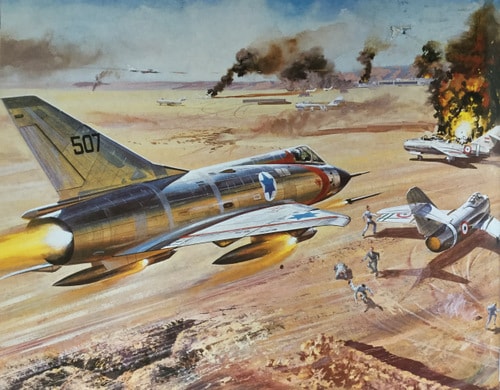 |
Mirage aircraft played a crucial role in the Six-Day War. Photo: Pinterest. |
Therefore, Israel decided to cooperate with France for development.Mirage V(later renamed Mirage 5),The Mirage variant is simpler, cheaper, easier to maintain, and easier to operate.This attack aircraft is capable of reaching speeds of 2,500 km/h and features a minimalist electronic system. The fuselage is longer than the Mirage IIICJ version, increasing fuel capacity and the number of weapon hardpoints.
The Mirage V proved effective during the Six-Day War in June 1967. Israeli bombers destroyed most of the aircraft of neighboring Arab air forces before they could take off, paving the way for Israeli infantry to win on the battlefield.
However, after the Six-Day War, French President Charles de Gaulle imposed two arms embargoes on Israel, including a comprehensive ban. The delivery of 50 Mirage V aircraft manufactured for the IDF/AF was completely canceled.
In early 1968, Dassault secretly signed a contract, codenamed "JC3," with Rockwell International to manufacture the Mirage V aircraft in Israel as a way to circumvent the embargo. Rockwell International focused on manufacturing automotive components, but they decided to acquire the renowned North America aircraft manufacturing corporation, and then sought to expand overseas.
The agreement between Rockwell and Dassault required the delivery of 50 aircraft in disassembled parts for assembly, with many parts manufactured by Dassault's subcontractors such as Aerospatiale and Reims-Cessna. Dassault only produced the front fuselage for 10 two-seat Mirage V aircraft in the early 1970s.
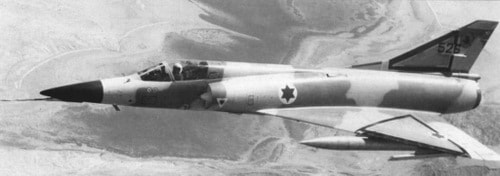 |
Mirage V attack aircraft in service with the Israeli Air Force. Photo: War is Boring. |
The result of these efforts was the creation of Israel Aircraft Industries (IAI) in 1968. Thanks to a secret contract with Dassault, just three years later, IAI produced the first of 51 Mirage V attack aircraft, all assembled from parts manufactured in France, as confirmed by the markings on the fuselage. However, IAI still maintained that its Mirage V fleet, nicknamed Nesher, was "developed and manufactured in Israel".
From this foundation, IAI gradually rose to become one of the major forces in the world's military aviation industry, helping Israel become a regional air power. The Israeli Air Force currently possesses 684 military aircraft of various types, including modern American F-15 and F-16 fighters, along with the advanced F-35 stealth fighters in the future.
According to VNE
| RELATED NEWS |
|---|


