
Iran's Underground Missile City Strategy: Deterrence Capabilities and Technological Challenges
Explore Iran's network of missile bases located 100 meters underground, their role in asymmetrical military doctrine, and their survivability against airstrikes.
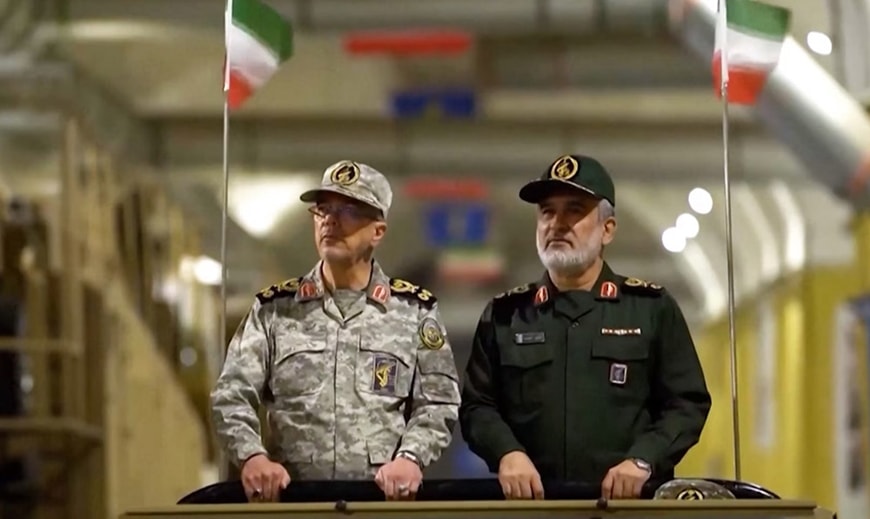
Amid escalating regional tensions, Iran's public display of its "underground missile cities" is not merely a military move but also a strategic message aimed at asserting its deterrence capabilities. This system of bases is designed to provide maximum protection for attacking forces against preemptive strikes from adversaries.
Underground defense structure
This network of underground bases belongs to the Aerospace Force of the Islamic Revolutionary Guard Corps (IRGC), distributed throughout Iranian territory. The facilities are typically built 50 to 100 meters deep beneath hard rock formations, incorporating reinforced concrete structures to ensure maximum survivability. The complex tunnel system is used not only for storage but also allows for the transport and deployment of missiles within minutes through cleverly camouflaged entrances and exits.
To counter modern reconnaissance technology, Iran has established a network of entry and exit points, including both real and fake ones. According to CNN, Iran possesses at least 27 underground bases with 107 exits. Although airstrikes could target these key points, Iran's professional engineering teams have demonstrated the ability to restore the infrastructure within days using specialized technical equipment.
Asymmetrical arsenal and military doctrine
This underground base system houses a diverse range of Iran's strategic missiles. The weapons arsenal includes short- and medium-range ballistic missiles such as the Kheybar Shekan, Qadr-H, Emad, and Sejjil, along with anti-ship cruise missiles. This forms the basis for Tehran's ability to maintain military pressure in strategically important areas such as the Persian Gulf.
Iran's asymmetric military doctrine focuses on avoiding direct competition in air technology with the US or Israel. Instead, it prioritizes building a highly survivable missile force. In actual conflict, Iran typically scales its attacks in phases to prolong its resistance, while reserving its most powerful missiles for decisive scenarios.
Limitations of modern reconnaissance technology
Despite offering significant defensive advantages, the "missile supercity" model still exhibits certain weaknesses. Concentrating weapons at fixed bases creates traces of ground infrastructure such as road and logistics systems that satellites can detect. Precision enemy attacks often don't aim to destroy entire underground bunkers but rather focus on disrupting transport routes or launch platforms as they move out.
Publicly displaying images of these bases is considered a "double-edged sword." On the one hand, it reinforces the image of a nation capable of strong retaliation; on the other hand, it provides valuable data for adversaries to analyze and develop neutralization strategies. The effectiveness of this model is facing a major challenge as precision attack technologies continue to develop.


