
The government will propose amendments to the Land Law, adding only what is already mature and clear.
When amending the Land Law, the Prime Minister requested that there be no perfectionism or haste. Only what is clear, mature, proven correct in practice, and has consensus should be added or codified.
The conference, chaired by the Prime Minister on the morning of July 10th, aimed to assess the three-year implementation of Resolution 18 and the one-year enforcement of the 2024 Land Law, and to propose adjustments and additions to some contents of the Resolution to further improve land law.
Resolution 18 is considered a significant document, serving as a guiding basis for the comprehensive revision of the 2024 Land Law.
According to assessments at the conference, after three years of implementing the Resolution and one year of enforcing the new law, the land policy system has made progress, many long-standing obstacles have been removed, and administrative reform and digital transformation have been promoted.
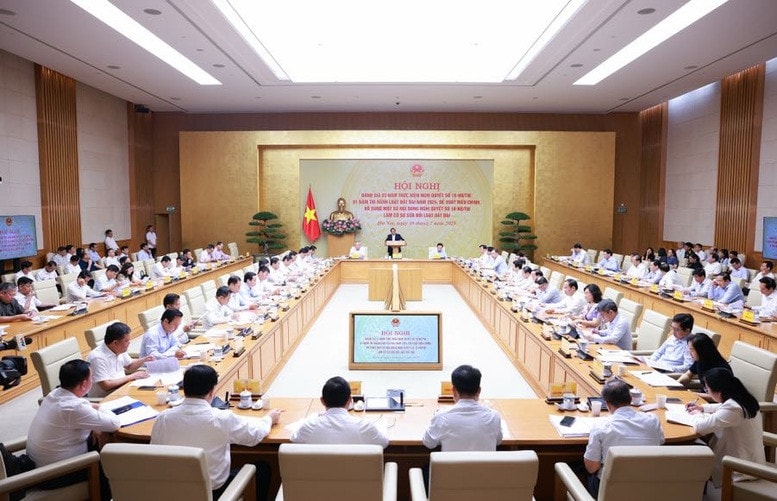
However, many practical issues remain unresolved: awareness of public ownership of land is still limited; land planning has not kept pace with the two-tiered local government model; land prices still do not accurately reflect the State's regulatory role; and policies on land acquisition, compensation, resettlement, land allocation, and land leasing... give rise to many shortcomings.
In particular, some opinions suggest that certain points in Resolution 18 need to be adjusted to create a clearer legal basis for amending the Land Law in a more flexible, effective, and substantive direction.
Don't rush.
Concluding the conference, Prime Minister Pham Minh Chinh basically agreed with the contributions from representatives of ministries, sectors, and localities. The Prime Minister highly appreciated the sense of responsibility, adherence to practical realities, and the specific and practical solutions proposed.
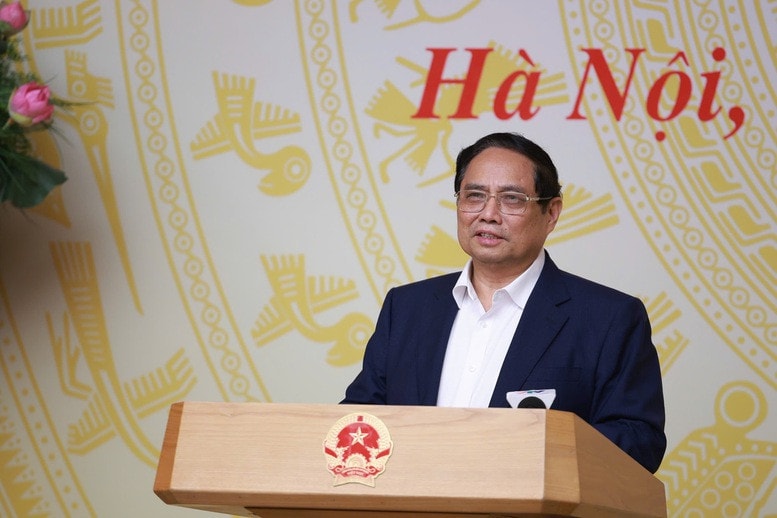
The Prime Minister emphasized that land is a complex and sensitive issue, involving many stakeholders and interests, therefore caution and steadfastness are needed in the process of adjusting policies.
"We shouldn't strive for perfection or rush; only what is clear, mature, proven correct by practice, and has consensus should be added or codified to ensure flexibility and effectiveness," the Prime Minister said.
With that in mind, the head of the government requested the lead agency to promptly compile the assessment findings for submission to the Politburo. This included affirming that Resolution 18 is an important political basis for further improving the legal framework regarding land in the coming period.
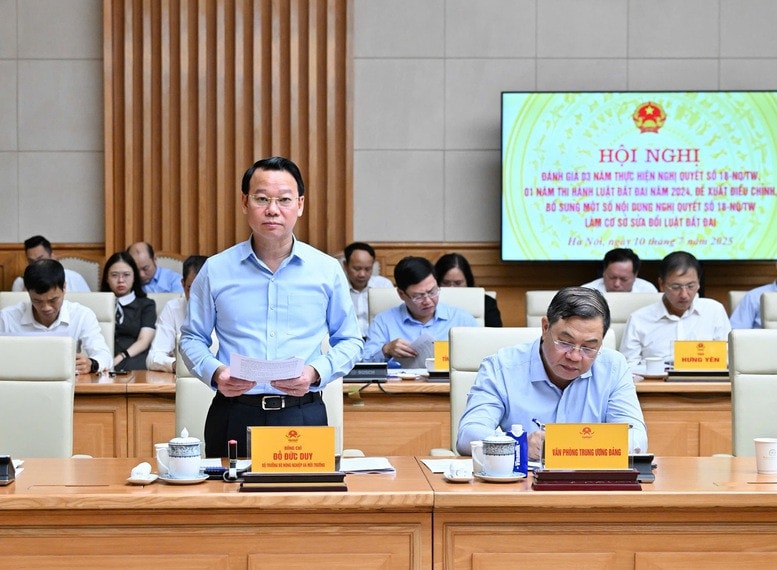
In response to the demands for rapid and sustainable national development in the new context, and in line with the two-tiered local government model, the Prime Minister requested proposals to adjust and supplement some viewpoints and tasks in Resolution 18.
The Prime Minister emphasized that land is a strategic resource for socio-economic development. Solutions should focus on planning, land allocation, leasing, land use conversion, land acquisition, and compensation for resettlement; while also improving financial mechanisms, valuing land realistically, ensuring fairness, and maximizing land use efficiency.
The Prime Minister instructed the Ministry of Agriculture and Environment to coordinate with the Government Office to finalize the dossier, ensuring its quality and timely submission to the competent authority.


