
The black market for buying and selling kidneys in Vietnam.
To meet the public's demand for organ transplants, a group of individuals, disregarding legal regulations, organized and brokered connections between supply and demand to profit from large price differences.
Organ trafficking in Vietnam: 150 million VND per kidney.
Upon closer examination, it becomes clear that there are many tricks and schemes behind the scenes, with brokers paying hundreds of millions of dong. So, does the human organ trafficking market exist in Vietnam? Is it possible that authorities are completely powerless against the rampant activities of these "brokers"?!
According to the regulations of the Law on Organ and Tissue Donation and Transplantation, only citizens aged 18 and above, with full legal capacity, who voluntarily donate, are biologically compatible, and whose organ donation does not significantly affect their health, are eligible for approval and transplantation by the relevant authorities.
To comply with these regulations, the list of people in need of organ transplants is growing while the number of donors is decreasing. This disparity is creating fertile ground for illegal brokers to operate freely.
Waiting for life...
Even now, Nguyen Thanh Tam (31 years old, residing in Tam Dao, Vinh Phuc) is still shaken when he thinks about his situation. Due to a stomach ailment, he had to spend a considerable amount of time and money buying various medications to completely cure the disease.
However, the joy was short-lived. During a medical examination, doctors informed Mr. Tam that he had acute kidney failure. His body showed symptoms of edema and swelling... if not treated urgently, it would be very dangerous to his health and life.
For two long years, treatment and dialysis at Hospital 108 maintained his health, but this also meant that the family's money and possessions gradually dwindled. Although his health was maintained, it couldn't last much longer, so a kidney transplant became necessary.
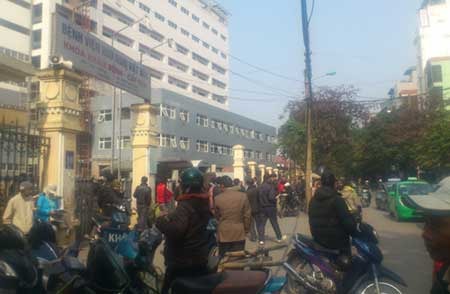 |
| The area in front of the hospital gate is often where touts and customers operate. |
Mr. Tâm said that the first people who wanted to donate a kidney were his parents, but they are both elderly (over 70 years old) and frail, so they are not healthy enough to donate.
In addition, I also have two siblings who have registered to donate kidneys to me, but they are both frail and constantly ill. If I were to take their kidneys without ensuring their health, the sin would be even greater because each of them still has heavy family responsibilities and their children are not yet grown. As their younger sibling, how could I possibly bring myself to do that?
As a last resort, family members have been frantically searching, registering at one hospital after another, hoping to find a kidney donor, but so far, despite their best efforts, they haven't found anyone.
"Recently, my brother was hanging around a hospital in Hanoi when he accidentally met someone from Ha Nam who confided that due to difficult family circumstances, he wanted to sell his kidney to earn some money to pay off debts back home."
Seeing this, my brother asked for the contact number and arranged for them to come and complete the necessary procedures for the transplant. However, after all the required medical tests were completed, when we returned to our locality to request confirmation of the donor and recipient's names, no one dared to certify them, citing the reason that the donor and recipient were not related by blood, and attempting to do so would violate the law. I thought I was saved, but I didn't realize the law was like that, so I had to wait until a legitimate donor was found and the registered hospitals called my name before I could proceed," Tâm emphasized.
Similarly, Ms. Tran Thanh Nga (from Thach That, Hanoi) said, "More than a year ago, I felt constantly weak and had high blood pressure. Worried about my health, I went to the hospital for a check-up and the doctors told me I had stage 4 kidney failure. Although I was prescribed medication and given a list of foods to avoid, my health continued to deteriorate."
During a recent follow-up visit, doctors at Thach That Hospital confirmed that a kidney transplant was necessary. Failure to do so soon would have a serious impact on my life. Because my family is small and no one is healthy enough to donate a kidney, I had no choice but to register with hospitals according to regulations, but the longer I waited, the more uncertain the outcome became.
Not only that, I also posted information to find a potential kidney donor, but somehow, despite some people agreeing to donate, some didn't pass the tests, and others had hepatitis B. So, even now, I'm still hoping for luck to come my way in the future.
Organ brokers are everywhere.
According to incomplete statistics from the health sector, there are currently about 6,000 people nationwide with chronic kidney failure needing kidney transplants, 1,500 needing liver transplants, 5,000 needing corneal transplants, and thousands needing stem cell transplants... However, the number of people receiving transplants is currently very limited due to a severe shortage of organs, with only a handful of people donating tissues and organs after brain death each year.
According to our investigation, the demand for organ transplantation is increasing, not just in one or two cases. However, due to legal regulations requiring donors to be related by blood, in good health, and recognized by doctors, the actual rate of successful transplants remains very modest.
This is what led to the emergence of an underground market for the trafficking of human organs. Sharing his story, Mr. Can Thanh Van (38 years old, Quoc Oai, Hanoi) said, "Three years ago, I suffered from a mild form of glomerulonephritis."
After taking medication and feeling healthy, I became complacent and didn't go back to the hospital for a follow-up examination. I thought my condition had improved, but unexpectedly, over a year ago, my health deteriorated significantly. My complexion turned pale, and I experienced frequent dizziness, lightheadedness, and headaches.
"After a check-up at a hospital in Hanoi, the doctors concluded that I have stage 4 kidney failure and need dialysis. They urgently need to find a kidney donor to ensure my health and survival. Although I have many siblings, no one is brave enough to donate a kidney, so I have to ask everywhere to find one for me."
After more than ten days of spreading the word, finally someone named K. called and introduced a family member who needed to sell a kidney for 200 million VND to pay off debts. If I agreed, we could meet and complete the procedures quickly. Everything went smoothly afterward, and the transplant was successfully performed, thanks to K.'s skillful planning. At first, I thought K. was a relative of the kidney seller, but after the negotiation process, I learned that K. was one of the intermediaries connecting the two.
However, what I admire about K. is that he took charge of all legal procedures and diplomatic relations, fulfilling all commitments. Although the cost was much higher than initially, my health is now stable. Especially, the transplanted kidney, according to the doctors' assessment, has a rapid and effective compatibility, which makes me very happy,” Mr. Van affirmed.
Although she didn't get a kidney as quickly as Mr. Van, Ms. Nguyen Thi Le Q. (from Ha Long City, Quang Ninh province) experienced equally great joy. It so happened that her family members went to Viet Duc Hospital to register for a kidney transplant.
After completing the procedures, Ms. Q's family went to the front gate of the hospital to get some water and coincidentally met someone who introduced them to a kidney donor. They asked if they really needed a kidney and offered their phone number for easy contact later. Thinking it was just a joke, they were surprised to find out about two months later that this person called to inform them that someone had donated a kidney, and they arranged a meeting to discuss the details and complete the procedures for the transplant.
So far, everything has gone smoothly, and Ms. Q. is also in the process of recovering her health. Recalling this, Ms. Q. confided: "You never know what will happen in life. When I registered according to regulations, I never received a call, but in the marketplace, anything is possible. As long as both sides agree on the terms, and everything is handled fairly and reasonably, things can go as desired?!"
Selling one's life for the sake of the whole family to change one's fortune?!
The news that a wealthy man, the owner of a large private economic group in our country, spent hundreds of thousands of dollars on intermediaries to find a liver transplant recipient has shocked society. The further revelation that the wealthy man essentially bought the young man's life by offering two livers for his transplant. A large sum of money, worth billions of dong, was exchanged.
This poor young man agreed to sacrifice his life so his family could have a better future. This news wasn't as surprising as the fact that, a few years after the liver transplant, this wealthy man also died of liver disease, but the information revealed was that he died of a stroke. This shows that we have a clandestine market for human organs, with all the activities from brokering, buying, selling, and exchanging, even human lives, and every exchange is heavily influenced by money.
According to Vietnam.net


