
Dinh Market has three sessions a month...
(Baonghean) - Every time Tet (Lunar New Year) approaches, I feel a strange mix of emotions as I remember the Dinh market on the 29th day of the 12th lunar month. The Tet celebrations of my childhood, and those deeply etched in the memories of many people from the rice-growing region, are never without the memory of the Dinh market on the 29th day of the 12th lunar month.
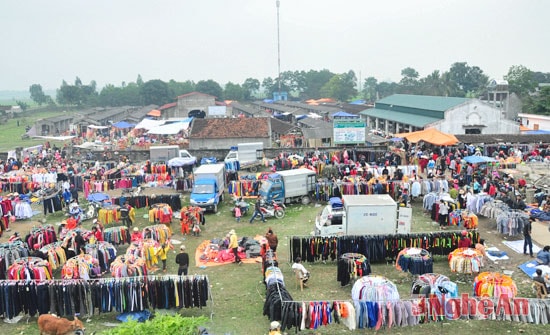 |
| Dinh Market is held on the 9th, 19th, and 29th of each lunar month. |
Dinh Market, located in Hoa Thanh commune, has historically been the trading center of Yen Thanh district, hence its name, the district market. People in the rice-growing region have a saying, "The district market has three sessions a month," referring to Dinh Market's three main sessions each month on the 9th, 19th, and 29th of the lunar calendar. The 29th of the 12th lunar month is the final main session of the year and the largest Tet (Lunar New Year) market in the region. Early in the morning, people from the villages and hamlets of the district begin preparing their goods for the market. Not only sellers and buyers, but almost everyone, young and old, men and women, go to the Tet market. Therefore, going to the Tet market on the 29th of the 12th lunar month is an indispensable part of the Tet tradition for the people of my hometown. And, as my grandmother often said, if you are from the rice-growing region and don't set foot in Dinh Market during Tet, you've surely missed a part of spring.
As a child, I often followed my sister to the market in the days leading up to Tet (Lunar New Year). My eyes were glued to the countless strange and alluring goods, both in color and shape. My maternal grandmother's house was in Dong Xoang hamlet, Hoa Thanh commune, about 2 km from Dinh market. My grandparents had eleven children, and to provide enough food for thirteen mouths to feed, my grandmother's life was almost entirely tied to the Dinh market. Besides the three main market days each month, she would still go to Dinh market in the afternoons, even though her daily afternoon sales were very small and infrequent. On ordinary days, she would leisurely carry her baskets of betel nuts and a few local treats. But during Tet, her baskets were always heavily laden. From around the 23rd of the lunar month, she would have to get up at 4 a.m. every day, and my mother and grandmother would carry countless goods through the fog and cold. On a lucky day, when sales were good, it was truly a case of "one day's work, enough to eat for a whole month." But sometimes, when it rained and the roads were slippery, just one slip of the foot could ruin all the New Year's goods, ruining the whole year's celebration. The stories my mother told were tinged with a poignant sadness, reflecting the arduous springs of her and my mother's lives. They were quite different from those my sisters and I experienced later in life.
Back then, my sister often took me for rides on her old motorbike. While she drove inch by inch, jostling through the crowds near the market, I sat behind her, enjoying the sight of the Tet goods and the people shopping. We parked the motorbike far away and walked hundreds of meters, jostling through the throngs, to reach the Tet stalls. I felt lost in a sea of people, in a world of countless stalls and a dense crowd. Outside, Tet flowers were displayed, countless branches of peach blossoms and kumquats stretching out to show off their colors. Right at the market entrance were rows of couplets and brightly colored paintings and pictures. There were countless stalls selling jams, candies, and toys. Then there were stalls selling clothes, food, pigs, chickens, buffaloes, and cows. Even farming tools like hoes, rakes, and plows, as well as fishing gear like nets, traps, and baskets... Everywhere was packed with people, bustling with laughter, bargaining, and the accents of various regional dialects. I really enjoyed looking at the flowers, embroidery, paintings, and sweets with their many strange shapes and flavors. But what I liked most was watching the puppies in the baskets. The puppies, with their fluffy fur like balls of cotton and round black eyes like marbles, kept scratching at the baskets with their paws as if they were hungry for their mother's milk.
My hometown now has many large, modern shops and stalls, and the goods are increasingly diverse. You don't need to wait for the "Tet market" to buy everything. My family is the same; we no longer lack essential items that we had to wait until Tet to get. But for me, the Dinh market on the 29th of the 12th lunar month is what I look forward to. This morning, receiving a message from my sister inviting me to go to the district market together, my mind wandered through the stalls, remembering each peach blossom branch, kumquat tree, and even the familiar smells came to mind…
Here are some pictures of Dinh Market on the days leading up to Tet (Lunar New Year):
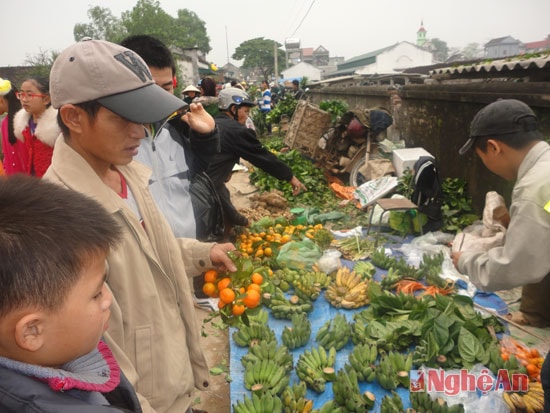 |
| Products from all over the countryside such as bananas, oranges, betel leaves... |
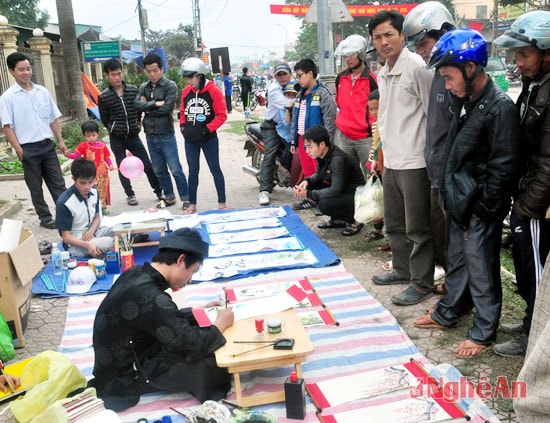 |
| The calligrapher gives a written character. |
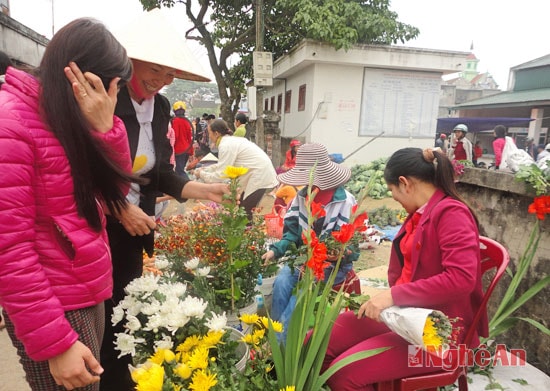 |
| Flower shop |
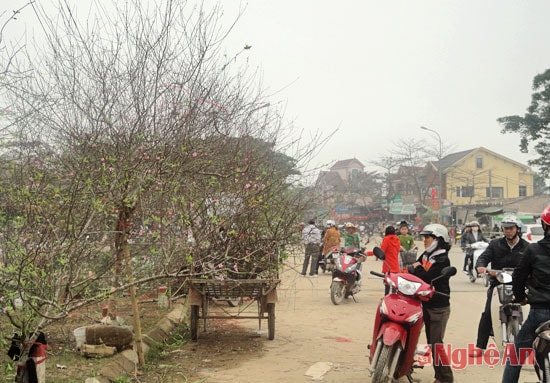 |
| Wild peach blossoms and garden peach blossoms are also sold at the Tet market. |
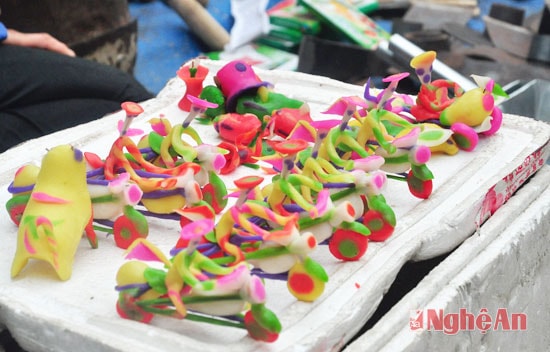 |
| Traditional Vietnamese toy figurines |
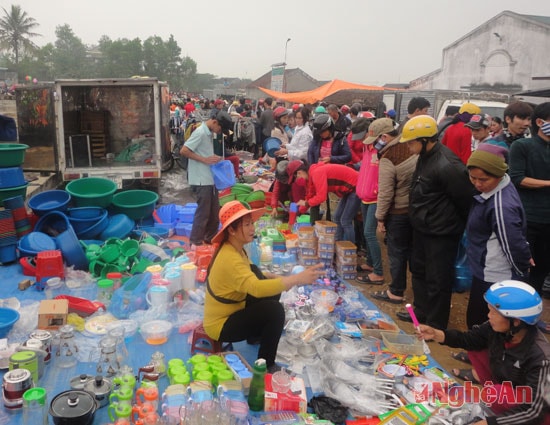 |
| General merchandise |
Ngo Viet Anh
Faculty of Law – Vinh University
| RELATED NEWS |
|---|


