
"LABOR MARKET" - different perspectives
(Baonghean) - For many years, spontaneous "labor markets" have appeared in Vinh City - an inevitable result of the urbanization process. However, to ensure that the operation of these "markets" does not affect security, order, and urban aesthetics, the government and relevant agencies must do many things...
The hardships of making a living
One cold winter day, at dawn, when the sounds of motorbikes and cars on the road were still sparse, the "porters" had already gathered at the area around the Kênh Bắc bridge, right at the intersection of Hà Huy Tập, Nguyễn Văn Cừ, and Nguyễn Sỹ Sách streets. Their means of transportation were mainly bicycles, with only a few motorbikes carrying 2-3 people (?!), along with a jumble of tools like carrying poles, hoes, shovels, knives, and sickles… Stopping their vehicles close to the bridge railing, they huddled together, some quickly eating a piece of bread or a handful of sticky rice for breakfast. I took the opportunity to chat with a porter named Hòa, from Hưng Xá commune (Hưng Nguyên district), who has been doing this job for two years. Hòa said: “The beginning and end of the year are when many families build or renovate their houses, so there's more work. Normally, it's only on lucky days that there are many people hiring. Not to mention the rainy and stormy days when no one hires us, so we have to be even more frugal.”
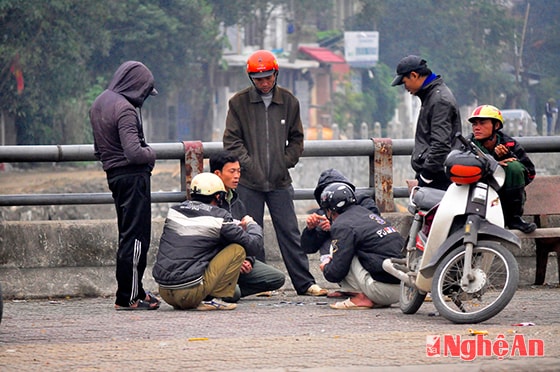 |
| Freelance workers gathered at the North Canal bridge, waiting for work. |
Around 7 a.m., 14 people gathered at this "labor market." Ms. Le Thi Nhi, 42 years old, from Nghi Long commune (Nghi Loc district), said: "Previously, my family had 4 sao (approximately 0.4 hectares) of rice fields, the income wasn't much, but at least we had something to rely on. But after the land was confiscated (handed over to the industrial zone), my family lacked work. My eldest son finished high school and went south to work as a factory worker, while my husband and I went to Vinh to do this job. I usually go with a group of women from my hometown; some have been here for 2-3 years, others for 7-10 years. Depending on the work, sometimes we earn 50,000 or 70,000 dong, sometimes a few hundred thousand. But there are also times when no one hires us for 3-4 days. We cycle out in the morning to wait and cycle back in the evening, it's very difficult to find money for expenses, food, and our children's school fees."
When asked, "Why don't you ladies apply for factory jobs, where you can have a stable income and avoid the wind and cold like this?", Ms. Nhi forced a smile and replied, "I'm getting old...! And finding a job now isn't easy. Without qualifications and skills, working overtime leaves no time to manage household chores. Doing odd jobs to make a living, although the income is unstable, gives me more freedom."
Around noon, two people who were building a house appeared, needing workers for tasks such as transporting materials and cleaning up. The whole group rushed over, eagerly waiting, but in the end, only five were chosen. They quickly grabbed their bicycles, loaded their tools, and followed the employers. The rest, with sad faces, returned to sit by the roadside and continue waiting…
Walking around Vinh City, one can see several areas with a high concentration of freelance workers waiting for jobs, such as Cua Nam Flower Garden, the Six-Way Intersection, Tam Giac Flower Garden, Tran Hung Dao Street, and Cua Tien Bridge… Towards the end of the year, a large number of workers flock to these “labor markets,” with a minimum of 7-9 people and a maximum of 15-20. Most of those participating in these “labor markets” are rural laborers from suburban communes and neighboring districts like Hung Nguyen and Nghi Loc, taking advantage of their free time during the agricultural off-season to come to the city to find work. However, a stroll through these labor markets reveals a scarcity of work but a large crowd. While waiting, some lie down, others sit, and vehicles and carrying poles occupy the sidewalks and roadsides, creating a very messy scene. When someone approaches to hire them, all the workers rush out to compete and haggle, causing disorder and affecting traffic safety. Moreover, after waiting a long time without anyone coming to hire them, some male laborers gather in groups to gamble for money, sometimes getting into arguments that create a commotion on the street corner… At lunchtime, these groups set out their packed lunches and eat, carelessly littering the sidewalks. In addition, according to reports from the laborers, there have also been instances of criminals infiltrating these "labor markets" to cheat at gambling or steal from families who hire them.
Difficult to manage
Regarding the issue of the "labor market," Mr. Nguyen Xuan Lam, Head of the Department of Labor, War Invalids and Social Affairs of Vinh City, stated that it is currently impossible to fully quantify the number of freelance workers in the area. Furthermore, the city does not have any official agency responsible for managing, training, and equipping this group with the necessary skills. The 2013 amended Labor Code only regulates the number of workers in the formal sector, while the number of "freelance workers"—who constitute a large proportion of the country's labor market—is largely unaddressed by the law. Furthermore, the nature of the work and the instability of their jobs make managing this group of laborers even more difficult.” Mr. Ngo Xuan Nam, Vice Chairman of the People's Committee of Ha Huy Tap Ward, stated: “For many years, a ‘labor market’ has formed in the area around the Kenh Bac Bridge, and these laborers all come from poor rural areas and are frequently unemployed. We have created opportunities for them to work, but management is not simple because the number and specific individuals in this labor market fluctuate constantly. Some people may be waiting for work here today, but tomorrow they have moved to another location…” Mr. Nam also admitted that even the urban order teams of the wards, during campaigns to clear sidewalk encroachments, have only focused on fixed shops and largely “ignored” these “porters.”
According to Mr. Le Van Thuy, Head of the Labor and Employment Department (Department of Labor, Invalids and Social Affairs), in addressing employment issues, the province has implemented many policies to support and encourage workers to learn vocational skills, create their own jobs, and participate in overseas labor export programs, such as: establishing a local employment support fund from the provincial budget with an amount of 2.5-3 billion VND/year; establishing new and upgrading vocational schools, vocational training centers, and career guidance centers in various regions and districts, cities, and towns; improving the capacity of job placement agencies; issuing policies to encourage overseas labor export, support vocational training, and policies to attract and train workers in the province's industrial zones; linking economic development investment programs with employment creation, and promoting the development of small and medium-sized enterprises. Furthermore, the province also focuses on measures and policies to maintain and expand small-scale handicraft villages, youth volunteer teams for economic development, and seek markets outside the province. However, creating jobs for workers in the province still faces many difficulties because there are not many large industrial zones in the area; the development of small-scale handicraft zones and villages is still fragmented; the shift in labor structure by region and industry is slow; and direct support for workers to create new jobs or self-employment is limited, especially the labor market information system. The large population and labor force also put pressure on job creation. Each year, the province has between 30,000 and 32,000 new workers, but production facilities and units have not developed proportionally to the labor force... Therefore, the number of unemployed or underemployed workers remains quite high, especially in densely populated rural areas with a high proportion of people of working age, where agricultural land is shrinking due to urbanization. However, job counseling and placement services in localities are still limited; even at the provincial level, the job exchange at the Provincial Job Placement Center, despite being open twice a month, operates rather sluggishly and appears ineffective, as demand exceeds supply.
It is thought that, in the current process of urbanization and labor restructuring in rural areas, the formation of "labor markets" in Vinh City is inevitable, because where there is supply, there is demand. Only when solutions to address unemployment are implemented comprehensively, from developing diverse occupations to providing career counseling and placement services, can the current situation of freelance workers flocking to the city to seek work be limited. However, in the short term, to prevent these labor markets from affecting public order, traffic safety, and urban aesthetics, it is suggested that the ward authorities of Vinh City should step in to strengthen reminders and rectify the chaotic and unsightly scenes at these markets. Furthermore, Vinh City should also consider planning and allocating waiting areas for freelance workers to ensure that the "labor markets" operate in a more orderly and disciplined manner.
Text and photos:Minh Quan


