
For the future, wallets, miles...
(Baonghean) - Decades ago, composers deeply concerned with the Ví and Giặm folk songs, such as Văn Thế, Thanh Lưu, and Phan Thanh Chương, questioned the existence and development of this unique folk song genre amidst the upheavals of history and society. Now, once again, that question resonates passionately, though not new, yet intensely relevant, in the context of Nghệ Tĩnh Ví and Giặm folk songs having just been recognized by UNESCO as an intangible cultural heritage of humanity…
| RELATED NEWS |
|---|
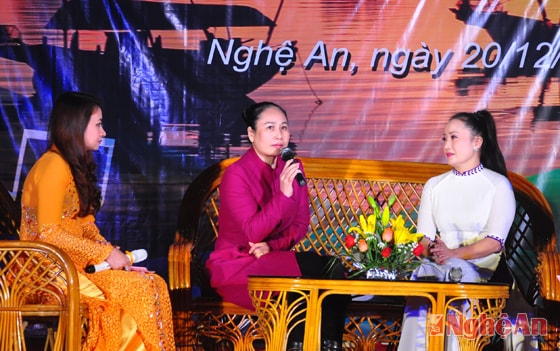 |
| Comrade Dinh Thi Le Thanh participated in the "Returning to the Land of Folk Songs and Melodies" program organized by former students of Phan Boi Chau Specialized High School. Photo: TC |
Amidst the gentle drizzle rustling the corrugated iron roof and the bustling crowds outside, the small space in front of the Nghe An Culture Magazine headquarters became a warm and friendly meeting place for scholars, musicians, and cultural managers to discuss systemic and strategic issues for the future of Nghe Tinh's folk singing. This future, no longer shrouded in uncertainty as it was decades ago, now stands in the joy of being inscribed in the treasury of intangible cultural heritage of humanity. Nghe Tinh's folk singing has gained a solid foundation to integrate into the ever-changing flow of life, rising to become a familiar musical form, a daily source of spiritual nourishment for every citizen. However, for this integration to be natural and inevitable, rather than forced and contrived, the insights of those who deeply love and understand folk singing are needed. The seminar revolved around examining and evaluating three main issues: the challenges of the times for folk singing and chanting; the future of folk singing and chanting; and solutions to ensure the survival and development of folk singing and chanting.
With his thinning gray hair, white glasses, and a voice that still retained its warmth and affection, musician Le Ham – the oldest participant in the seminar – gave the first presentation. He spoke about the profound changes of the "flat world," the rapid development of information technology and science and engineering dominating most aspects of life for generations, and affirmed that not only folk songs but all other forms of folk music are facing this challenge. The need for folk songs as a form of entertainment is no longer as pressing as it was decades ago, because there are now so many audio-visual media available. Folk songs originate from the working lives of the people; therefore, the melodies reflect the labor process and the feelings and aspirations of the working people. In the past, there were folk songs about the weaving and firewood industries, but nowadays, applying those melodies to every forum and every space is no longer appropriate and will diminish the enthusiasm of the audience. He gave very practical examples: “Simply put, we go to a wedding, and it's all loud, jarring music or frenzied dancing. Who would think of bringing folk songs like 'ví' and 'giặm' to the wedding stage for people to enjoy? Then, in schools, elementary and middle school students learn folk songs, but if they don't compose new lyrics and still sing 'I came with you, but the boat had already crossed the river / I came to find you, but you had already married...', is that appropriate? On the other hand, our province has dozens of folk song clubs, but in reality, have those clubs been operating effectively, or do they only organize performances during holidays, festivals, and conferences?” Composer Lê Hàm concluded that folk songs of the Ví and Giặm genres belong to the people; only when the people recognize them as the voices from their souls can they take deep and lasting root.
Artisan Cao Xuan Thuong (Dien Hoa, Dien Chau) expressed the concerns of those working in grassroots cultural activities. He affirmed that the folk songs of Vi and Giam have never faded from the people's memory. For nearly 10 years now, the movement to sing Vi and Giam folk songs has been revived and is spreading, albeit less enthusiastically than before. This decline can be understood as a lack of organizers at the performances, a lack of talented individuals to compose new lyrics, and even a lack of... benefactors! He worried that the funding for preserving and promoting this type of folk music is still too limited. Each performance sees the artisans taking to the stage with passion and love for Vi and Giam, but few know the anxieties behind the scenes about logistical support, food, and clothing. To encourage artists and the public to join hands in preserving and developing the Ví and Giặm folk singing styles, first and foremost, let them feel reassured that their intellectual contributions and time are worthwhile.
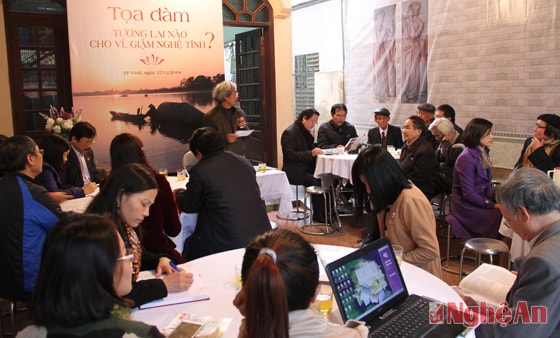 |
| Seminar "What future awaits the folk singing traditions of Nghe Tinh?". Photo: TH |
The future of the Ví and Giặm folk songs lies in their transmission and nurturing by future generations of the country. Regarding this issue, Mr. Vũ Thế Vinh – Vice Principal of the College of Culture and Arts – shared his thoughts: “Our school is responsible for recruiting and training personnel for the Center for Preservation and Promotion of Nghệ An Folk Song Heritage, but unfortunately, we have to admit that for many years, we haven't been able to recruit any students to pursue folk music, especially those passionate about Ví and Giặm. We are so eager to find young people that Ms. Hồng Lựu (People's Artist Hồng Lựu – PV) announced she would seek tuition sponsorship for them, but we still haven't found anyone.” Young people may enjoy singing and listening to folk songs, but very few are inclined to pursue a professional career in this genre, due to concerns about salary and life in general…
The challenge of having young talent for the Ví and Giặm folk songs received much empathy from the panelists. Along with that were discussions about Ví and Giặm folk songs in schools. The movement to introduce Ví and Giặm folk songs into schools has been implemented for several years, bringing positive effects, but also raising many problems that need to be addressed. These include a change in quantity rather than quality; that is, students sing Ví and Giặm out of habit rather than truly understanding the essence of the folk songs. And if they don't understand, then surely they don't love them? On the other hand, there is a need to reorganize the team of folk song teachers, because even some within this team still lack a proper understanding of folk songs, with instances of incorrect lyrics and arbitrary adaptations of melodies…
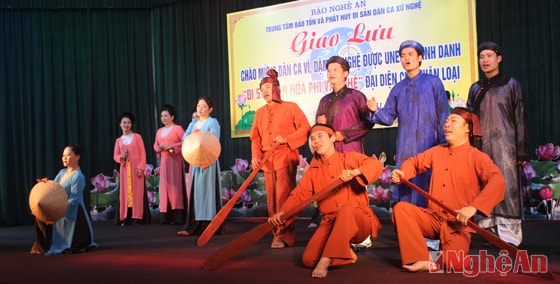 |
| A cultural exchange performance celebrating the UNESCO recognition of Ví and Giặm folk songs at the Nghe An Newspaper. Photo: NS |
Adding to the lively discussion was the idea of staging folk songs – a practical way to revive and spread the Ví and Giặm folk songs. Composer Thanh Lưu expressed that over 40 years ago, he and his colleagues boldly staged, composed, and adapted folk songs, receiving strong public support. He passionately stated: "We talk about preserving the performance space, but that space must be flexible and adaptable. We must give Ví and Giặm folk songs a new look, encouraging the creation of songs with folk influences and content that is truly relevant to reality, even connecting them to vibrant programs like the New Rural Development program and the nationwide movement to build a cultural life in residential areas… but everything must be artistically transformed!"
The future of Nghe Tinh folk singing (Vi and Giam) remains a concern for those involved in cultural management. Mr. Ho Mau Thanh, Director of the Department of Culture, Sports and Tourism of Nghe An province, arrived very early for the seminar. He attentively listened to each discussion and carefully took notes, compiling each point and engaging in thorough discussions with scholars, researchers, and musicians. He shared that, according to statistics, the province has 80 folk singing clubs with nearly 200 artisans. Most recently, the department submitted a proposal to the Provincial People's Committee suggesting mechanisms and policies to honor and promote folk singing artisans, as well as compiling a list of outstanding artisans for recognition. Furthermore, the plan to integrate Vi and Giam folk singing with major festivals, events, and tourism is being actively promoted, promising a bright and promising direction to elevate the dissemination of Vi and Giam folk singing in the new era.
That direction, that determination and enthusiasm, brought the emotionally charged discussion to a close. The future of the Ví and Giặm folk songs is no longer a question echoing from the depths of concern, but a question with a clear answer. That future belongs to each and every "person from Nghe An" to decide.
* On the morning of December 27th, the Nghe An Culture Magazine organized a seminar on the future of Nghe Tinh folk songs (Vi and Giam). Attendees included leaders from the Department of Culture, Sports and Tourism, folk culture researchers, musicians, artists, and folk artisans from Nghe An and Ha Tinh provinces. Following the recognition of Nghe An folk songs (Vi and Giam) by UNESCO as an Intangible Cultural Heritage of Humanity, many organizations and localities have organized exchanges and sought directions for the future of Nghe An folk songs. The seminar also aimed to find solutions for the preservation, safeguarding, and promotion of Nghe An folk song heritage in the future. Many heartfelt opinions suggested that localities and relevant sectors need to have mechanisms and policies for existing folk song clubs; honor folk song artisans; introduce folk songs into schools; strengthen the introduction of Vi and Giam folk songs through materials, printed books, VCDs, and organize regular folk song competitions in schools and communities… to make Vi and Giam folk songs spread, develop, and thrive.Thanh Thuy |
Phuoc Anh


