
Choose crops that are reliable and resistant to flooding.
(Baonghean)Choosing the right crops for specific soil types and regions, and determining the appropriate planting season, are crucial factors in avoiding the negative impacts of natural disasters. These are considered essential elements for a successful winter crop.
In Nghe An province, the winter crop season presents more challenges than advantages, primarily due to unpredictable weather patterns and frequent, prolonged heavy rains that significantly impact production. Therefore, selecting crops suitable for specific soil types and climatic conditions is considered a crucial factor in the success or failure of winter crop production. Currently, a wide variety of crop varieties are available. Local authorities need to review and select varieties that are appropriate in terms of growth time, minimizing the impact of natural disasters and ensuring they are suitable for local soil conditions to achieve the highest possible yield.
Dien Thanh (Dien Chau district) is a commune with very favorable conditions for winter crop production, with mainly arable land. In recent years, winter crops have brought very high economic efficiency to the people. However, in many years, Dien Thanh has not been able to avoid damage due to the adverse impact of weather on winter crop production. Among them, corn crops are most affected, due to flooding during the seedling stage and storms during the tasseling and flowering stages.
Meanwhile, the yield from vegetable crops is very high, so in recent years, Dien Thanh has been gradually reducing the area of winter corn and increasing the area of various vegetables. Locals say that during the winter season, they can grow two, or even three, crops of vegetables. The first crop of sweet cabbage is planted as early as the beginning of July, followed by an early cabbage crop for the Tet (Lunar New Year) market, and then a late cabbage crop harvested in February of the following year.
According to Ms. Le Thi Huong (Vice Chairman of the People's Committee of Dien Thanh commune), in addition to that formula, in recent years, Dien Thanh has introduced many new and diverse vegetable varieties to meet market demand and increase people's income, such as green cabbage, cauliflower, carrots, and especially soybeans. Soybeans were introduced into production in the winter of 2012, but due to poor intensive farming techniques, the yield was not high, even though the product was easily sold. This year, the commune, in coordination with the District Agricultural Extension Center, organized training and technical guidance for the people, converting nearly 8 hectares of double-cropping rice land in Mai Thanh hamlet, previously used for sweet potato cultivation, to soybean cultivation. In addition, the entire commune has about 10 hectares of winter peanuts planted as seeds for the spring crop on high, well-drained fields. This crop is both economically efficient and safer than winter corn because it is sown early (from August 10th to August 20th), so by early September, when there are often floods, the peanuts are already large enough.
In guiding agricultural production, localities must absolutely avoid cultivating winter crops in a "campaign" or all-encompassing manner. The important thing is to select the most suitable and valuable crops, both in terms of efficiency and market demand, ensuring the success of each crop. Priority should be given to developing crops that can be stored for a long time. Appropriate post-harvest preservation methods should also be implemented. |
Currently, corn remains the first choice and one of the main crops that defines the "brand" of the winter crop. With over 15 million poultry, more than 700,000 buffaloes and cattle, and nearly 1 million pigs, the demand for animal feed is enormous. This doesn't even include sales to other localities and animal feed factories in the area. However, to maximize the effectiveness of corn cultivation and overcome the declining corn acreage in recent years, it is crucial to ensure farmers profit from this crop. To achieve this, selecting corn varieties that have been recognized by the Ministry of Agriculture and Rural Development, tested, or demonstrated in successful local demonstration models is extremely important.
Furthermore, it is necessary to plan and arrange production in accordance with the soil conditions, seasons, and intensive farming capacity of each area. Mr. Tu Trong Kim (Head of the Crop Production Department - Department of Agriculture and Rural Development) said: This winter crop season, Nghe An aims to plant 30,000 hectares of corn, an increase of 4,543 hectares compared to last winter crop season, mainly on alluvial land and hillside land. Of which, about 8,000 hectares are on double-cropped rice land not affected by flooding during heavy rains in the lowland and low mountainous districts; 22,000 hectares are on hillside land in mountainous districts, mountainous communes in lowland districts, and alluvial land in coastal and riverside areas. Mountainous localities need to consider the crop structure for the next season, reasonably expanding the area of late winter corn on hillside land and alluvial land.
In particular, some districts like Tuong Duong and Que Phong need to take advantage of the lower rainfall during the rainy season compared to other localities to develop the area of winter corn cultivation. Localities with convenient transportation and proximity to TH Milk Company should promptly contact the company to develop joint ventures, partnerships, and contracts for corn production to serve livestock farming and processing. It's time we considered corn cultivation differently. Since farmers cannot become wealthy solely from rice cultivation, growing corn to support livestock development should be seen as a necessary direction.
In addition to the varieties already grown in the area, last winter, Nghe An added several new varieties that yielded very good results, such as DK6818 and NK7328. Therefore, depending on specific conditions, localities and people can plant different varieties. However, on double-cropping rice land in the delta region, priority should be given to varieties with short growing periods, and sowing should be completed before September 20th. Preparing corn seedlings and planting them in seedbeds is necessary to ensure timely planting.
According to Mr. Nguyen Van Duong (Head of the Agriculture Department of Yen Thanh District): With the goal of ensuring a successful winter crop, Yen Thanh district is replanning its field system. Corn will be planted in areas with good drainage and minimal impact from rain and floods. To plant 1,500-2,000 hectares of corn this winter, "We prioritize medium and short-day corn varieties such as NK66, NK6654, LVN16, MX2, MX4..., with MX2 and MX4 having a growth period of only 80-85 days." According to many agricultural experts, for a "guaranteed" corn crop, it must be planted in high-lying areas with minimal flooding and as early as possible, as corn is a heat-loving, light-loving plant; planting late will reduce yield. By using short-day corn varieties, farmers should not sow directly in the field, but instead prepare seedlings early and transplant them when they have 3-4 leaves to avoid adverse weather conditions.
Along with corn, various types of vegetables are also one of the main crops in winter production. For many years, vegetables have brought billions of dong in revenue to farmers. Many commercial vegetable growing areas have been established, such as in Quynh Luong and Quynh Bang communes (Quynh Luu district), Nam Anh and Nam Xuan communes (Nam Dan district), and Dien Thanh commune (Dien Chau district). To increase the efficiency of vegetable cultivation and ensure a successful winter crop, it is necessary to base the planting of suitable vegetables and legumes on the land, market demand, and farming practices and experience of each region.
Based on past experiences, we can expand the area under cultivation for several crops such as zucchini, soybeans, and potatoes. It can be said that few crops surpass potatoes in yield; in just 85 days, one hectare can produce 100-110 quintals of produce. In recent years, many areas such as Thanh Linh (Thanh Chuong), Nam Xuan, and Nam Anh (Nam Dan) have developed zucchini cultivation with very high economic efficiency. Hung Tay commune (Hung Nguyen) has introduced climbing zucchini cultivation; all that's needed is to build mounds of soil, add fertilizer, and plant. It requires minimal care, only needing to protect the roots from waterlogging and rotting. Each plant only needs to produce two fruits, and one hectare can yield around 15 tons of zucchini. In the northern provinces, after harvesting the summer-autumn rice crop, farmers don't need to plow; they leave the stubble intact, scatter soybean seeds, and have buffaloes or oxen plow across to cover the seeds. In Nghe An, because the rainy season ends about a month later, planting soybeans in late September or early October often results in heavy rain and high humidity, making the plants susceptible to bacterial diseases and wilting. Therefore, it is necessary to choose high-lying areas in the midland and mountainous regions, or sandy coastal areas, with raised beds and good drainage, for soybean cultivation.
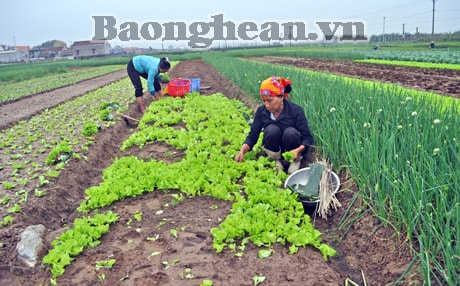
Winter vegetable production in Quynh Luong (Quynh Luu).
In reality, Nghe An's vegetable growing areas are mainly concentrated in the riverside and coastal areas of Quynh Luu, Dien Chau, and Nam Dan districts. In these localities, in recent years, there has been a focus on developing high-quality vegetable varieties to meet market demand and increase economic efficiency. However, expanding the area of safe vegetable production and prioritizing support for building brands in these areas for commercial purposes still face many limitations.
According to Ms. Hoang Thi Huong (Vice Chairperson of the People's Committee of Dien Chau District): Dien Chau has about 600 hectares of commercial vegetable crops. Due to favorable soil conditions and good irrigation, Dien Chau vegetables are very popular in the market of Vinh City, mountainous districts, and inland provinces such as Ha Tinh and Quang Binh.
However, with nearly 4,000 hectares of arable land, plus approximately 5,000 hectares of paddy fields, Dien Chau still has significant potential for developing winter vegetable crops. Despite actively encouraging businesses to invest in the production and consumption of vegetables and root crops in recent years, there has been little success. To improve the efficiency of vegetable cultivation in general, and winter vegetable crops in particular, localities need to leverage their role as intermediaries, providing guidance and support to farmers to establish joint ventures and partnerships to expand production areas and guarantee the purchase of vegetable products. To ensure a stable market for winter crops, especially the two main crops of corn and various vegetables, the following factors must be considered: planning concentrated production areas, creating large volumes of marketable products, ensuring food safety and hygiene, meeting market demands, and involving businesses in the production and distribution process.
Phu Huong


