
Which driving mode is the most fuel-efficient for a car?
Besides knowing which driving mode is the most fuel-efficient currently available, users should also learn and apply fuel-saving driving techniques and experiences to achieve the best results.
Which driving mode saves the most fuel?
Advances in technology have led to many new changes in the automotive industry. These innovations have resulted in the restructuring and design of vehicles with many new features that improve efficiency and fuel economy. One of these features is the Eco fuel-saving driving mode system.
What is Eco driving mode?
Eco Mode (EM) is one of the driving modes equipped on many modern internal combustion engine vehicles. The typical function of Eco Mode in a car is to minimize fuel consumption by controlling four basic car systems to optimize fuel efficiency while driving.
Each car model has a different Eco mode with its own effectiveness. However, generally, car manufacturers agree that Eco mode can improve fuel efficiency by 5-10%. In addition, this driving mode helps reduce environmental pollution because when a car burns less fuel, it also emits less CO2.
When should drivers use Eco mode?
Users can use Eco driving mode whenever they want to save fuel. However, because this mode affects the car's performance, drivers should not use it when extra efficiency is needed.
Eco driving mode should be used when the vehicle only needs to be driven at low or medium speeds, on short urban roads. When driving long distances, on highways, or uphill, drivers should not activate Eco mode as it may make the vehicle more difficult to control.
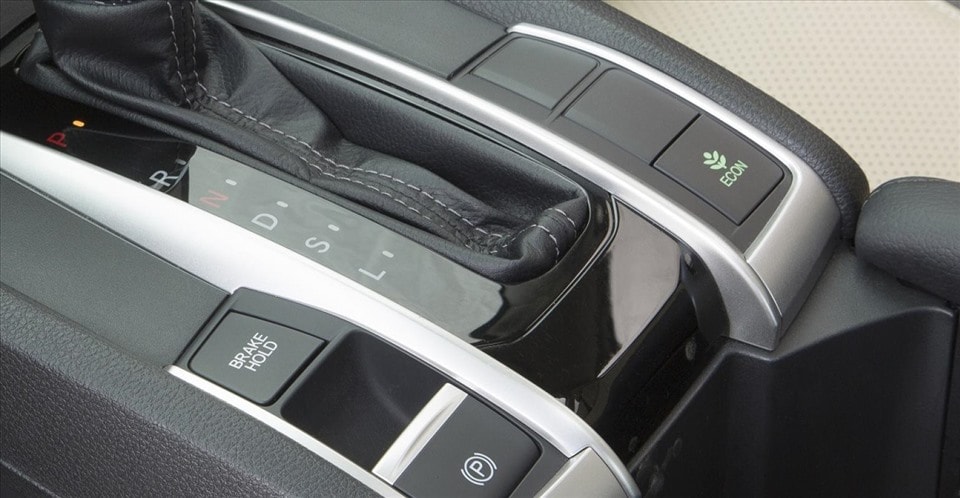 |
| Eco driving mode limits engine and transmission performance. Photo: Ngo Phong |
Why does Eco mode save fuel?
Essentially, Eco driving mode limits engine and transmission performance by controlling the throttle opening, restricting fuel flow to the pistons.
This mode helps the car decelerate gradually and limits excessive fuel injection. If the driver suddenly presses the accelerator pedal, the throttle will not be allowed to expand, preventing fuel waste. Eco mode also has an intelligent feature that allows the driver to accelerate suddenly when needed.
In addition to limiting both engine and transmission performance, Eco mode also fine-tunes the air conditioning temperature and other key adjustments to maximize fuel efficiency without causing any serious side effects.
Other effects of Eco driving mode include the following:
Change the car's throttle response.
When Eco mode is selected, the system controls how air is taken in through the throttle valve to save fuel. Engine performance and responsiveness are reduced in this mode, but the amount of fuel and air supplied to the engine for combustion is more efficiently controlled.
Change the way the car shifts gears.
Shifting gears down makes the engine work harder, consuming more fuel. When Eco mode is activated, the ECU will limit downshifting when not absolutely necessary to save fuel.
Change the response of the cruise control system.
In cars equipped with cruise control technology, Eco Driving Mode helps the driver maintain a specific desired speed range for the most efficient fuel consumption.
Modify the car's air conditioning system.
Eco mode can affect air conditioning performance to save fuel by allowing the air conditioner to operate at only 70-80% capacity to reduce energy intake from the engine, instead of at maximum 100% capacity.
Essentially, Eco mode is a set of limitations imposed by the manufacturer on a car when activated to control and optimize fuel consumption. Therefore, by choosing to activate Eco mode, users accept sacrificing some of the car's power and responsiveness in exchange for better fuel economy.


