
Choosing Dien Bien Phu - A historic decision
The historic decision to launch the Dien Bien Phu campaign was the result of a combination of factors. However, the Party's strategy of a people's, comprehensive, self-reliant, and protracted resistance was most clearly and convincingly demonstrated in this historic decision.
That is the assessment of Associate Professor Dr. Nguyen Manh Ha, Director of the Institute of Party History, when analyzing the decision to choose Dien Bien Phu as the "historic rendezvous point," as General Vo Nguyen Giap once named it.
On November 20, 1953, while officers from the regimental level and above, summoned by the General Staff, were attending a meeting to disseminate the 1953-1954 Winter-Spring operational plan, the Commander-in-Chief of the French army in Indochina – General Navarre – hastily deployed six battalions to occupy Dien Bien Phu. The French's passive response began to show. Although the French command had just concluded Operation Seagull, with 32 battalions of infantry, artillery, and armored units participating, supported by the navy and air force, attacking the Ria, Nho Quan, and northern Thanh Hoa areas, and were showing complacency about regaining the "initiative" on the battlefield, a single operational action by our forces, proceeding normally, completely disrupted the French command's plan, forcing them to react to our actions.
According to Associate Professor Dr. Nguyen Manh Ha, this move by the French army, by passively accepting the decisive battle at Dien Bien Phu, further demonstrates the wisdom and foresight of the Party and President Ho Chi Minh in formulating the 1953-1954 Winter-Spring campaign plan, and further proves the correctness and timely decisiveness in deciding to launch the Dien Bien Phu campaign, concentrating all forces on this decisive battle.
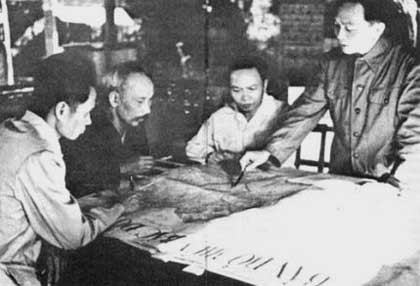 |
| On December 6, 1953, in Viet Bac, President Ho Chi Minh and other Party leaders decided to launch the Dien Bien Phu Campaign. (Archival photo) |
Why did Dien Bien Phu become a "historical rendezvous point"?
According to Mr. Nguyen Manh Ha, the decision to launch the Dien Bien Phu campaign by the Party and President Ho Chi Minh, based on reports and preparations, and the campaign plan developed by the Central Military Commission, the General Staff, and the General Staff, was based on many factors.
Firstly, the resistance movement had grown stronger, entering a phase of continuously launching proactive offensive campaigns against the French army. At that point, the strength and momentum of the resistance movement allowed for a decisive strategic battle to achieve victory and end the war.
Although, in terms of overall military strength, we were inferior to the enemy in terms of troop numbers (we: 290,000 troops; enemy: 449,000 troops), weapons, equipment, and war vehicles, the combat skills and experience of our troops had improved significantly. While our troops had not yet successfully defeated the fortified complex defense system, it was not entirely new or invincible, provided we employed the right tactics, possessed heavy artillery, and concentrated overwhelming force within a single campaign.
Meanwhile, the French military command demonstrated strategic and operational passivity by deploying a large force of elite mobile troops to the remote Dien Bien Phu area, which could only be resupplied by air, organizing defenses, and waiting for our troops to attack in order to counter them. This was a miscalculation by Commander-in-Chief Navarre, based on a flawed and subjective assessment of the enemy's offensive capabilities, which we could exploit to defeat the enemy with the determination and courage of the entire army and people.
Regarding the Party's policy, based on the realities of the battlefield, it was not and could not be achieved to completely annihilate the invading French army, but rather to concentrate forces on a decisive blow aimed at crushing their will to continue the war, forcing the French command to acknowledge the reality that they could not defeat Vietnam by military strength alone. In fact, after the devastating defeat at Dien Bien Phu, all more than 16,000 enemy troops defending this fortified complex were killed, wounded, or captured. Although this only represented 4% of the total strength of the French expeditionary army and the armies of the allied nations in Indochina, their will to invade was completely shattered because even the highest form of French defense ultimately failed.
After more than eight years of protracted resistance, the Central Party Politburo, President Ho Chi Minh, the entire army, and the entire people all demonstrated high fighting determination and confidence in victory. The Central Party Committee, the General Military Commission, and the General Staff anticipated potential situations, limitations, and difficulties, as well as the practical requirements that needed to be addressed, including tactics for attacking fortified positions, mobilizing and concentrating forces, ensuring logistical and technical support for prolonged combat, roads, and transporting artillery to the battlefield… This was the result of efforts beyond the imagination of the French command, but within the capabilities of our army and people.
During the campaign, the decision to change the operational strategy from "quick victory" to "steady advance" when the front situation had changed, the enemy had reinforced their forces and fortified their positions, and the possibility of defeating the enemy's fortified complex was not yet certain, was also a historic decision that contributed greatly to the final victory.
According to Associate Professor Dr. Nguyen Manh Ha, the decision to choose Dien Bien Phu as the strategic decisive battle also held historical significance because it was a very well-coordinated, timely, and effective combination of military and diplomatic struggle. In November 1953, President Ho Chi Minh, in an interview with the Swedish newspaper Expressen, raised the possibility of diplomatic negotiations to resolve the war. In January 1954, the conference of the four major powers in Berlin decided to convene an international conference in Geneva to discuss the Indochina War, scheduled for May 8, 1954. However, on the afternoon of May 7, our army and people completely destroyed the Dien Bien Phu stronghold, creating very favorable conditions for negotiations.
The decision to launch the Dien Bien Phu campaign and achieve a resounding victory after 56 days and nights of tenacious, difficult, arduous, and sacrificial fighting was also a decisive blow to the intentions of the French government in Paris and the French Command in Indochina to achieve a military victory to enter negotiations from a position of strength, withdrawing from the costly and costly war "with honor".
The battle of wits and strength both before and during the Dien Bien Phu campaign demonstrated the brilliant and wise leadership of our Party, headed by President Ho Chi Minh. This was the decisive factor that created the combined strength for our army and people to achieve victory.
According to chinhphu.vn