
Is it 'Chôn rau cắt um' or 'Chôn nhau cắt um'?
A parent with a primary school child in Hanoi claims that the 5th grade Vietnamese textbook incorrectly uses the idiom "Chôn rau cắt rốn" (burying the placenta and cutting the umbilical cord), arguing that it should be "chôn nhau cắt rốn" (burying the placenta and cutting the umbilical cord).
Specifically, in the Vocabulary Practice section on the topic "Expanding Vocabulary: Homeland" on page 18 of the Grade 5 Vietnamese textbook, Volume 1, there is question 4 with the following requirement:
Write a sentence using one of the words below:
a) Homeland
b) Motherland
c) Ancestral homeland
d) Place where the placenta is buried
However, this parent argued that it should be "Place of birth and umbilical cord," not "Burying the placenta and umbilical cord."
Previously, a teacher in Ho Chi Minh City, when commenting on this book, also argued that the idiom "chôn rau cắt rốn" (burying the placenta and cutting the umbilical cord) was incorrect; it should correctly be "chôn nhau cắt rốn" (burying the placenta and cutting the umbilical cord).
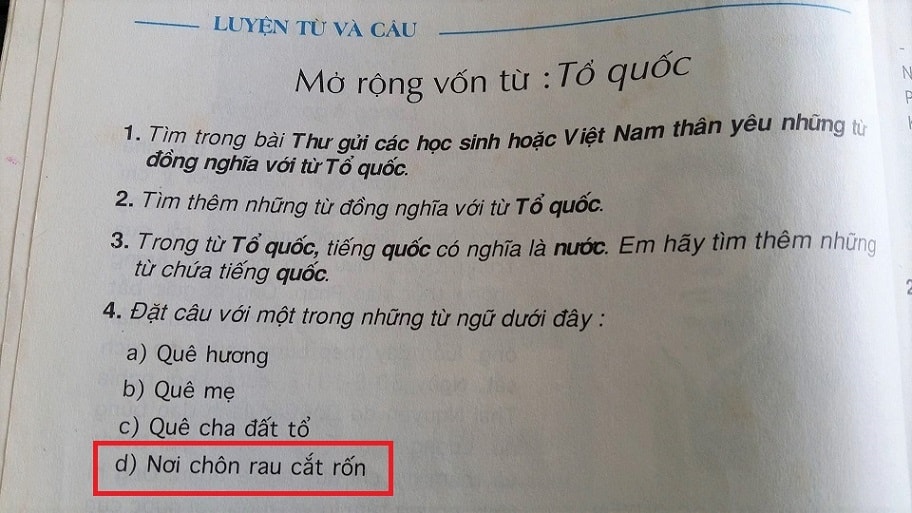 The content in the Vietnamese language textbook for 5th grade, volume 1, is causing concern among parents. Photo: Thanh Hung. |
Meanwhile, Kieu Hai, a journalist in Hanoi, commented: "'Burying the placenta and cutting the umbilical cord' is a very common idiom, even more frequently used than 'burying the placenta and cutting the umbilical cord,' because 'placenta' and 'umbilical cord' sound more natural and pleasant to the ear."
He said that this idiom is recorded and explained in many dictionaries, such as:
- The Comprehensive Dictionary of the Vietnamese Language (Ministry of Education and Training and the Center for Vietnamese Language and Culture), edited by Nguyen Nhu Y.
- Vietnamese Dictionary (Vietlex Dictionary Center), 2014 edition.
- Vietnamese Idioms, by Nguyen Luc - Luong Van Dang, with the collaboration of Nguyen Dang Chau, Pham Van Thu, Bui Duy Tan, printed in 1978 and 2009. The 2009 edition also includes the reverse expression "cutting the umbilical cord and burying the placenta".
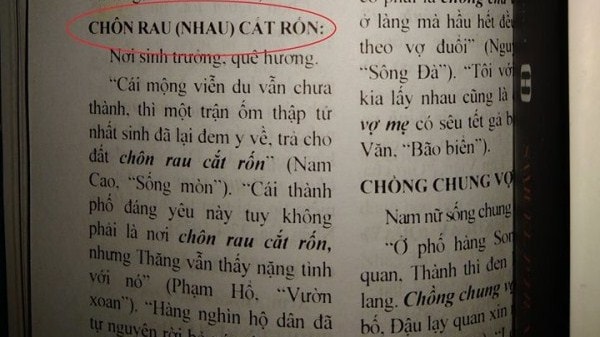 |
| The idiom "burying the placenta and umbilical cord" is explained in a dictionary. |
Mr. Hai added: "Fearing that in the South and previously, people were used to using 'nhau' instead of 'rau' (vegetables), I tried searching further and found that 'chôn rau cắt rốn' (burying the placenta and cutting the umbilical cord) also appeared in the 'Vietnamese Dictionary' by Le Van Duc and a group of literary friends, edited by Le Ngoc Tru, first published in Saigon in 1970."
According to Mr. Hai, parents' opinions may be based on emotion; however, teachers are negligent, lacking the habit of consulting dictionaries before giving feedback, which is "unscientific."
VietNamNet has contacted the Vietnam Education Publishing House to clarify this matter.
Mr. Nguyen Van Tung, Deputy Editor-in-Chief of Vietnam Education Publishing House, affirmed that this statement is not incorrect.
Mr. Tung explained that in Vietnamese, "rau" or "nhau" are two pronunciations (two phonetic variations) of the same word referring to the part that connects the fetus to the mother's uterine wall via the umbilical cord to provide nutrition, excrete waste, and exchange gases through the blood for the fetus.
Mr. Tung cited the following example: The Vietnamese Dictionary of the Institute of Linguistics (edited by Hoang Phe, Da Nang Publishing House and the Center for Lexicography, 2005) has both entries for "rau" and "nhau," but states that "rau" is a dialectal pronunciation (pp. 706, 822).
However, the book Anatomy and Physiology, Volume 2, published by the Ministry of Health (Medical Publishing House, 1986), refers to the aforementioned part as the placenta: "Fetal development is due to the combined effects of the ovaries, the placenta, and the anterior pituitary gland" (p. 93); "The placenta itself also secretes progesterone and estrogen" (p. 94).
Hoang Van Hanh's book "Vietnamese Idioms" (Social Sciences Publishing House, 2015) accepts both idioms "Chôn rau cắt rốn" (burying the placenta and cutting the umbilical cord) and "Chôn nhau cắt rốn" (burying the placenta and cutting the umbilical cord).
As for To Huu, a master poet in the use of folk language, he wrote:
"Whoever visits the Đồng Tháp wetlands,
Northern and Southern Vietnam, the graves of the French invaders.
"The place where we were born and raised!" (To Huu Complete Works, Literature Publishing House, 2009, p. 224)
 |
Thus, Mr. Tung affirmed that the idiom "place where one's umbilical cord is buried" provided in the Vietnamese Language 5 textbook is correct. "In localities where vegetables are commonly called 'nhau,' teachers can explain this to students, and students can also use whichever term is more familiar to them," Mr. Tung said.
Sharing the same view, Associate Professor Pham Van Tinh (Secretary General of the Vietnam Linguistics Association) also believes that "Chôn nhau cắt rốn" and "Chôn rau cắt rốn" are two variations, each used differently in different places, and both are acceptable.
According to VNN


