The letters are shaky.
(Baonghean) - As the new school year begins, parents in the mountainous My Ly commune (Ky Son district) are burdened with many worries. These include concerns about the cost of textbooks, clothes, food, and accommodation for their children. For the people of Cha Nga, Xop Duong, Nhot Lot, and Yen Hoa villages, the added worry is the river and ferry crossing. Because to get to school, their children have to cross the Nam Non River during the rainy season...
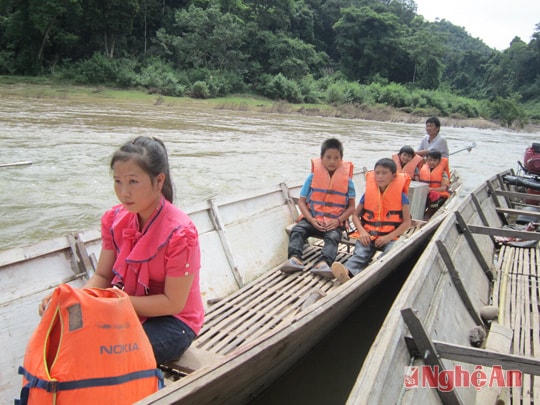 |
| Students in My Ly (Ky Son) go to school on flimsy boats. |
We arrived at the Xieng Tam ferry landing. The river water had been high and muddy for several days. Occasionally, small boats would appear from upstream, speeding along the current and docking at the ferry landing. These were boats from the upper villages, taking their children to school. Looking at the swirling Nậm Nơn river and the fragile little boats, visitors from elsewhere couldn't help but feel worried and apprehensive. This situation has been going on for generations in this riverine region, and it seems unlikely to change anytime soon. In conversation with Mr. Lo Van Lieu, Vice Chairman of the People's Committee of My Ly commune, we learned that My Ly has 12 villages (8 Thai ethnic villages, 3 Mong ethnic villages, and 1 Khmu village), located along the Vietnam-Laos border and on both banks of the Nậm Nơn river. Therefore, except for the four villages located in the central area, namely Xieng Tam, Xop Tu, Hoa Ly, and Xang Tren, where junior high school students can travel to school by road, students in the remaining villages all have to go to school on flimsy wooden boats.
That night, we traveled upstream to Yen Hoa village and stayed at a friend's house. At dawn, the cheerful chatter of children echoed from the ferry landing. Unbeknownst to us, the villagers had gathered at the dock, unanchoring their wooden boats to prepare for crossing the river to school. Then, the fragile boats, each carrying 5-7 students, crossed the river one after another. The boats were small, the oars small, but with their skill and experience, in less than 10 minutes, they had steered their boats to the other side (right bank). They found a place to anchor their boats and then continued along the path winding up the steep mountain slopes to get to class. At this moment, three small boats appeared in the middle of the river, speeding downstream, still carrying the same students on their way to school. A resident of Yen Hoa village explained: "Those are boats belonging to students from villages further north, such as Xop Duong and Cha Nga, located about 20 km from the commune center. The people and students there are very skilled at rowing. During the dry season, it's normal and nothing to worry about, but during the rainy season and floods, it's very dangerous."
For now, we still don't know when all students in My Ly commune will no longer have to travel to school in small, rickety boats on the turbulent Nam Non River. Certainly, the government and all levels of government need to pay more attention to the border commune of My Ly, so that the journey to school for these students will be less arduous and difficult!
Bui Cong Kien