
Proactively secure local sources of passion fruit seedlings.
(Baonghean) - Since 2010, passion fruit has been introduced to Tri Le commune (Que Phong district) and has proven its economic effectiveness, contributing to poverty reduction. Currently, the commune has 70 hectares of passion fruit cultivation, and this area will be further expanded to 500 hectares. To meet the demand for seedlings, a research group from the North Central Agricultural Science and Technology Institute has conducted several breeding experiments.
According to the plan, the area for passion fruit cultivation in Tri Le commune will reach 500 hectares; each year, the commune will expand by 50-70 hectares. However, one of the difficulties in the locality is the lack of breeding facilities that supply good quality, high-yielding passion fruit seedlings that meet processing standards, are suitable for the ecological conditions, and have good resistance to external conditions. For a long time, seedlings have mainly been imported from various sources, and the cost of seedlings is high (50,000 VND/seedling), so the cost of planting 1 hectare is quite high (1 hectare with about 1,100 plants requires an investment of 55 million VND). In light of this situation, the scientific project: "Research on technical measures to produce passion fruit varieties to create raw material areas for the processing industry in Nghe An," led by the North Central Agricultural Science and Technology Institute, focused on researching and finding effective propagation solutions under the ecological conditions of Nghe An to produce high-quality passion fruit varieties.
The variety was investigated and selected in 2012 in three districts: Quynh Luu, Tan Ky, and Que Phong. During the investigation and assessment of the current production status, as well as the effectiveness and quality of the variety, the research team selected the Dai Nong 1 variety, originating from Taiwan, because it is suitable for the climate and hilly soil conditions in the northwestern districts of Nghe An province in general, and Que Phong district in particular. This variety has strong growth potential, high yield, and good quality, meeting the requirements and standards for processing and export. Two commonly used methods are cuttings and grafting. Of these two methods, grafting requires a longer time, while cuttings are faster, ready for planting in 2.5-3 months.
The cutting method is very easy to perform, while the grafting method requires more complex techniques. The cutting method has a high survival rate, reaching 85% of seedlings ready for planting, while the grafting method has a lower survival rate. The project, launched in 2013, initially provided seedlings to farmers, reducing costs to the lowest possible level, from 50,000 VND to 10,000 VND per plant. Currently, the project has supplied over 6,000 seedlings to farmers. Initial calculations show that for one hectare of production, over 40 million VND in seedling costs will be saved. These are significant advantages for mass production of passion fruit seedlings, replacing imported seedlings which have previously posed many risks for passion fruit growers.
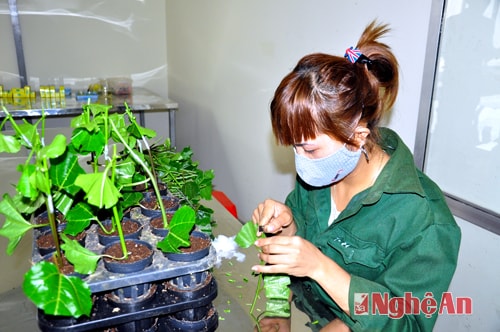 |
| Passion fruit seedlings are being grown at Napaga Agricultural Investment and Development Joint Stock Company. Photo: Tran Hai |
Mr. Quang Van Xuan, from Yen Son village, is one of the earliest passion fruit growers in Tri Le commune. Since 2010, he boldly invested in planting 200 passion fruit vines. Seeing the clear benefits, he expanded his orchard to 0.5 hectares (approximately 800 vines). However, in 2013, his passion fruit orchard, which had only yielded 35 million VND in income, was affected by stem rot disease, causing the vines to gradually die. In early 2014, the project provided him with 400 replacement passion fruit vines. With guidance on planting, caring for, and preserving the plants after harvest, and partial support with seedlings, Mr. Xuan's passion fruit orchard thrived, with a survival rate of nearly 100%. After 8 months of planting, the orchard yielded a very promising harvest. Mr. Xuan stated that he urgently needs more seedlings to replace the remaining vines.
Although the trial period has not been long, the passion fruit propagation method implemented by the project "Research on technical measures for producing passion fruit seedlings to create raw material areas for the processing industry in Nghe An" has clearly shown outstanding advantages. The results in finding technical measures for seedling production and building a successful passion fruit production model have created a breakthrough in passion fruit propagation in Nghe An province. The local government and farmers in Tri Le hope that the model will be further expanded to meet the demand for seedlings, ensuring a local seed source. This also serves as a foundation for developing passion fruit cultivation linked to raw material areas, bringing sustainable economic benefits.
| According to Engineer Le Van Quy - the project leader, the process of propagating passion fruit plants by cuttings involves several simple steps: First, select a semi-mature branch from a plant that is 6 months or older, with two nodes, the upper node 2cm from the lower node. Remove all leaves from the lower node, and cut off 2/3 of the leaves from the upper node. Soak the lower part of the rooting stem in a rooting stimulant solution for about 2 minutes. Then prepare a pot for the cutting, measuring 9x12cm. The soil must be loose and porous. When filling the pot, ensure it is straight and not bent or broken. Next, insert a stick into the center of the pot and then insert the cutting. When inserting, be careful not to plant the leaf side down, but with the leaf facing upwards. After planting, use two fingers to firmly press the soil down; otherwise, the plant will dry out easily. Apply Viben-C fungicide at a ratio of 20g per 8 liters of water, spraying evenly onto the leaves and soil surface to control both plant pests and diseases, as well as soil-borne diseases. Place the seedlings under a shade structure to block 5-70% sunlight and care for them. When the plant has developed several branches and a certain length (approximately 20cm from the apical bud to the top), and the uppermost leaves have stabilized and turned dark green, transplant them. Depending on the weather, the time to transplant may be faster or slower, but it is usually around 2.5-3 months. |
Le Hien


