
Proactive response to drought
(Baonghean) - With the rainy season nearing its end, the average rainfall across the province remains very low, resulting in many large reservoirs and dams only reaching 35-37% of their designed capacity. Therefore, local authorities and businesses are focusing on maintaining, repairing, and reinforcing irrigation canals to ensure efficient and economical water use for production and to cope with the risk of drought.
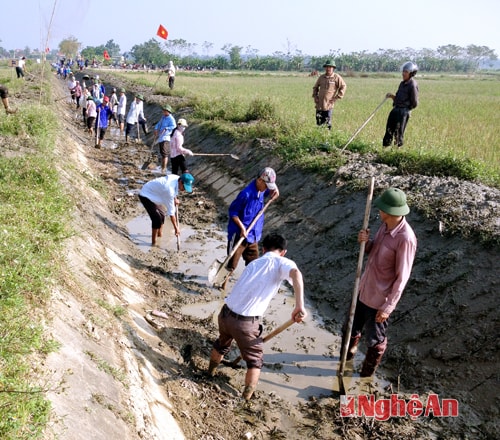
Recognizing the severe water shortage for the two main cropping seasons in 2015, Yen Thanh district launched a campaign on October 12, 2014, to encourage all residents to participate in irrigation work four days earlier than planned. Immediately after the launch ceremony, all communes mobilized their forces to begin irrigation work. Mr. Thai Ba Linh, a farmer from Tuong Lai hamlet, Vinh Thanh commune, said: "My family cultivates 7 sao (approximately 0.7 hectares) of rice fields located at the end of the water source, so dredging and clearing the waterway is extremely important. After a year of use, the canal has become heavily silted, so farmers are undeterred by the difficulties and are striving to complete the work as quickly as possible to obtain water for the spring crop." From October 12th to the present, 44 households and over 50 laborers from Tuong Lai hamlet have participated in dredging a canal more than 1,000 meters long.
Mr. Thai Huy Hoang, Chairman of the People's Committee of Vinh Thanh commune, said: The commune has 488 hectares of rice fields, mainly located at the end of the Do Luong tributary system, making irrigation difficult. Therefore, the commune always prioritizes irrigation work. Immediately after the launching ceremony, all 16 hamlets mobilized for irrigation work with nearly 1000 laborers participating. According to the plan, Vinh Thanh will focus on dredging canals first, namely the Hoi Danh water channel from Ngoc Thanh hamlet to Tien Trung hamlet, and the Roc Len canal from Vinh Tien to Trung Thanh hamlet. The project involves reinforcing a 2 km long canal from Trung Thanh hamlet to Ngoc Thanh hamlet, costing 400 million VND, using funds from irrigation fee subsidies, the commune budget, and contributions from the people. Over 200 laborers were mobilized to dredge the canal at the Rai dam (upgraded since 2009), as the water level in the dam is only over 50% of its designed capacity due to low rainfall. Dredging and repairs help reduce water loss.
In addition, the commune has also implemented the maintenance of field and plot embankments and focused on replenishing the soil for internal agricultural roads. To date, Vinh Thanh has dredged over 700 m3 of mud and soil along a canal over 30 km long. It has also replenished and leveled 1,025 m of soil and stone for internal agricultural roads. Vinh Thanh is continuing to maintain its workforce to complete the dredging and clearing of bushes along the canals, focusing on maintaining field and plot embankments. Not only in Vinh Thanh, but many localities in Yen Thanh district have also launched irrigation projects, maintaining this campaign until December 30, 2014, divided into three phases. The entire district aims to dredge approximately 1.5 million m3 of mud and soil. With high determination, the district has completed over 30% of the work to date.
 |
| Employees of Bac Irrigation Company Limited are deployed to carry out irrigation work in Dien Chau. Photo: Thuy Vinh. |
The Northern Irrigation Company Limited provides irrigation water for nearly 27,000 hectares during the winter-spring crop season; of which, the company is responsible for 17 large and small reservoirs irrigating over 6,000 hectares of rice fields. According to surveys, most reservoirs have low water levels, with some only reaching 50-60% of their design capacity. Therefore, to conserve water in the reservoirs, the company's enterprises have coordinated with local authorities to carry out simultaneous dredging and repair of canals to prevent water loss. At Canal B10 (the irrigation canal of Vuc Mau Reservoir), students from Hoang Mai Town High School are actively dredging. Mr. Duong Canh Tan, an employee of the Hoang Mai Irrigation Enterprise, said: The canal is 6 km long, irrigating rice fields in Quynh Vinh and Quynh Thien districts, but it is frequently silted up. The enterprise coordinated with Hoang Mai Town High School, mobilizing over 1,500 students to participate. Over three days, they dredged 965 cubic meters of mud and cleared nearly 1,000 square meters of bushes. By the end of the campaign, the Hoang Mai Irrigation Enterprise will coordinate with local people to dredge the entire Vuc Mau canal system, including the Main Canal, South Canal, B1 Canal, B10 Canal, etc.
For the past 13 years, Nghe An province has successfully maintained the movement of mobilizing the entire population to participate in irrigation work, in accordance with Resolution 02 of the Provincial Party Committee. This year, there are many new aspects. Instead of organizing a launching ceremony as in previous years, localities, irrigation companies, and farmers have proactively implemented the movement of mobilizing the entire population to participate in irrigation work right in their localities. Most localities in the province launched their irrigation work before October 16th, setting specific goals and tasks based on land conditions and the volume of work. For example, in newly converted land areas, in addition to dredging canals, they also focused on leveling the fields. In other localities, the workforce was generally allocated rationally to focus on dredging and clearing canals and water intake gates.
Mountainous districts are organizing the maintenance, repair, and reinforcement of small dams to expand irrigation models for rice and industrial crops, and repairing temporary water intake structures in streams. Each locality has its own creative and effective approaches. For example, Hung Nguyen district has a specific mobilization plan, with youth as the core, followed by the Farmers' Association, Women's Association, and Veterans' Association, each organization undertaking a specific project. To date, the entire province has mobilized over 20,000 people to participate in dredging canals, removing over 500,000 cubic meters of mud and hundreds of thousands of square meters of bushes along the canals. Everyone is striving to use water efficiently and economically, proactively responding to the risk of water shortages for production in the context of low average rainfall this year.
Van Truong


