
Chu Huy Mân, the "Two Mighty Generals"
General Chu Huy Mân's life was closely linked to the revolutionary cause of the Party and the nation. He always excelled in all his duties, made many contributions, and was a well-rounded military and political leader. He was affectionately loved by officers and soldiers, and was awarded the title "Two Excellences" by President Ho Chi Minh.
General Chu Huy Mân was born and raised in a land rich in patriotism and revolutionary traditions, the homeland of President Ho Chi Minh, the beloved leader of our people.
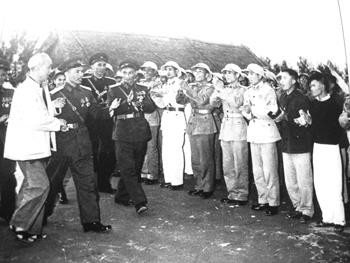 |
| General Chu Huy Mân and officers and soldiers of Military Region 4 welcome President Ho Chi Minh to visit their unit. (Archival photo) |
| RELATED NEWS |
|---|
In May 1951, he was appointed Deputy Political Commissar, then Political Commissar, and Party Secretary of the 316th Division, leading the Division in many major campaigns. Notably, on March 13, 1954, the 316th Division fought the opening battle of the Dien Bien Phu Campaign, destroying the Him Lam stronghold and participating in the final battle to capture General De Castries.
From 1954 to 1960, he was twice entrusted by the Party and President Ho Chi Minh with the important responsibility of Head of the Delegation and Secretary of the Party Committee of the Vietnamese Military Experts Delegation in Laos. In 1961, he returned to serve as Political Commissar, Secretary of the Party Committee, and Commander of Military Region 4. In 1962, he was sent by the Army to study at the Föwrunde Academy (Soviet Union).
In September 1963, the revolution in South Vietnam entered a new phase. Military Region 5 was subjected to concentrated enemy sweeps, inflicting heavy losses on the revolutionary forces. Faced with this difficult situation, he was assigned by the Central Party Committee to the battlefield in Military Region 5. He directed the armed forces of Military Region 5 to defeat enemy tanks despite a shortage of anti-tank weapons, shooting down aircraft with rifles and machine guns. On May 7, 1965, the US 3rd Marine Division landed in Ky Lien commune (Quang Nam province). While still searching for a way to counter them, under the nickname "Hai Manh," he directed: "Strive to shift the mindset of the guerrillas and soldiers from fighting the puppet regime to fighting the Americans, build a perimeter to eliminate the Americans in Chu Lai, and find a way to completely wipe out the American company." Military Region 5 launched a nationwide movement to contribute ideas to fight the American invaders. On May 26, 1965, Company 2, Battalion 70, Quang Nam, for the first time completely annihilated an entire American company. The enemy did not expect that the Chu Lai perimeter would completely disrupt their plans. From the Chu Lai perimeter, the anti-American movement flourished on the Southern battlefield. From there, Military Region 5 built a fairly solid defensive position in both the plains and the mountainous areas.
In August 1965, he was appointed Commander and Political Commissar, and Party Secretary of the B3 Front – Central Highlands. In September 1965, the US deployed forces to the Central Highlands to secure this strategically important area. The Party Committee and Command of the Central Highlands Front, headed by Mr. Chu Huy Mân, decided not to launch the campaign to liberate the North Central Highlands anymore, but instead launched the Pleime-Ia Drang Campaign, which took place from October 19 to November 26, 1965. This campaign completely annihilated one battalion and inflicted heavy losses on two battalions of the 3rd Brigade, 1st Air Cavalry Division of the US Army. It also eliminated the 3rd Brigade of the US Army and almost completely destroyed the 3rd Regiment of the South Vietnamese Army. US General Westmoreland publicly acknowledged: "This was the only US battalion completely annihilated in the war in South Vietnam." Thirty years later, he revealed to his comrades that the reason for the change in strategy and the decision not to launch the campaign to liberate the Northern Central Highlands was that American intelligence had obtained our plan to attack the Central Highlands. General Mueller, the former commander of the 1st Battalion in Operation Pleime, after visiting the old battlefield, asked him about the plan to attack the Central Highlands. He replied, "We proactively postponed that plan." Mueller asked, "Until when?" He answered, "We postponed it until 1975."
In his capacity as a high-ranking military officer in charge of Party affairs, he made immense contributions to building a politically strong army. As Vice Chairman of the State Council and concurrently Head of the General Political Department, he, along with the Party and State leadership, the Central Military Party Committee, and the Ministry of National Defense, proposed many sound policies and decisions, and directly led the successful completion of military and national defense tasks, building and protecting the Fatherland, and focusing on building the army towards a "revolutionary, regular, elite, and progressively modern" direction.
According to nguoicaotuoi.org.vn


