
The Thai script in Nghe An is experiencing a revival.
 |
The Thai ethnic script learning club in Chau Cuong commune was established according to Decision No. 285/QD-UBND dated April 3, 2006, of the People's Committee of Quy Hop district, Nghe An province. In the past two courses, the initial achievements, though modest, have created momentum and built confidence for the People's Committee of the commune to continue opening more courses, serving the goal of preserving and developing the local culture.
In its orientation, the club will maintain its activities by focusing on teaching and learning the Thai script. The Thai script is an ancient Thai writing system with a long history and was widely used for all types of administrative documents in the feudal Thai society of Muong Ham (Quy Hop, Nghe An) in the past. By learning the ancient Thai script, students can read and understand ancient Thai texts, family and clan documents, etc. Simultaneously, indirect activities will also be considered and developed to suit the specific conditions in the new circumstances.
The club commenced its second course on June 30, 2007, and the first revision and supplementation of the "Thai Script Learning Guide" was also completed.
The "Thai Script Learning Guide" consists of six books. It is known that there are eight different Thai script systems in Vietnam, and to date, the Chau Cuong Commune Thai Script Club has received six of them. Accordingly, each script system, along with all its phonetic rules, is designated as a separate book in this series, arranged in the order of "reception" by the Club. Specifically, as follows:
- Volume I: Hybrid script - handwriting. Scope of use: mountainous districts in the Northwest of Nghe An province (Que Phong, Quy Chau, Quy Hop, Con Cuong...).
- Volume II: Hybrid Script - Muong Ham Region. Scope of use: Thai Script Club of Chau Cuong Commune, Quy Hop District, and members in various other localities.
- Volume III: The Hybrid Script System - Muong Muoi Region. Scope of use: Son La and Lai Chau provinces…
- Volume IV: Hybrid script system - Muong Mun region. Scope of use: Hoa Binh province.
- Volume V: Hybrid script system - Thai Thanh region. Scope of use: Thanh Hoa province and some districts in northwestern Nghe An province, where Thai Thanh people live.
- Volume VI: The Lai-Pao script system. Scope of use: Tuong Duong district (Nghe An province) and some localities along Highway 7.
The content of the readings in each book is consistent. These readings are taken from traditional texts, ritual texts, folk songs, and even some works by contemporary authors. Each lesson consists of two separate readings, suitable for the learning needs of both adults and high school students; on the other hand, it closely follows the cultural content and customs of the Thai people. In fact, some older students, after completing the course, were able to grasp more content and perform some simple rituals (for ancestors) within their families. Besides learning the Thai script, this is a great encouragement for many students, as it has partially met their own and their family's needs.
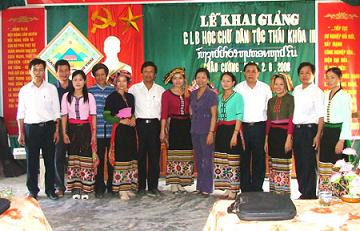
On August 2nd, 2008, the Club inaugurated its third course for 35 local residents. This course is considered the smallest compared to previous courses (which at their peak had up to 200 students). A significant difference is that from this course onwards, all activities and basic orientations of the class will be linked to the overall direction of the Vietnam Thai Script Preservation and Development Network (VTIK), coordinated by the Thai Studies Program of the University of Social Sciences and Humanities.
The revival of the Thai script within the community life of the indigenous people is gradually awakening intangible cultural heritage values, enabling these values to continue serving the sustainable development goals of contemporary life. In a quote from UNESCO, Professor Deborah Wong of the University of Riverside, California, USA, affirmed: “One of the key characteristics of intangible cultural heritage is that it is constantly recreated by communities and groups (...). Without recreation, there is no contemporary life; a traditional cultural activity can only have value in a museum.”
Observations from the Thai script club classes in Chau Cuong commune (Quy Hop district, Nghe An province) during recent courses show that people enthusiastically attend classes regardless of age, ethnicity, occupation, or occupation… Although it is still simply about sharing knowledge and learning from each other, the important thing is that the Thai script continues to be passed on to future generations.
Text: Sam Van Binh, Photos: Vo Ngoc SonChau Quang, Quy Hop, Nghe An


