
Not sustainable...
(Baonghean) - Besides leveraging internal resources and focusing on utilizing state support programs, localities in Do Luong district are mobilizing people to exploit land potential and labor capacity... to implement economic projects aimed at improving agricultural production efficiency. In particular, the transformation of crop and livestock structures is considered the "key" to economic development...
Currently, in the fields of Do Luong district, farmers are continuing to improve their land, intensify irrigation work, plow and plant crops, and prepare for the spring crop. To ensure close guidance and direction for localities to successfully implement the cropping seasons, the district has assessed the results of the "Crop and Livestock Restructuring and Aquaculture" project over the past two years (since 2012). Accordingly, the area of rice, beans, vegetables, mulberry trees, paper raw material trees, and improved orchards has increased compared to the plan; at the same time, the area of corn and peanuts has decreased, and notably, the area of seasonal rice has gradually decreased towards conversion to dryland crops. The area of high-quality rice and rice seed production in 2013 reached 2,153 hectares/1,750 hectares of the plan (equivalent to 123%). Regarding the shift in livestock development, although many localities, through various channels, have organized and encouraged a model to create a transformation in livestock farming towards commercial production, based on the aforementioned plan, only the targets for developing lean meat pigs and foreign breed sows (Mong Cai) have been achieved.
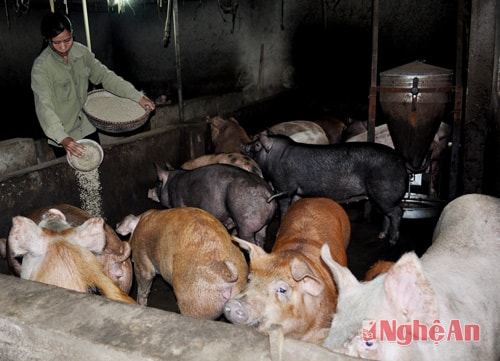 |
| Commercial pig farming at the household of Nguyen Thi Thu Hien, Hamlet 2, Thuan Son Commune, Do Luong District. |
Thus, the restructuring of crop and livestock production in Do Luong district still needs to continue, requiring adjustments in both guidance and specific support, as well as raising awareness and improving production skills for farmers. Mr. Tran Doan Hung, Head of the Agriculture and Rural Development Department of Do Luong district, frankly admitted that the main obstacle remains the lack of strong and synchronized application of new scientific and technical advancements in production; crop and livestock models are still largely demonstration-based and slow to be replicated. In addition, some commune authorities have only focused on investing in infrastructure development without truly paying attention to investing in supporting production development and increasing people's income; and there is still much confusion in selecting and building production development models. In reality, the current restructuring of crop and livestock production requires a very large linkage between farmers and various service providers such as businesses supplying seeds, science and technology, and materials. However, the inadequate awareness and responsibility of local authorities have inadvertently "pushed" businesses away from their goals of connecting with farmers. For example, the planned rice seed production area in eight communes – Yen Son, Van Son, Thinh Son, Hoa Son, Lac Son, Xuan Son, Tan Son, and Minh Son – covering over 1,000 hectares (as of 2015), has only reached 205 hectares after three years. "Based on our observations, seed companies require farmers to sow seedlings for transplanting, but the farmers refuse. The local authorities are also unenthusiastic and lack effective guidance, so the seed companies are quietly withdrawing," Mr. Hung explained.
Through our research in several communes, we found many difficulties in planning and directing the restructuring of crop and livestock production. In Xuan Son commune, besides building a model for producing high-quality AC5 rice on about 100 hectares (out of a total area of 315 hectares), people still heavily rely on old production practices, and another major difficulty is the slow progress of land consolidation and exchange, with each household currently cultivating 4-5 plots of land. When asked about specific solutions to promote the implementation of crop and livestock transformation according to the district's plan, Mr. Nguyen Dinh Thu – Vice Chairman in charge of economy of Xuan Son commune – said that the commune focuses mainly on livestock farming, providing capital and land leases to capable farmers to build barns and develop livestock farming in an industrialized direction, and developing pond and reservoir areas for aquaculture, increasing the area for growing grass to boost cattle farming... However, to date, Xuan Son commune only has 7 pig and chicken farms, while the development of aquaculture and grass cultivation for cattle farming is still "not well implemented."
In Thuan Son commune, the implementation of crop restructuring is more evident, thanks to available land and effective land consolidation. Currently, each household cultivates an average of 1.3 plots of land, and the people are very conscious of investing in improving the land, embankments, and field boundaries. Many households have spent tens of millions of dong to rent machinery to improve the production surface. The commune has also planned watermelon growing areas in the Dong Lo area and the resettlement areas of hamlets 1 and 2, with 4 hectares in each area. However, the difficulty is that in recent years, the market for watermelons has been poor, and the watermelon plants are gradually becoming stunted due to diseases that cannot be prevented or treated. Nevertheless, Thuan Son is achieving results with the conversion from sweet potatoes to pumpkins in the winter season, with an area of 20-30 hectares annually.
Mr. Nguyen Nhu Bon – Vice Chairman in charge of the economy of Thuan Son commune, said: “Winter pumpkin crops in Thuan Son are yielding good income, about 20 million VND/hectare; households planting an average of 5 sao (approximately 0.5 hectares) have earned 5 million VND in just 3 months while incurring very low costs, mainly just labor.” According to Mr. Bon, Thuan Son is also seeing a growing trend of large-scale commercial pig farming at the household level. Currently, the entire commune has about 20 households raising 70-150 pigs per year. We visited the pig farming household of Nguyen Thi Thu Hien in Hamlet 2, Thuan Son, where she told us that she and her husband switched from traditional farming to large-scale farming in 2006. Only in 2010, due to the "downturn" in market pig prices, did they incur losses; otherwise, they have made a profit. For the past two years, she has raised about 150 pigs annually, selling 3 batches, earning nearly 100 million VND in profit each year. She also raises several breeding sows, so she practically has a closed-loop farming process.
To implement the Project on restructuring crop and livestock production, many communes in Do Luong district have utilized various programs and projects to build production models suitable to their local conditions; among them, the models implemented by the District Agricultural Extension Station, focusing on production according to VietGAP standards, are noteworthy. ... However, as Ms. Nguyen Thi Hanh – Head of the Do Luong Agricultural Extension Station – shared, while most models are effective, due to a lack of investment capital from the people and a lack of attention from local authorities in replicating the models, the results are slow to materialize or are not fully realized.
Thus, the implementation of the crop and livestock transformation project lacks sustainability, partly due to the responsibility of the authorities at all levels, posing the biggest challenge to the goal of developing it into a new production movement in Do Luong; meaning that the "key" has yet to unlock the door to agricultural economic development in this locality.
Text and photos:Dinh Sam


