
No increase in tuition fees, strict control over textbook prices.
Reporting at a meeting on price management of important and essential goods chaired by Deputy Prime Minister Le Minh Khai, Head of the Steering Committee for Price Management, on the afternoon of June 13th, Deputy Minister of Education and Training Pham Ngoc Thuong stated that the Ministry agrees with the solution of the Ministry of Finance to continue to maintain the current price of educational services for the 2022-2023 school year, despite price increases in many other goods.
The Ministry of Education and Training will continue to maintain the current prices of educational services for the 2022-2023 school year, without increasing them; and will strictly control textbook prices, ensuring that every student has access to textbooks at reasonable prices.
The process of declaring textbook prices is very strict.
Regarding proposed price management measures for the remaining months of 2022, the Ministry of Finance suggested that, for goods and services whose prices are set by the State, price adjustments should not be considered for the time being. Prices should remain stable to ensure overall inflation control and support businesses and the people. Any price adjustments according to the roadmap must be carefully assessed for their impact on the Consumer Price Index (CPI) to ensure sufficient room for controlling inflation throughout the year.
Given the developments and forecasts of gasoline and oil prices in the last months of the year, which are expected to impact the CPI, adjustments to education service prices need to be carefully considered. Therefore, the Ministry of Education and Training is requested to submit to the Government a plan for managing education service prices, ensuring the goal of controlling inflation.
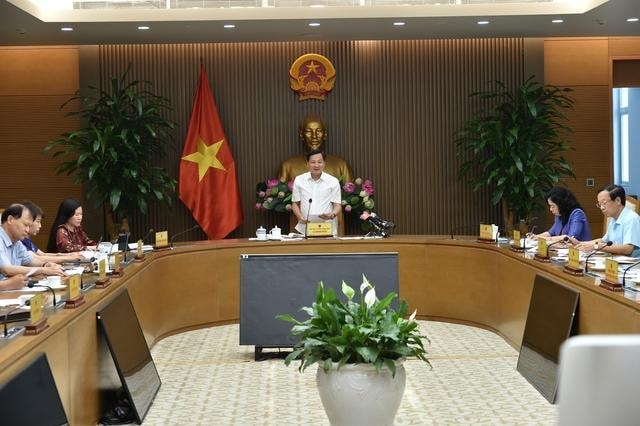 |
Exercise extreme caution when increasing tuition fees; ensure all students have access to textbooks at reasonable prices. Photo: VGP/Quang Thuong |
Explaining the higher price of the new set of textbooks compared to the old sets, Deputy Minister Pham Ngoc Thuong said that besides the issue of the number of printed copies, it is also related to the mechanism for determining the price.
Previously, the costs of compilation and printing were covered by the State; now, with the implementation of socialization, publishing houses invest their own money in compilation and printing, resulting in higher prices. The number of official textbooks is not higher than the old ones; in fact, the total number of books from primary to lower secondary school is two less.
Before the Law on Prices was amended, the Ministry of Education and Training, in coordination with the Ministry of Finance, strictly enforced price declarations by businesses for this product. Each time a price declaration was submitted, the Price Management Department (Ministry of Finance) conducted a thorough review. After each declaration, the price of each set of textbooks decreased by 5-15%.
The Ministry of Education and Training has also issued a directive to its specialized units to research and develop technical standards and norms for textbooks. This is being carried out urgently as the textbook compilation schedule is nearing completion.
No increase in education service fees for the 2022-2023 school year.
Regarding tuition fees, Deputy Minister Pham Ngoc Thuong stated that, according to Decree 81/2021/ND-CP (which regulates the mechanism for collecting and managing tuition fees for educational institutions within the national education system and policies on tuition fee exemption and reduction, support for learning expenses; and service prices in the field of education and training), the Government stipulates the tuition fee framework and ceiling for each locality, and the unit decides the specific tuition fee for each academic year within the framework and ceiling set by the Government.
Due to the impact of the COVID-19 pandemic, the Ministry advised and received approval from the Government to maintain tuition fees for the 2021-2022 academic year. However, starting in September of the 2022-2023 academic year, a tuition fee increase will be implemented according to regulations. Under this plan, public preschool education fees will increase by approximately 75%, and university fees by approximately 12.5%.
According to estimates from the General Statistics Office, the adjustment of education service prices will impact the national average CPI in 2022 by approximately 0.55-1.05%, and tuition fees for the 2022-2023 school year are expected to impact the CPI by 1.5-2.8%.
In accordance with the Resolution of the May Government meeting, the Government has assigned the Ministry of Education and Training to review and assess the impact of price increases for educational services and textbooks, and to report to the Government next month.
The Ministry of Education and Training agrees with the Ministry of Finance's solution to maintain the current prices of educational services, without increasing them, for the 2022-2023 school year.
According to Deputy Minister of Finance Vu Thi Mai, textbook prices are currently managed according to regulations in the Education Law and the Price Law. Accordingly, textbook prices are on the list of items subject to price declaration, and are not on the list of items whose prices are set or stabilized by the State.
During the 2022-2023 school year, the Ministry of Finance, in coordination with the Ministry of Education and Training, implemented the process of receiving price declarations for textbooks and issued a document requesting units to review and implement cost-saving measures (especially for certain expenses such as management costs, book promotion costs, profits, etc.) in order to continue controlling inflation, ensuring social welfare, and sharing the burden with consumers.
To date, educational institutions have declared price adjustments and reductions for textbooks, with common reductions ranging from 5% to 15% depending on the book.
The higher overall price of the new set of textbooks compared to the old ones is mainly due to differences in book size, the number of books, and the increased number of colors used in printing. This results in higher material costs for the new books.
Furthermore, the prices of input factors such as raw materials and labor costs are currently higher than before; at the same time, some costs such as manuscript costs and initial royalties are not subsidized by the State budget and are included in the textbook price.
Some newly incurred costs, such as advertising and promotion expenses, and profits, are included in the textbook price according to the regulations on pricing and corporate income tax (old textbooks do not have these costs).
Include textbooks in the list of goods subject to state price control.
Currently, the Ministry of Finance is widely soliciting opinions on the draft Law on Prices (amended), which includes textbooks in the list of goods subject to state price regulation and assigns the Ministry of Education and Training the responsibility of regulating textbook prices in accordance with technical and professional requirements to ensure reasonable prices that meet professional requirements in education and training.
"While awaiting the National Assembly's approval and implementation of the amended Price Law, the Ministry of Finance will continue to coordinate with the Ministry of Education and Training to receive and thoroughly review price declaration documents in accordance with the law to stabilize textbook prices," Deputy Minister Vu Thi Mai affirmed.
Ms. Vu Thi Mai also stated that for the 2022-2023 academic year, the Ministry of Education and Training, as the lead agency on tuition fees and educational service prices, issued Official Letter No. 2153/BGDĐT-KHTC dated May 24, 2022, requesting ministries, sectors, People's Committees of provinces and cities, and educational institutions to develop appropriate tuition fee levels and fee increase schedules, contributing to price stability and ensuring social welfare. This includes policies to support tuition fee exemptions, reductions, and extensions of payment deadlines, as well as support for textbooks for students from disadvantaged backgrounds, remote areas, mountainous regions, and islands. Simultaneously, it emphasizes strengthening inspections, supervision, and transparency in disclosing information on educational service prices, textbook prices, and educational materials and equipment.
According to Nguyen Thi Huong, Director General of the General Statistics Office, the price of education services in the CPI calculation is very high (5.45%) and is expected to increase at a rate of 10-19%. Currently, due to the impact of the pandemic, support is still being provided. The question is, when state support is no longer available, solutions must be found to prevent provinces and cities from simultaneously increasing the price of education services.
Ms. Huong also stated that textbook prices account for a very low proportion, only 0.3% of the CPI, and that while a price increase could be considered, a specific roadmap is needed.
Exercise extreme caution when raising tuition fees; ensure all students have access to textbooks at reasonable prices.
Emphasizing the need for extreme caution when increasing tuition fees, and urging public educational institutions to carefully calculate the impact and have a roadmap, Deputy Prime Minister Le Minh Khai cited figures from the Ministry of Education and Training, stating that the price of educational services for the 2022-2030 school year is expected to increase by 40-90%, impacting the overall CPI in 2022 by 0.55-1.05%, which is a very significant increase.
With the combined impact of rising fuel prices and other commodities, managing the situation will be very difficult. Considering that increasing education service fees is not the last resort, the Deputy Prime Minister suggested that the Ministry of Education and Training, in coordination with the Ministry of Finance, consider, based on available state budget resources, the possibility of continuing appropriate support at a certain time.
Regarding textbooks, the Deputy Prime Minister requested a thorough study of legal regulations on pricing to manage prices appropriately according to the actual situation, ensuring that all students have access to textbooks at reasonable prices. Textbooks are essential goods that every student must purchase; therefore, the socialization of textbook compilation and printing needs to be appropriately designed to meet requirements.


