
Effective remedies for sore throat using... wild plants.
This wild plant, which grows abundantly along roadsides and field edges, is a remedy for many ailments such as back pain and soft tissue injuries.
Wild perilla, also known as wild perilla, little devil's needle, strong flower grass, single needle, single needle, button flower, etc., is a wild herbaceous plant commonly found along roadsides, field edges, and wastelands around houses. Its stem and branches have longitudinal grooves and are covered in hairs.
Leaves are opposite, with long petioles; leaflets are lance-shaped, slightly rounded at the base, with short petioles and coarsely serrated margins. Flower heads are yellow, growing singly or in pairs in the leaf axils or at the tips of branches. The fruit is a spindle-shaped achene, 3-sided, irregular, 1 cm long, with longitudinal grooves.
According to traditional medicine, the herb *Polygonum multiflorum* has a mildly sweet taste and a neutral nature. It has the effect of clearing heat, detoxifying, dispersing stagnation, and reducing swelling. It is used to treat colds, flu, sore throats, enteritis, malnutrition in young children, injuries, rashes, and ulcers...
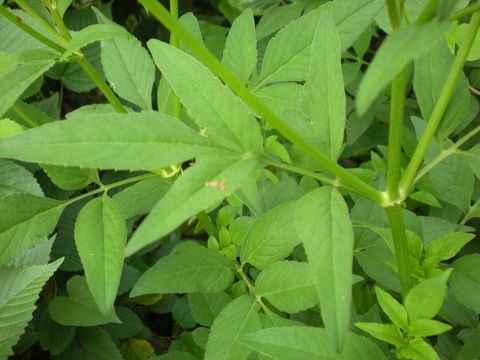 |
| The trunk and branches of the bo binh plant have longitudinal grooves and are covered with many hairs, especially along the edges of rice fields and roadsides. |
Some commonly used remedies:
Treatment for back pain caused by overexertion: Wash 150-180g of purslane, boil it to extract the juice, add 250g of jujube, brown sugar, and a little white wine, simmer over low heat until the jujube is soft; Divide into 4-5 portions and drink over 2 days, for 7-10 consecutive days.
Treating allergic rashes caused by weather changes: Boil 100-200g of water spinach in 4-5 liters of water for bathing, and at the same time rub the remaining pulp thoroughly onto the rash. Usually, only 1-2 applications are needed to see results.
To treat minor soft tissue injuries, hematomas, and pain: Take 10-15g each of the leaves and flowers of the *Polygonum multiflorum* plant and the leaves of the *Dioscorea opposita* tree, crush them together, and apply as a poultice to the affected area 1-3 times a day.
Treating toothache and cavities: Wash both the flowers and leaves of the wild spinach plant, add a little salt, crush them, and apply to the painful area. Alternatively, take 50g of wild spinach, wash it, and soak it in 250ml of white wine (at a ratio of 1/5). In case of toothache, hold it in your mouth for a while and then spit it out.
Treatment for sore throat caused by cold: Use 10-15g each of *Polygonum multiflorum* (both flowers and leaves), honeysuckle, *Wedelia chinensis*, lemon balm leaves, and licorice root. Boil these ingredients together and drink one decoction per day, divided into two doses. Use for 5-7 days.
Treatment for rheumatic pain: Wash 30-60g of purslane thoroughly, boil it in water, and drink the decoction in two doses per day. Use for 10-15 days.
Treatment for infantile malnutrition: 15g of water spinach, 30-60g of pork liver. Wash the water spinach leaves thoroughly, place them at the bottom of a pot, cover with water, and steam until cooked. Divide into two portions per day and consume for 5-7 consecutive days.
It is necessary to distinguish wild Bidens bipinnata L. (also in the daisy family) from another plant called Bidens bipinnata L., which also grows wild everywhere. Bidens bipinnata differs from Bidens bipinnata only in that it has more than 3 compound leaves and its flowers are in a head-shaped cluster and yellow in color.
According to Health and Life


