
Standardizing commune-level planning
(Baonghean) - With the support of various programs and projects, in recent years, communes, wards, and towns (collectively referred to as the commune level) in Nghe An have seen many positive changes in the orientation and management of socio-economic development. In particular, with over 5 years of operation, the Poris project - “Poverty Reduction through Strengthening Institutional Capacity in Quy Chau District and Nghe An Province” funded by ODA from the Government of the Kingdom of Belgium and counterpart funding from Vietnam - has actively contributed to building a standardized roadmap for commune-level planning.
With the largest geographical area in the country, Nghe An has 21 district-level administrative units and 480 commune-level administrative units. The complex terrain and the large number of ethnic minorities living there result in significant differences in development conditions among communes, or more accurately, a clear disparity between lowland and mountainous districts and communes, especially in the high mountainous districts which still face many difficulties. Over the years, with state investment and the mobilization of additional social investment, the gap between regions is gradually narrowing. However, the coordination of resources for the province's development still has certain limitations. One of the fundamental reasons for this is the inadequacy in planning, the mobilization of investment capital, and particularly the weaknesses and shortcomings in development planning at the local level.
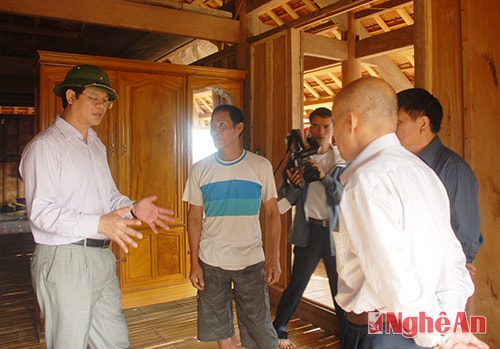 |
| Comrade Le Xuan Dai visits and inquires about the well-being of people resettled due to the Hua Na Hydropower Plant. Photo: Thanh Duy |
Aware of this limitation, over the years, provincial leaders have consistently directed departments, agencies, and districts to strengthen investment in development at the commune level, demonstrated through the combination of national projects and programs, as well as domestic and international funding projects. These efforts have gradually helped ethnic minority communities in the province improve their living conditions, while also creating a foundation for perfecting the policy framework related to socio-economic development planning. From 2010 to the present, policy research and the reform of mechanisms for local socio-economic development planning, especially at the commune level, have seen significant progress thanks to the participation and support of many units, organizations, and projects, such as the Poris Project, Luxembourg's VIE028 Project, projects from Oxfam, and SNV. Six districts participated in project areas and piloted reforms in socio-economic development planning at the commune and district levels.
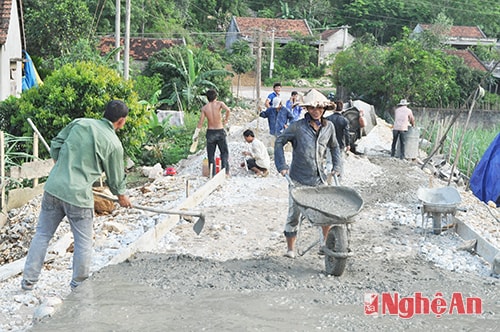 |
| Residents of Chau Hanh commune are building a concrete road to the Ke Ninh ferry terminal. Photo: Nguyen Hai |
Overall, the planning methodology has yielded encouraging results and has been implemented with a very high level of consensus. Local people have actively participated in the local planning process, and the pressing needs of communities have been partially integrated into development promotion programs such as 30a, 135, and other national target programs. This process has received timely support from the project “Poverty Reduction through Strengthening Institutional Capacity in Quy Chau District and Nghe An Province” (Poris). This project is managed by the Department of Planning and Investment and Quy Chau District with ODA grant funding from the Government of the Kingdom of Belgium and counterpart funding from Vietnam. The purpose of the project is to help communes reduce poverty by strengthening their capacity in planning and management over a 5-year period, from September 2009 to September 2014. Project components include training to improve the skills of commune officials; Financial support for planning from villages to communes; support for economic models, construction of welfare facilities... These interactions significantly contribute to promoting socio-economic development for the poor through support for public administration reform at all levels, with the commune level being the closest to the people. The Poris project is based on the principle that the commune level is close to the people, the unit that can best identify priorities and best address the needs of the people.
After more than 5 years of implementation in communes and towns, the project, led by the Department of Planning and Investment, has made many adjustments to the methodology for socio-economic development planning, making it increasingly more rational to the province's conditions. It is time for us to review and evaluate the results achieved by the program to improve the institutional capacity at the commune level, thereby summarizing the lessons learned to continue developing new policies for socio-economic development planning in each locality. During our monitoring of the Poris Project's activities, we have observed several encouraging aspects. These include:
Firstly, the project has established a management system and planning manual at the commune level in Quy Chau district, which has had a significant impact on the understanding and responsibility of commune officials and the enthusiastic participation of a large number of ethnic minority people in planning, contributing to infrastructure construction, and operating and maintaining small-scale infrastructure projects.
Secondly: Through its activities, the project contributes to assessing the institutional capacity and research on local economic development; it also evaluates the current state of public service provision and the development of a commune-level economic development model in Quy Chau district in more detail.
Thirdly: The Poris Project, in collaboration with the Department of Planning and Investment and in coordination with donors Oxfam Hong Kong (OHK), LUXDEV, and SNV in Nghe An province, has completed the development of an innovative planning process at the commune level. This process has been piloted in five western districts (Quy Chau, Ky Son, Tuong Duong, Con Cuong, Thanh Chuong) and one lowland district - Nghi Loc. The Department of Planning and Investment is currently drafting this process and advising the Provincial People's Committee to potentially issue it for application in all communes.
Fourth: This is one of the project's most outstanding policy contributions to Nghe An. Together with the "Provincial-Level Planning Process" research group, led by the Department of Planning and Investment, the pilot implementation of the annual socio-economic development planning process at the commune level was successfully supported by the project and institutionalized into a general regulation on commune-level planning, applied uniformly throughout the province from 2014. The Provincial People's Committee approved Decision No. 811/QD-UBND dated March 7, 2014, and it was applied throughout the province starting from the 2015 planning period. Immediately after the Provincial People's Committee's decision, the Department of Planning and Investment coordinated with programs and projects to organize capacity-building training for provincial and district-level officials in planning and administrative reform; and conducted training for commune officials on applying the innovative socio-economic development planning process for communes throughout the province.
In the coming period, building on the project's implementation results, the Provincial People's Committee will continue to direct relevant agencies to improve the technical aspects of the processes; in addition, it will direct research into mechanisms to enhance the sustainability of the new planning methodology, such as: strengthening the planning linkage between communes and districts, piloting some models of direct budget decentralization to communes through community implementation and government management, as well as institutionalizing training in the province's training units. This activity is based on the achievements of the commune-level planning reform implemented in the past period. Therefore, it is necessary to promote the socialization of planning work, change the planning mindset from passive to proactive based on internal resources and mobilize maximum resources, integrate international and national programs and projects... to invest effectively in socio-economic development, improve people's lives, and contribute to the successful implementation of the New Rural Development Program in the communes.
Le Xuan DaiButMember of the Standing Committee of the Provincial Party Committee, Vice Chairman of the Provincial People's Committee
Why is planning at the commune level necessary? The commune level is the closest to the people, so any innovation in the government's management methods will have a direct impact on the people and will easily gain their support. To improve the effectiveness of directing and managing socio-economic development in the province, the Provincial People's Committee can proactively issue regulations on planning work at the commune and district levels within the province. Reforming commune-level planning does not require many adjustments in the way the State directs and manages; it simply involves creating a mechanism for proposals from the grassroots level to be more fully reflected in the State's investment decisions. Reforming the planning process helps to enhance the capacity of not only grassroots officials but also provides district and provincial officials with more knowledge about the grassroots level, creating conditions for provincial and district policies to become closer to the people. Steps in community-level planning Step 1:Issuing directives and guidelines for plan development: Issuing directives, organizing conferences to implement information gathering. Step 2:Information gathering and synthesis: Gathering information from villages; Gathering information from departments and organizations; Gathering information from higher levels. Step 3:Commune planning compilation: Compiling the commune planning framework, entering and compiling data on the computer, evaluating the feasibility of proposed activities and capital structure, drafting the socio-economic development plan. Step 4:Discuss and approve the draft plan and report to higher authorities: Organize a planning workshop at the commune level, update and finalize the draft after the workshop, send the plan to higher authorities for review and integration into the sectoral plan, and provide feedback to the commune level. Step 5:Consultation, feedback, and plan refinement: Consultation, information updates, and completion of the draft plan. Step 6:Finalize, submit to competent authorities for approval, and organize the implementation - Legalize the prepared plan. |


