One love
(Baonghean) - I was deeply moved as I sat in that auditorium. Below, the stage was brilliantly lit, and behind the music, were smiles and tears of reunion. They – musicians, artists, folk artisans of all ages – gathered here from all corners of the country. They may or may not know each other, but that doesn't matter, when the sacred shared love of folk songs and melodies has brought them all together…
(Baonghean) - I was deeply moved as I sat in that auditorium. Below, the stage was brilliantly lit, and behind the music, were smiles and tears of reunion. They – musicians, artists, folk artisans of all ages – gathered here from all corners of the country. They may or may not know each other, but that doesn't matter, when the sacred shared love of folk songs and melodies has brought them all together…
The man, with his romantic appearance, thin salt-and-pepper hair, casually tied up in a bun, and slender build, arrived very early and sat thoughtfully alone on the vast row of seats. “I arrived a little early because I was so impatient; I read the invitation to 9 am over and over again, but I still ended up arriving an hour early!” – folk artist Nguyen Canh Binh (Nghi Hai Ward, Cua Lo Town) began the conversation. Nguyen Canh Binh was invited by the Provincial People's Committee to attend the meeting to honor folk artists and collectives and individuals with outstanding achievements in the preservation, promotion, and documentation of Nghe Tinh folk songs. Nguyen Canh Binh easily gives the impression of a romantic, carefree demeanor with his rugged appearance, but the more you talk to him, the more you realize that this seemingly romantic air, if it exists at all, only seems to exist during those moments when he is inspired to compose new lyrics for the folk songs. Otherwise, it all comes down to sincerity, seriousness, and a willingness to learn.
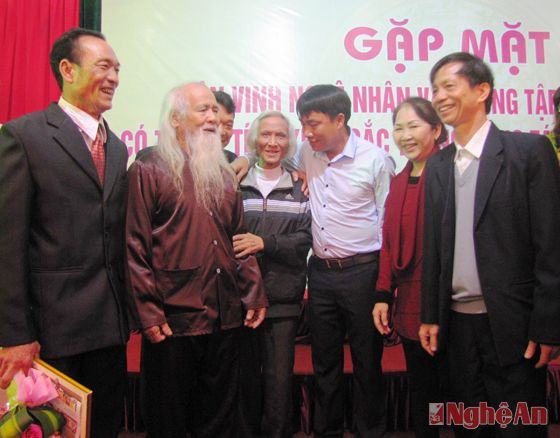 |
| The joy of reunion. Photo: Thanh Chung |
There were moments of poignant silence as he recounted his impoverished childhood, with images of stormy seas, his father's small, dilapidated boat silently resting its bow on the blood-stained, silvery sand, covered in clam shells. He and his siblings would gather clams and snails, adding salt and chili to their meals to get through those hungry days. “On stormy days, the whole village would sit and wait for the storm to pass. My mother would sit and mend nets while singing. She sang often, and she sang beautifully, the boatman's songs, the laments of parental love and sacrifice, the folk songs of the coastal people… they gradually seeped into me without me even realizing it,” confided folk artist Nguyen Canh Binh. He added that people often say, “Sing to forget hunger and hardship, sing to give you more faith and strength for the future,” which might seem cliché, but it's true. "Because the folk songs are so skillful, they're sung as if they're telling their own story, revealing both their past and future. They're sad, but they don't drag people down; they lift them up."
It was the simple sadness in the folk songs his mother sang that nurtured his love for the Ví and Giặm folk songs, making them an indispensable part of his being. Now over eighty years old, he has been dedicated to Ví and Giặm folk songs for nearly 70 years. He diligently collects ancient Ví and Giặm melodies from coastal regions, adding a unique element to the folk song treasury of Nghe An province. Unlike Ví and Giặm folk songs from the plains and midlands, the Ví and Giặm from the salty coastal areas have a unique appeal, both vigorous with boat rowing chants, describing the scenery and stimulating the spirit of labor, and expressing the sorrows of those whose lives are spent adrift on the waves. For almost his entire life, he has personally spent his own money traveling throughout the beaches and docks of Nghe An province to find and transcribe such authentic and vibrant songs. From fishing songs to daily life songs… With each field trip, his “family heirloom” notebook grows a little thicker, and he lives in complete happiness amidst the simple, heartfelt folk songs of his homeland. “I used to fear that the folk songs of the coastal people would be lost, so much so that I repeatedly copied down the pieces I collected and sang them to my children and grandchildren. Now I am at ease. The Ví and Giặm folk songs have become an intangible cultural heritage of humanity, and this has awakened the responsibility of preserving and promoting Ví and Giặm among all the people,” affirmed folk artist Nguyen Canh Binh.
I was fortunate to meet folk artist Nguyen Nghia Hoi (Nghia Hoi, Nghia Dan), one of the guardians of the Vi and Giam folk songs in the basalt land of Phu Quy - a multi-ethnic, multi-cultural region. He was a respected former teacher at many schools in Nghia Dan district. For decades, he dedicated himself to teaching, starting from the early 1960s and 1970s. Besides teaching and shaping character, he also passionately incorporated folk song practice sessions into extracurricular activities and organized singing competitions for students and teachers to rekindle their love for Vi and Giam folk songs. “The lyrics of the Ví and Giặm folk songs are mostly words of gratitude and have a very good educational value in shaping character and nurturing the souls of the younger generation. Folk songs are not just songs, but also lessons. I am very happy that the Education Department of our province has promoted the folk song singing movement in schools, so that folk songs truly live strongly in the hearts of young people,” shared folk artist Nguyen Nghia Hoi. He proudly stated that in Phu Quy, not only the Kinh people, but also the Thai and Tho ethnic groups love and sing Ví and Giặm folk songs just as well as anywhere else.
Ví and Giặm are songs that soar from the daily lives of the people; therefore, they are not "picky" about performance spaces, nor are they strict with singers or listeners. Anyone can sing and listen to Ví and Giặm, because they touch people's hearts in such a simple yet profound way! In the auditorium today are familiar faces from the journalistic journey, including those who have become subjects in many journalistic works such as Artisan Võ Thị Vân (Ngọc Sơn, Thanh Chương), Artisan Cao Xuân Thưởng (Diễn Hoa, Diễn Châu), Artisan Trần Văn Hồng (Đông Hiếu commune, Thái Hòa town)... and musicians who have chosen folk music as their guiding principle in their artistic careers, such as composers Lê Hàm, Thanh Lưu, and Võ Văn Thế... Joy shone brightly on everyone's faces, warm handshakes of friendship, shared stories, and the simple, heartfelt songs that filled the air. It seems everyone wants to express as much as possible, but how can we adequately express the joy of this reunion of like-minded individuals?
Overwhelmed with emotion after the joyful reunion, composer Nguyen Trong Tao slowly said that, like many other sons of Nghe An, he had waited a long time to see the moment when the folk songs of Vi and Giam – the precious gem of the land of the Lao wind – were honored. From Hanoi, composer Nguyen Trong Tao took a night train back to his homeland, and before attending this meeting and honoring event, he made a pilgrimage to his ancestral land. That was Phu Dien – where the Bung River flows gently, the river where, in his childhood, he and his friends had countless times "buried their faces in the river of their homeland," like burying their faces in their mother's milk, and those peaceful memories transformed into songs, speaking for the hearts of those far from home. On that moonlit Bùng Giang river, he witnessed hundreds of call-and-response singing sessions of farmers with muddy hands and feet. The simple, vigorous singing deeply imprinted itself on the artist's heart, and as a matter of course, ví and giặm became the continuous source of his artistic creations. Despite the geographical distance, he felt as if he always lived peacefully in the simple, tolerant heart of his homeland, thanks to the beloved ví and giặm melodies. Composer Nguyễn Trọng Tạo said, "ví and giặm are the blessings of my life!"
How many people, like that venerable musician, have exclaimed such words? The folk songs of Ví and Giặm, imbued with affection, are nurtured from the fields of July and March, from the erosion and deposition of riverbanks in the countryside, from moonlit nights by cornfields and sugarcane plantations… From countless simple things, Ví and Giặm have conveyed to humanity so many noble things: humanity, morality, loyalty, sweetness, and bitterness… Simple yet sublime, they have illuminated the love of Ví and Giặm in countless people…
Phuong Chi
| RELATED NEWS |
|---|